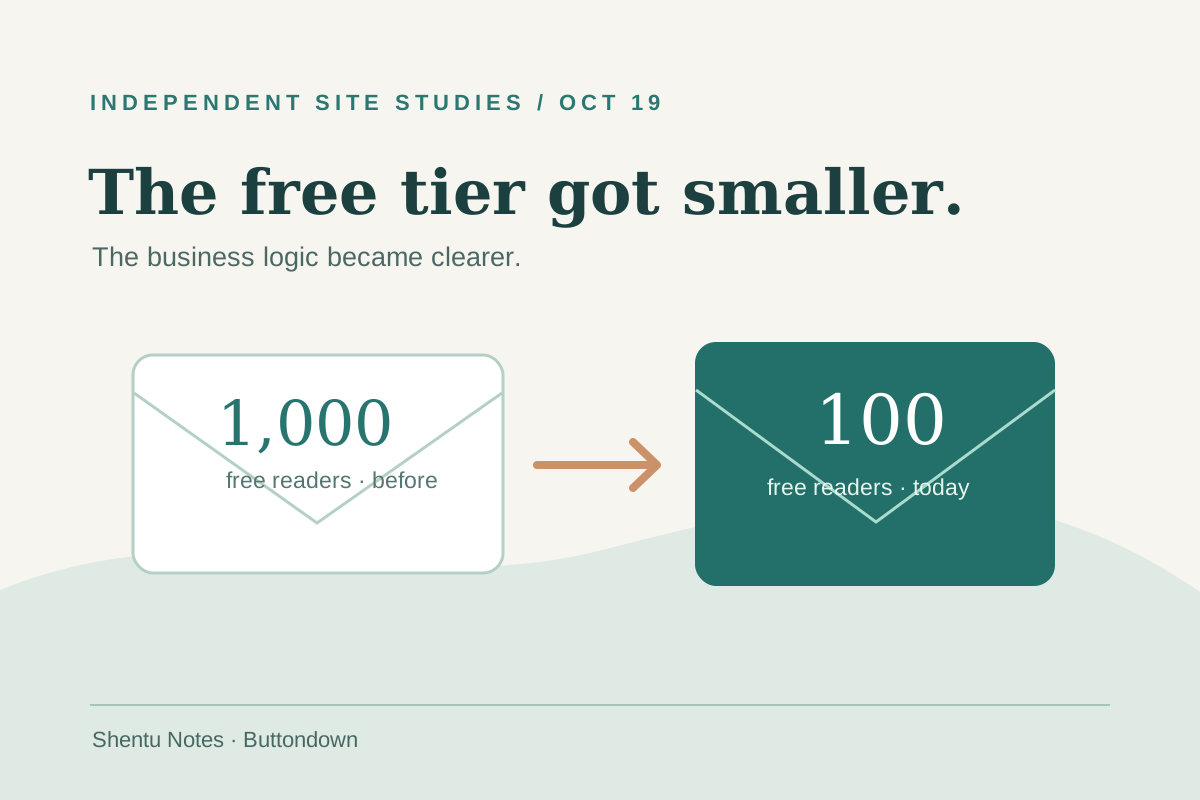
Suppose you build a newsletter tool for independent writers. A generous free plan gets people started—but every new list also brings delivery costs, setup questions, and support requests. How do you decide where “free” ends?
Buttondown offers a useful, unusually documented case. In 2022, founder Justin Duke said its free allowance was moving from 1,000 subscribers to 100. On the current price page, checked October 19, 2026, the first 100 subscribers are still free. The story is not simply a price increase: it is a decision about which ongoing work a small software company can afford to carry for everyone.
The early product found paying users quickly
In his 2017 year-end account, Duke wrote that he decided to build Buttondown in late April, had a version able to send emails by the end of May, launched by the end of June, and had a few paying customers in July. Those milestones are the founder's retrospective report. They show a narrow first job—send a newsletter—reaching payment early; they do not establish how those first buyers discovered it or how much they paid.
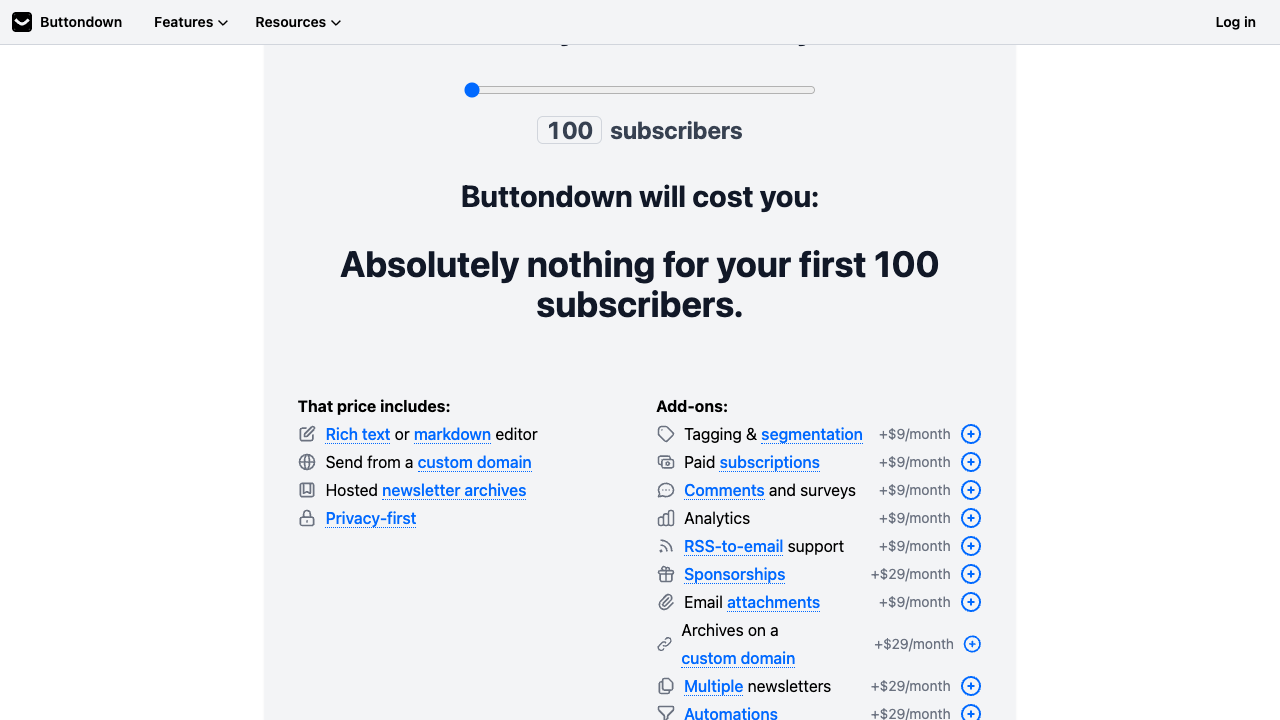
The present product still leads with writing and delivery. The public pricing page includes a rich-text or Markdown editor, sending from a custom domain, and hosted archives in the free starting offer. A writer can therefore test the basic publishing job before buying audience or workflow features.
What changed at the free boundary
In his June 2022 pricing explanation, Duke said the previous arrangement gave the first 1,000 subscribers free, then charged by subscriber count with a separate charge for power-user features. The new structure reduced the free allowance to 100. He gave three reasons: simpler billing, a clearer offer, and a shift away from a very large free-user base. He also reported that around 85% of his support time went to nonpaying users. That percentage is the founder's own historical estimate, not an audited cost allocation or a statement about the business today.
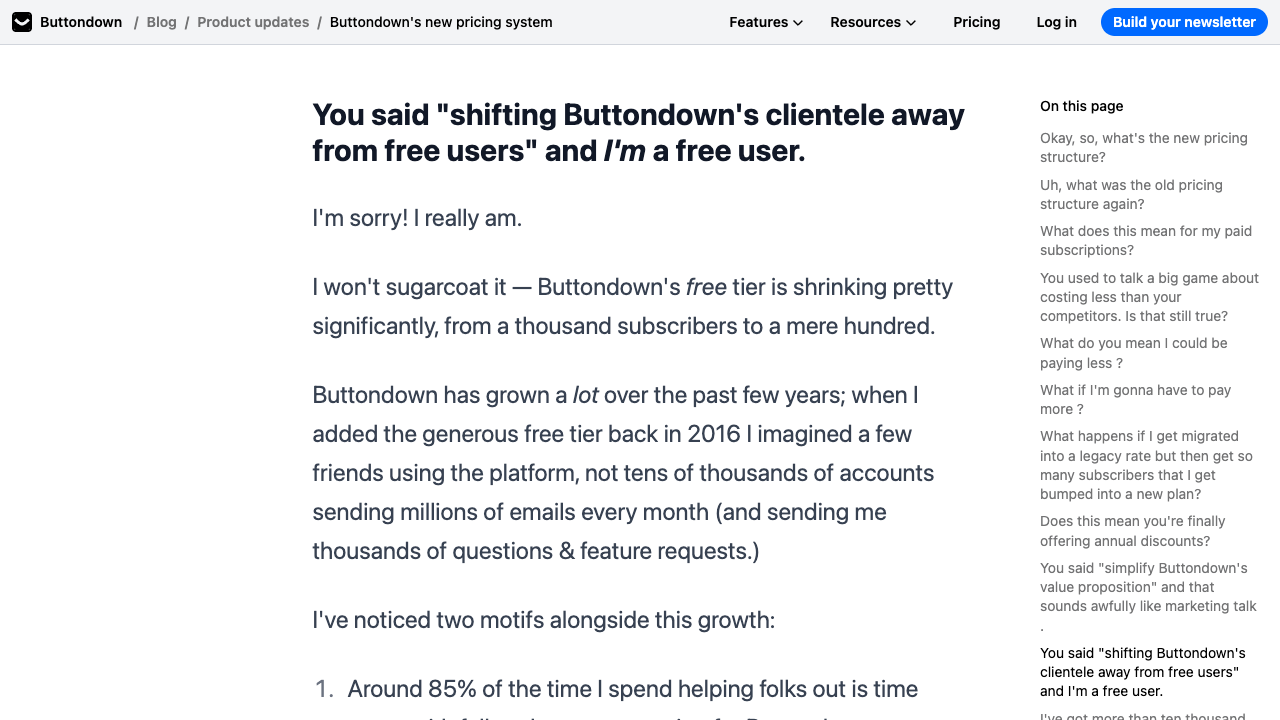
This explains an often-missed part of a free plan: the cost is more than hosting an inactive account. A sender asks for help with domains, formatting, deliverability and billing, while every email must be processed. In a 2025 pricing note, Duke called sending email the largest unit cost and engineering the largest fixed cost. That later note also describes making API access and automations easier to reach; the paid boundary can move in either direction when use and costs change.
The current offer makes the boundary visible
At 100 subscribers, Buttondown's interactive pricing calculator displayed “Absolutely nothing for your first 100 subscribers” on October 19, 2026. The same view listed optional add-ons: paid subscriptions and analytics at $9/month each, automations at $29/month, and teams at $79/month, among others. Its FAQ says it charges for active subscribers, and that listed prices assume at most one email per day to the full list. A larger list or a different sending pattern needs its own live calculation.
A later April 2026 product note moved metadata, transactional-email customisation and integrations behind a paid plan for new accounts, while exempting existing users. Duke cited the ongoing engineering, infrastructure, documentation and support involved. The visible pattern is a paid boundary around heavier or more specialised work, not a claim that every advanced user pays or that each add-on is profitable by itself.
What a solo maker can borrow
Draw two lists before copying a competitor's free tier. On the first, put the smallest complete outcome a new user can achieve without your help: for Buttondown, draft and send a basic newsletter. On the second, put the recurring costs that rise with use: emails delivered, active readers, specialised features, and support time. Then ask when a user receives enough continuing value to cover those costs without a surprise bill.
If you already run a small tool, measure one month of support requests and variable usage by account type. A good free plan is an invitation to finish a real task; its boundary should be explainable in the language of that task. Buttondown's public record illustrates the reasoning, while the right threshold for another product depends on its own costs and users.
We reviewed the public site and founder-authored pages, not Buttondown's internal accounts. Present revenue, margins, conversion and customer acquisition shares were not available. The pricing page's “profitable” claim is the company's self-description. We did not register or send a newsletter.
Original sources: 2017 founder review, 2022 repricing post, current pricing, 2025 pricing update, and 2026 paywall note. The cover is an original editorial illustration; the two article images are dated captures of public Buttondown pages.
Browse all Independent Site Studies · Browse the Chinese section