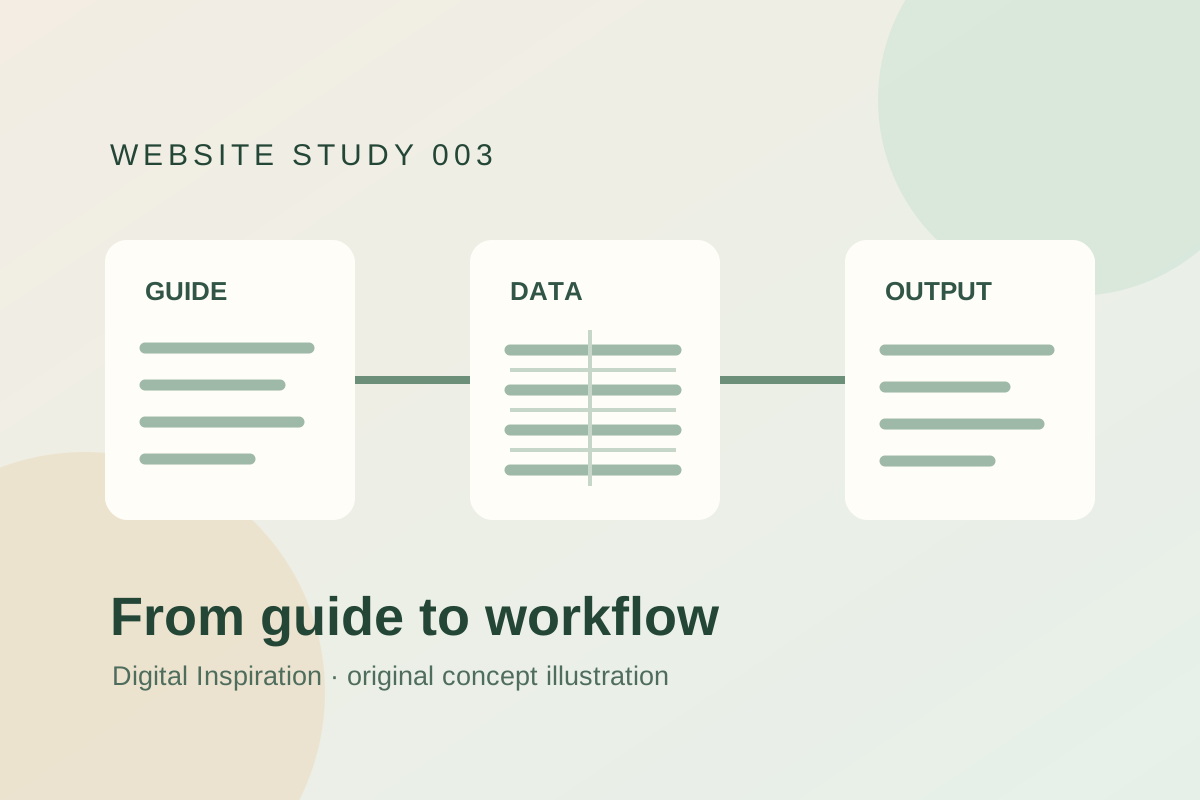
A reader can follow a tutorial to generate documents from a spreadsheet once. Why would that reader then pay for an add-on? Digital Inspiration's answer is worth examining: when the same task recurs, a dependable workflow becomes more valuable than another explanation.
Who it serves, and what the free content teaches
Digital Inspiration was founded by Amit Agarwal. The blog publishes software tutorials, while its product site sells Google Workspace add-ons. This case focuses on Document Studio, which takes data from Google Sheets or Forms, applies a template such as a Google Doc, generates files, and can send emails. Making certificates for a school or invoices for a business are examples in its tutorial.
That 2017 tutorial breaks the work into three steps: create a template, prepare a sheet, and install the add-on to generate documents. Readers first see whether they can accomplish the task. They can then decide if the process belongs in their regular work. This is an observable content design; no public conversion rate connects the tutorial to purchases.
How the tutorial leads to the tool
The tutorial links directly to the add-on and its help center. Amit's about page places the blog alongside products including Mail Merge and Document Studio. A reader can move from a document-merging problem → a tutorial → add-on installation → usage limits and plans. Google Workspace Marketplace is another visible installation route. The public pages do not show what share of users comes from search, email, or the marketplace.
The sequence is the useful part: teach a task first, then show the tool for doing it repeatedly. Content answers how; the product takes responsibility for doing it again.
The free-to-paid boundary
On September 20, 2026, the official help page said the free plan could process 25 form submissions or spreadsheet rows per month, with separate 25-item limits for emails and documents. Paid plans increased daily capacity and added workflows and support. The product page listed Standard at $79.95 per year and Enterprise at $99.95 per year, with a license tied to a Google account.
The help page showed $79 and $99 per year on the same date, a $0.95 difference from the product page. We did not enter checkout, so the final payable amount was not verified. The offer itself is clear: pay for greater workload capacity, additional features, and support.
How the business reached this point
On his about page, Amit says he left his job in 2004 to run a technology blog. In a 2015 interview, he recalled early recommendations from aggregators, participation in blogging events, income beginning roughly a year later, and a gradual move into software tools. A 2007 Google AdSense case study documents the advertising model at that time. Historical ad income, current add-on revenue, and installations are different measures and do not add up to a current revenue estimate.
That history includes years of content and Amit's earlier software experience. For someone starting a personal site now, a more manageable first step is to identify one recurring task they already explain well.
A small experiment
Choose an existing how-to article. List the three steps readers must repeat each time. Make a reusable template or checklist, then ask three people who actually do the task to try it. Record whether they can finish independently and which step still takes manual work. If the repeated problem is real, decide whether automation is worth building.
The question to take away is: which tutorial helps a reader today, but addresses a task they will face again next week?
Original sources
- Amit Agarwal's background and business, checked September 20, 2026.
- Document-generation tutorial, published November 1, 2017; checked September 20, 2026.
- Document Studio product page and pricing help page, checked September 20, 2026.
- YourStory interview, July 8, 2015; historical Google AdSense case study, December 27, 2007.
This study uses public pages. We did not install the add-on or buy a license.
English translation published October 19, 2026. The original Chinese study was published September 20, 2026; dated facts and prices above retain their original verification dates.