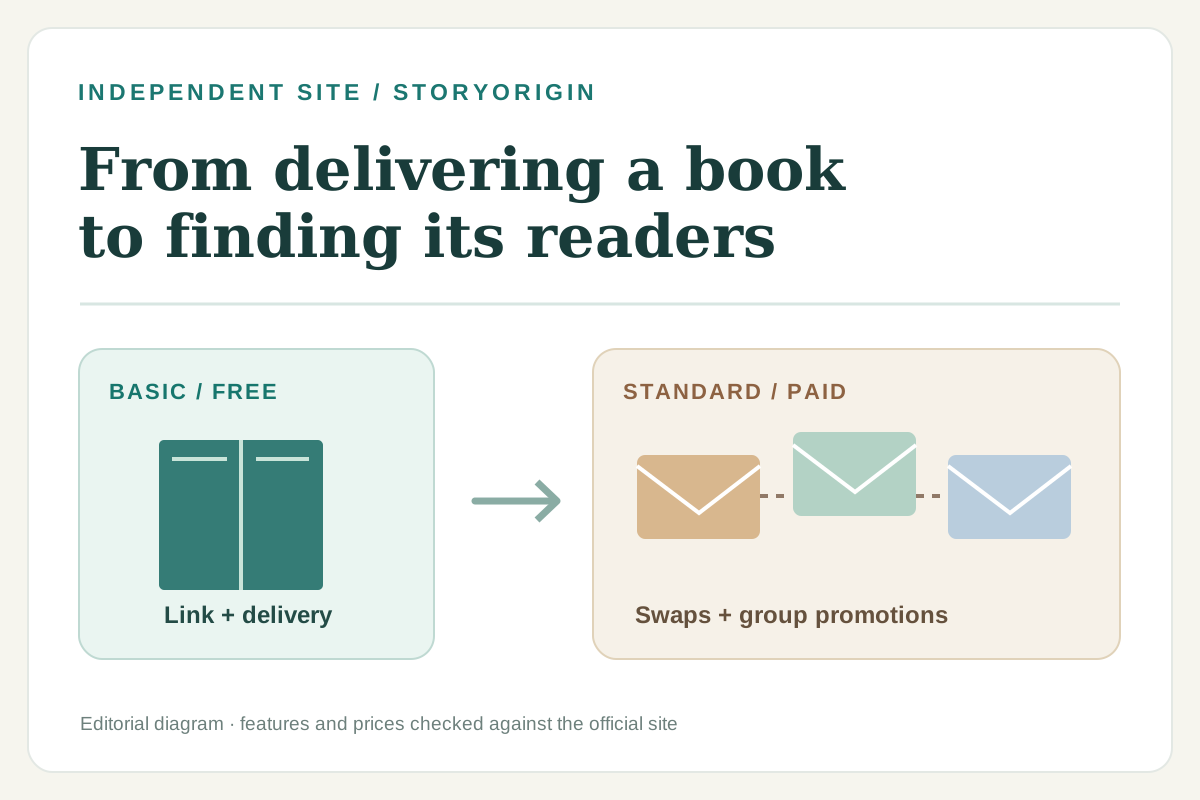
An indie author can make a book link and send a free file to a reader. The harder question comes next: how does that reader discover the book in the first place? StoryOrigin places those jobs on opposite sides of its pricing page. Basic tools remain free; the Standard plan sells the coordination work around finding readers, exchanging newsletter mentions, and running group promotions.
That distinction makes StoryOrigin useful to study even if you do not write books. The case is about a specific moment in a creator's work: when a tool stops serving only your own file and starts helping you work with other people's audiences.
The free period came first
Founder Evan Gow told Buttondown in a 2025 interview that StoryOrigin launched in April 2018, stayed in an open beta for three years, and made its features free during that period. He said the company moved out of beta in April 2021 after the product had become the one-stop author toolkit he had set out to make. His explanation is a founder's retrospective account, not an independently audited record of adoption or revenue.
The current product is still organized around authors' existing work: retail links, file delivery, email integrations, reader magnets, review copies, and promotions. StoryOrigin's tutorial library teaches these workflows in the language of mailing lists, reviews, and newsletter swaps. This is a narrow audience with a recurring task, not a general “grow your brand” pitch.
Where the paid boundary sits today
On October 16, 2026, the official pricing page listed a free Basic plan and a Standard plan at $10 per month or $100 per year. Basic includes unlimited file delivery, email-service integrations, universal retail links, and word-count tracking. Standard adds group promos, newsletter swaps, collection of reader email addresses, beta-copy feedback, review follow-up, and other tools. Guided setup carries a separate, variable setup fee plus Standard.
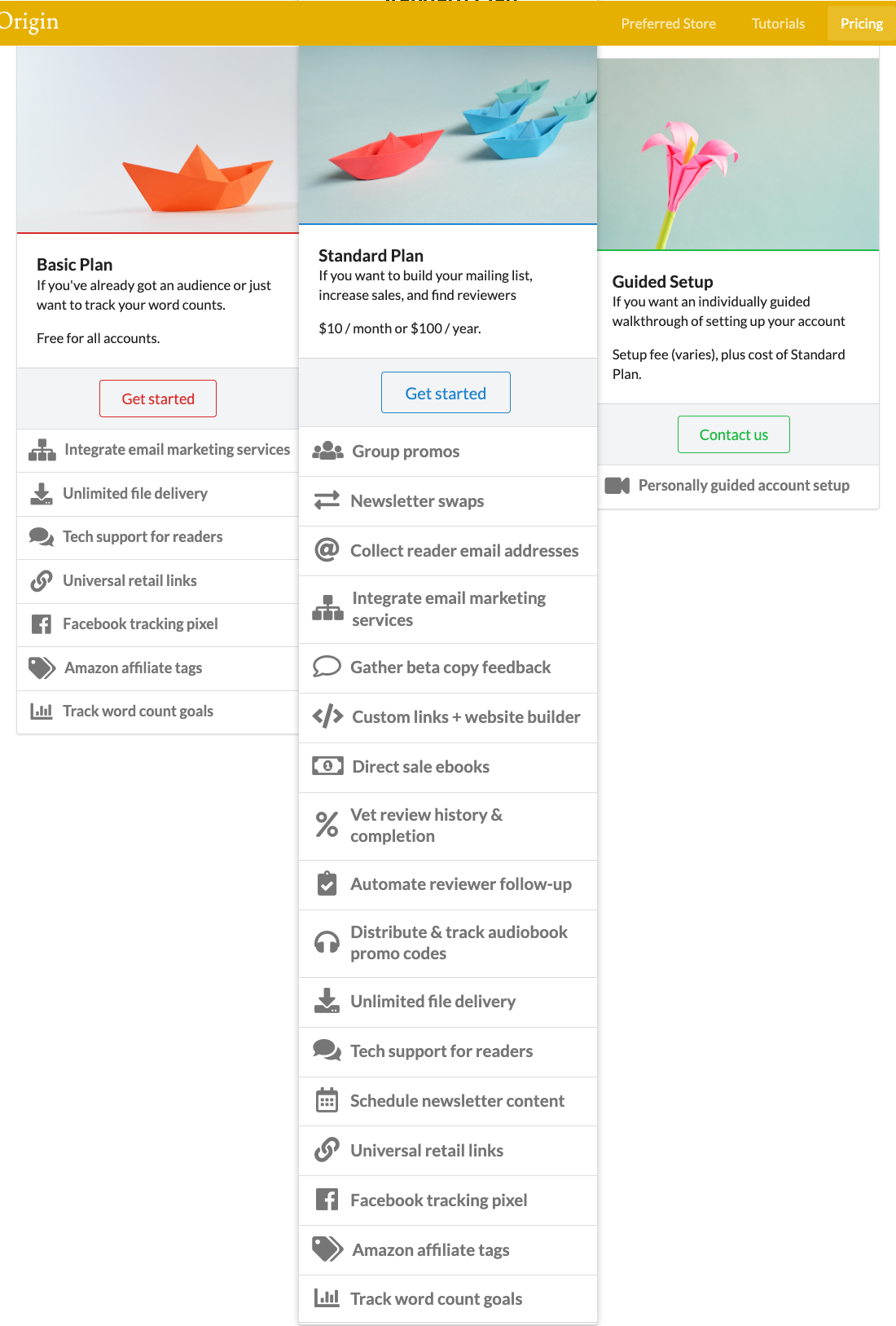
The free side helps an author deliver and link something already made. The paid side helps coordinate discovery and follow-up with other authors and readers. This is an interpretation of the visible feature boundary, not a claim about which feature generates the most sales for StoryOrigin.
StoryOrigin's reader-list feature page illustrates the workflow: create a page for a free story, send readers to it through group promos or newsletter swaps, and collect sign-ups through an integration or a CSV download. In an author-written guide hosted by StoryOrigin, Gow explains that a swap means each writer includes a link to the other's book in a newsletter; the authors do not exchange their subscribers' email addresses. It is coordination of attention and trust, rather than a purchased list.

What an independent maker can borrow
If you are building a small product for a specific creator group, map the user's job in two passes. First, identify a complete result you can provide alone and cheaply—here, a usable link or file delivery. Then identify the result that becomes difficult when several people must coordinate—here, planning, vetting, and tracking cross-promotion. Ask three target users which part they currently manage in spreadsheets, messages, or favors. Charge only after you can show that the coordinated workflow reliably saves them work or helps them reach an outcome they value.
There is an important audience limit. A novelist already sending a newsletter can make sense of a swap immediately. A creator with no book, no reader magnet, and no willingness to promote a peer may not have the same need. StoryOrigin's pricing is evidence of the offer, while its testimonials and case studies are selected customer accounts. They do not establish the average customer's results.
What the public record does and does not show
We checked the live site, pricing, feature page, tutorial index, and founder interview on October 16, 2026. The founder's 2018 launch and 2021 paid transition are historical self-report. The public pages do not disclose present revenue, profit, paid conversion, or how many customers came from each channel. We did not create an author account or test a complete promotion. The useful lesson is the observable product boundary and workflow, not an invented financial outcome.
Original sources
- StoryOrigin homepage, pricing, and tutorial library
- Reader-list feature page and newsletter-swap guide by Evan Gow
- 2025 founder interview with Buttondown
The cover is an original editorial diagram. The two article screenshots are attributed captures of StoryOrigin's public pages.
Browse all Independent Site Studies · Browse the Chinese section