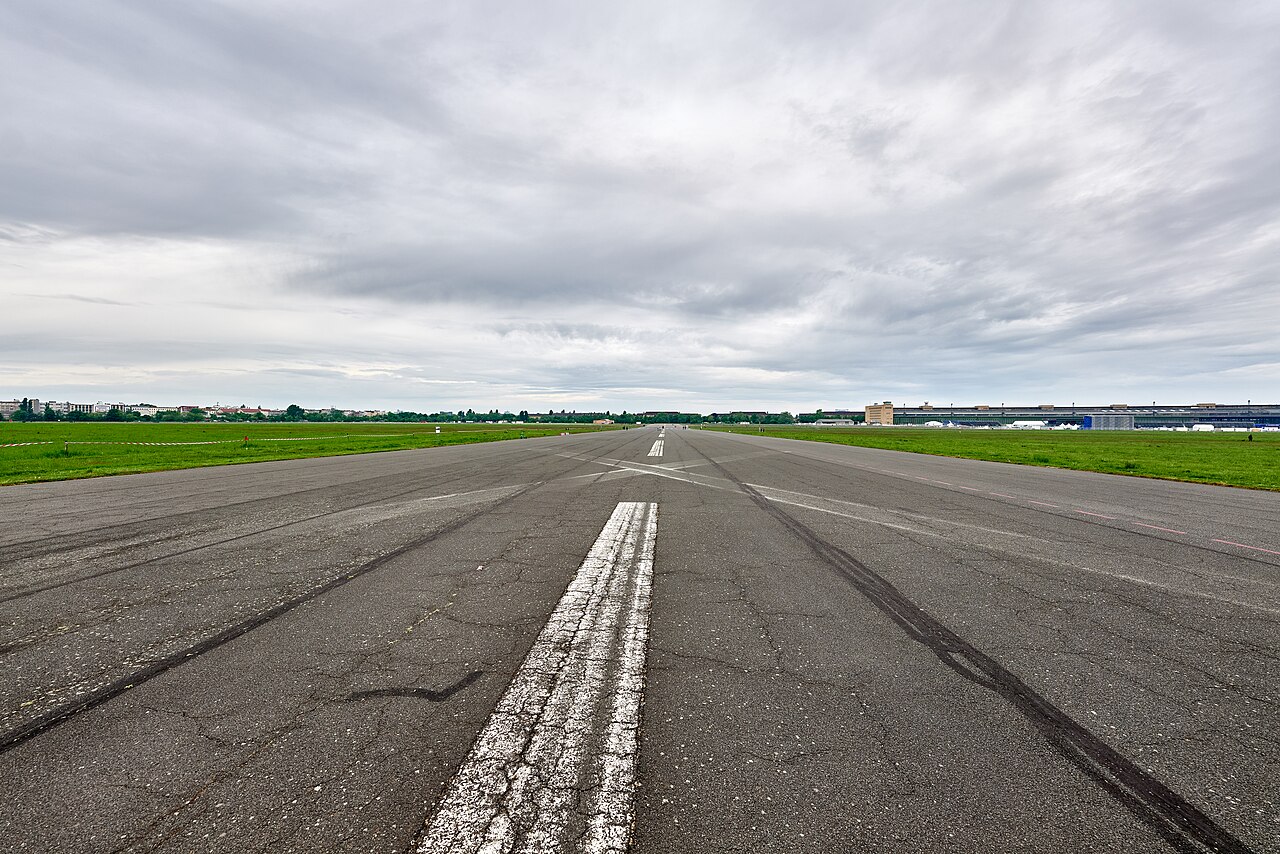
The white markings still point down a wide runway. The horizon remains unusually open for the middle of a capital city. But the place in this photograph has changed its audience: Tempelhofer Feld in Berlin is a former airfield that became a public recreation space. The runway survived its original job. 1
That is the visual surprise. Many conversions announce themselves with a new building or a dramatic interior. Here, a large part of the transformation lies in who gets to use an existing surface. A strip designed around aircraft movement can become a place to skate, cycle or simply experience a long, uninterrupted view.
The empty space became the attraction
Flight operations ended in 2008, and the field opened to the public in 2010. Its operator describes more than 300 hectares available for recreation, alongside habitats for protected plants and animals. Activities include strolling, picnicking, gardening and kiteboarding. The airfield’s openness, once a practical requirement for aviation, became part of its public appeal. 1
The 2024 photograph preserves the airport geometry: broad paving, worn markings and distant edges. It is a view of the runway itself, not evidence that every corner of the park is crowded or used in the same way. Keeping that distinction makes the transformation more interesting. A familiar shape can hold a different set of possibilities without being completely disguised.
A runway is also an unusual way to think about a park. Instead of a narrow path directing visitors between attractions, the large surface offers room to spread out. The photograph invites you to imagine the difference in scale between a person and a structure laid out for aircraft. That mismatch is the story’s strongest visual clue.
A garden joined the airfield
One example of the new uses is Allmende-Kontor, a community garden established in 2011. The operator presents it as a collective project built around urban gardening and exchange. It adds a different rhythm to the former airport: tending plants, sharing knowledge and working together in a place once associated with departures. 2
Nature has a role beyond planted beds. The field’s environmental education material describes the value of its meadows, plants and wildlife, with opportunities to learn about the landscape rather than treat all unused land as empty. A broad grassy area can be both recreation space and habitat, though those uses need thoughtful management. 3
The earlier history remains
The site’s past deserves more than an airport-to-park caption. Its official history includes the Nazi period, forced labour and the later Berlin Airlift of 1948–49. Those layers sit alongside the leisure uses rather than disappearing beneath them. The field is a place where a pleasant afternoon and difficult history can occupy the same map. 1
The conversion is compelling precisely because the earlier form remains legible. Look again at the runway markings. They still belong to the airport’s visual language, while the public park gives them another meaning. Sometimes a striking transformation begins by keeping the large, awkward thing that was already there—and changing the kinds of lives that can unfold around it.
The long sightline is the detail to linger over. With the airport’s original traffic gone, the scale of the runway becomes an invitation to imagine ordinary movement in an extraordinary amount of space.