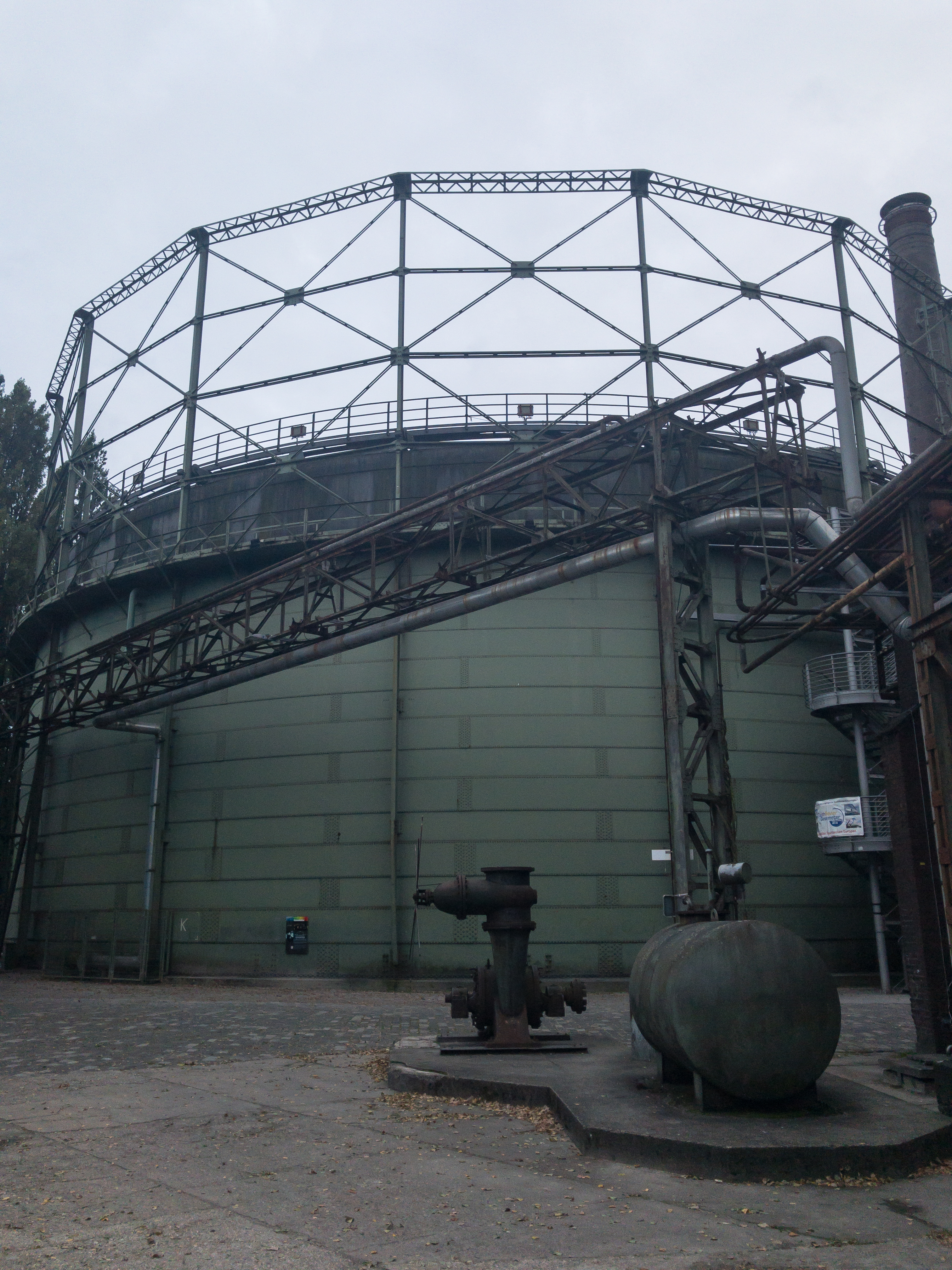
The cylindrical tank still looks at home among industrial pipes and steelwork. Its outer framework gives little away. Yet the gasometer at Landschaftspark Duisburg-Nord has taken on an unexpected second life: divers enter a water-filled basin where industrial gas was once stored. 1
The 2017 photograph shows the exterior of the actual gasometer in Duisburg, Germany. It is not an underwater photograph. The surprise comes from connecting this familiar industrial shell with the documented activity inside, rather than imagining that the visible door opens onto a functioning gas plant.
A buffer for a working ironworks
The park’s industrial history explains the original purpose. Blast-furnace gas was a by-product of making pig iron. After cleaning, it could be used to power machinery, but the amount produced did not always match immediate demand. The gasometer acted as a holding facility between production and use. 1
A large container therefore helped manage a changing flow of energy. The building’s round shape and substantial shell were practical parts of an industrial system. Those same physical qualities later made an unusually enclosed aquatic setting possible, though the change of use required more than simply keeping an empty structure.
This is a useful way to read the photograph. Follow the curve of the tank instead of concentrating only on the machinery around it. The scale of the container is the link between the two uses: first a space for holding gas, later a volume that could accommodate water and diving.
An underwater setting inside the shell
The operator describes a basin roughly thirteen metres deep, with features including a shipwreck, an aircraft wreck and an artificial reef. These are part of a constructed diving environment. Their presence does not mean the former factory accidentally flooded around a collection of abandoned vehicles. 1
The site’s diving page describes the facility as a place for organized diving activities and training. Access to a specialist facility is different from wandering into the public areas of a park. Its conditions and arrangements belong to the diving operator, rather than to the industrial appearance visible in the photograph. 2
That difference adds another layer to the transformation. From outside, a visitor sees preserved infrastructure. Someone entering the basin experiences an enclosed underwater landscape. One surviving shell connects two very different perspectives on the same place.
The wider park kept its industrial scale
Duisburg’s city visitor information places the gasometer within a larger conversion of the former works. Other spaces have become climbing areas, paths and viewpoints, while much of the industrial fabric remains recognizable. The project changes what people can do around the structures without making their former purpose disappear. 3
The appeal is partly the refusal to disguise the starting point. A conventional pool building might announce water with windows, signs or an obvious leisure entrance. This tank carries a different visual history, which makes the new use more surprising once you know it is there.
The photograph leaves the diving experience hidden, just as the tank once concealed its contents. Its story is about that change in contents and purpose. What used to help an ironworks balance its gas supply now offers a carefully managed place to descend beneath the water.