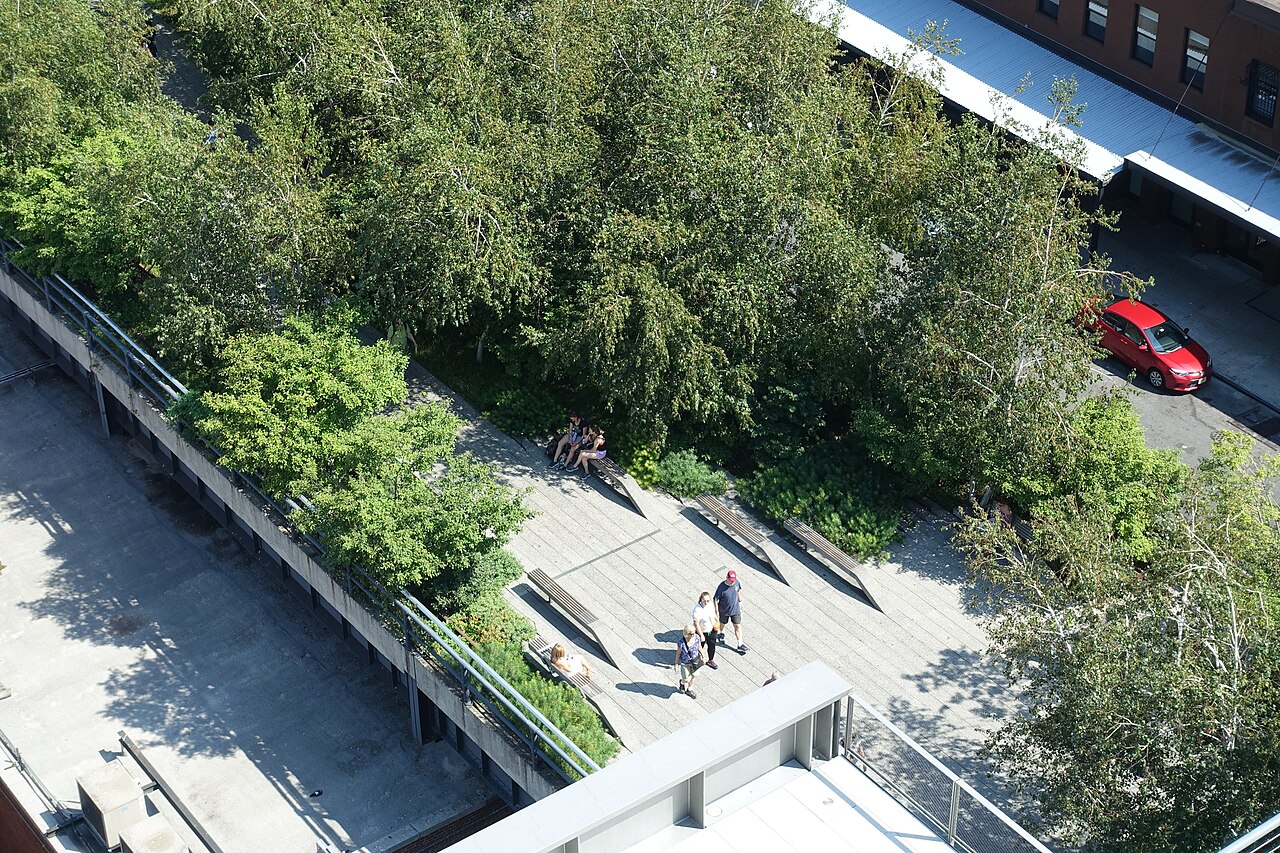
A garden threads between Manhattan buildings, held above the street instead of spread across an empty block. In Ellywa’s September 2018 photograph, its long shape is especially clear: planting and a walking route occupy a corridor with the proportions of a transport line. That is exactly what it used to be. 3

The High Line was built on an elevated freight railway. Where people now move through gardens, trains once carried deliveries along the West Side. The surprise is not simply that an industrial site became green. It is that the city kept the unusual structure that made the site difficult to treat like an ordinary park. 1
A delivery route with an upstairs entrance
The Institution of Civil Engineers dates the railway to 1934 and explains that it served businesses in Manhattan’s industrial district. Trains could reach stores and warehouses directly, unloading inside buildings. The raised route was practical infrastructure, designed around moving goods rather than giving pedestrians a different view of the city. 1
The park’s own 2026 pocket guide makes that former purpose wonderfully concrete: the railway transported food, including meat, dairy products and produce. Looking at the planted route now, it takes a small mental adjustment to replace the walkers with freight cars and the garden visit with a delivery. 2
By the early 1980s, trains had stopped running. The structure then faced a very different possible future: demolition. The guide identifies 1999 as the year Friends of the High Line began campaigning to preserve it and turn it into public open space. 2
Keeping the awkward shape
That decision left designers with a space that was already narrow, elevated and tied to the surrounding buildings. Those constraints are still readable in the photograph. The park does not dissolve into a broad lawn. It takes you along a route, with the city close on both sides.
There is a useful reversal here. A railway separates its route from the streets so that vehicles can move along it. A garden on that same structure lets people occupy the separation itself. The height and linear form become experiences rather than obstacles to be erased.
ICE describes a planting approach associated with Piet Oudolf and inspired by a wilder appearance. That greenery helps soften the former railway, while the inherited corridor continues to determine how the place unfolds. The project opened in stages, beginning in June 2009. 1
It could have been a very different attraction
Before that opening, the High Line invited ideas for its future. Its pocket guide records 720 submissions from more than 36 countries in a 2003 competition. Some proposals were deliberately impractical, including a rollercoaster and a swimming pool stretching for a mile. Those were ideas, not features that were built. 2
The eventual transformation offered a slower kind of attraction: a walk through an old route with a new reason to exist. Our photograph shows the result in 2018, rather than every later extension or current planting arrangement.
What makes the image linger is the remaining outline of its first job. The railway’s shape survived the loss of its trains. Instead of disappearing, it became the thing that makes this garden recognizably different from the streets below.