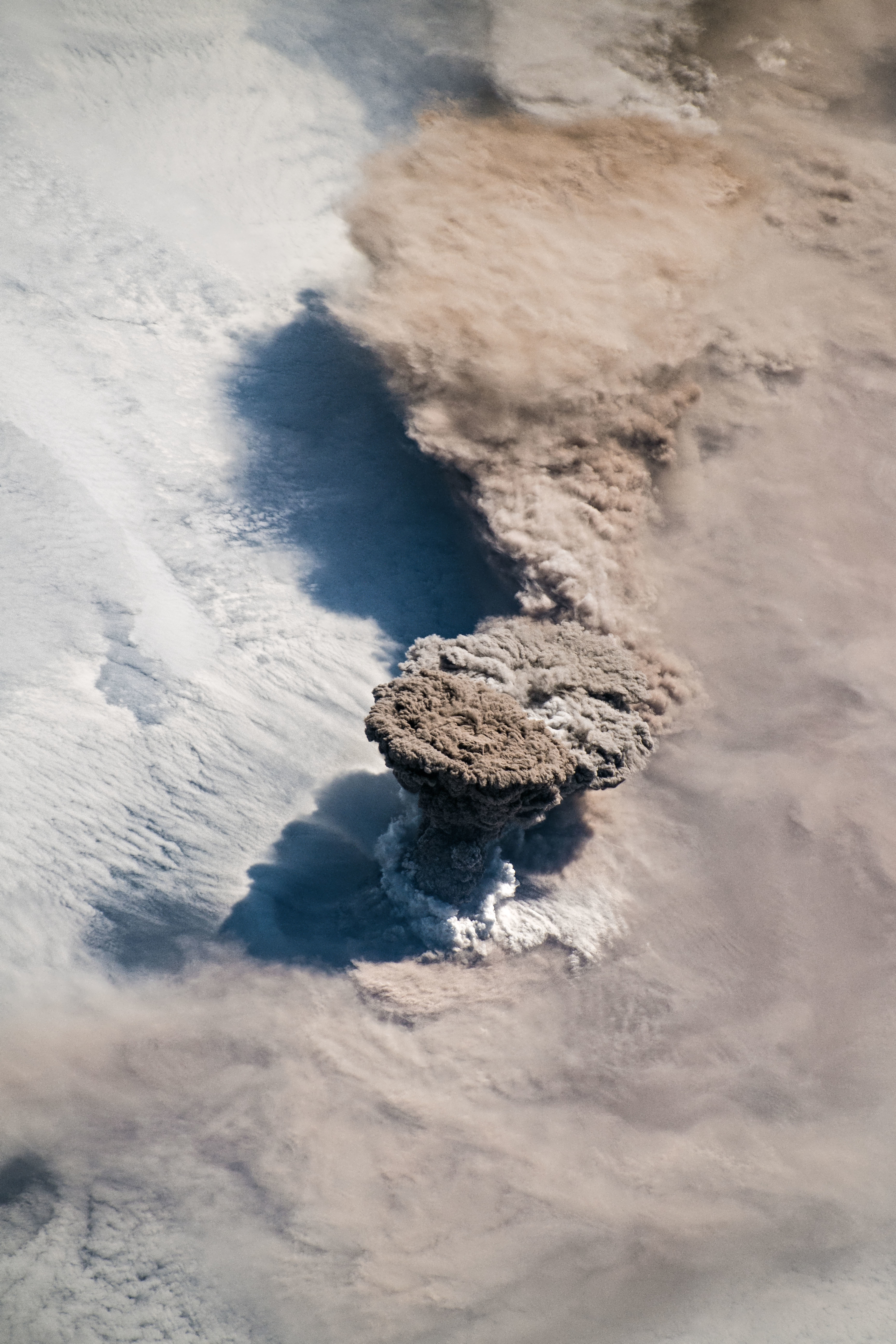
A narrow brown column rises through a ring of white cloud and spreads into a broad canopy. The view looks almost too neatly arranged to be a passing event, but it is an astronaut photograph of Raikoke’s June 2019 eruption in the Kuril Islands. The camera was aboard the International Space Station. 1
This is a dated eruption story, not a report of new activity today. NASA identifies the photograph as ISS059-E-119250, acquired on June 22, 2019, by an Expedition 59 crew member. Its published version was cropped and enhanced, with lens artifacts removed, before being supplied to the public. 1
Why the column spreads at the top
NASA’s Earth Observatory calls the spreading part the umbrella region. The rising plume reaches air conditions at which its density and the surrounding atmosphere balance, and the material spreads outward instead of continuing upward in the same narrow column. The shape gives the photograph its unusual clarity. 1
Follow it from the bottom upward. The white ring surrounds the place where the column emerges, while the darker material carries the eye toward the large upper canopy. The image makes several layers visible at once, even though a single photograph cannot measure all of their heights or explain every part of their composition.
The light-coloured material near the base was interpreted as water vapour, with more than one possible process discussed in NASA’s account. That is a useful example of the difference between noticing a feature and proving its cause. A striking outline does not remove the need for interpretation. 1
The eruption extended beyond the frame
The Smithsonian’s Global Volcanism Program records a powerful sequence of explosions in June 2019, following the volcano’s previous recorded activity in 1924. Its account brings together observations from regional monitoring teams and satellites, describing ash and gas spreading far beyond the small island. 2
That broader record changes the scale of the photograph. What appears to be a compact object above a patch of ocean was part of an event whose material travelled across a much larger region. The astronaut’s view is a memorable instant within that sequence, rather than a complete diagram of the eruption.
The programme’s following weekly report describes lower steam-and-gas plumes, sometimes containing ash, after the main explosive phase. It also records changes in aviation alert levels as the situation evolved. Those dated observations belong to the 2019 event and should not be read as a current advisory. 3
A photograph and a monitoring record work together
The photograph is powerful because the shape is so easy to recognize. The accompanying records are valuable because they add dates, repeated observations and later developments. Neither needs to replace the other: one catches attention, while the other helps establish what that attention is directed toward.
Look again at the umbrella outline against the darker ocean. Its almost sculptural form is temporary, made from moving material in moving air. A space-station camera preserved the arrangement for a fraction of the eruption’s history, giving viewers a chance to examine a real event that had already changed by the next observation.
The date beside the image is part of its meaning. It locates this spectacular shape within a documented sequence, instead of leaving it to circulate as an unexplained cloud.