You have rehearsed what to say to a colleague about a missed hand-off. The sentence in your head starts, “You always leave me waiting.” Even if the problem is real, always invites an argument about the last time they did not. Before the meeting, you need an opening that names one event and gives the other person something they can answer.
Conflict Simulator offers a small place to test that first sentence. Its rule-based checker flags words such as broad generalisations and judgements, then asks a more useful question. I tried the English method page and the start of its conversation-preparation flow on October 28, 2026. The tested example below is supplied by the site; I did not enter a real person's words.
First, test the sentence that might start a fight
Open the English method page and scroll to Try it on your own sentence. For a low-stakes trial, click Use the example sentence. The page fills in “You are always late, it is just disrespectful.” It marks always as a generalisation and disrespectful as a judgement, then asks when you last noticed the behaviour and what precisely happened. Those are prompts to revisit the facts, not a verdict on who is right.
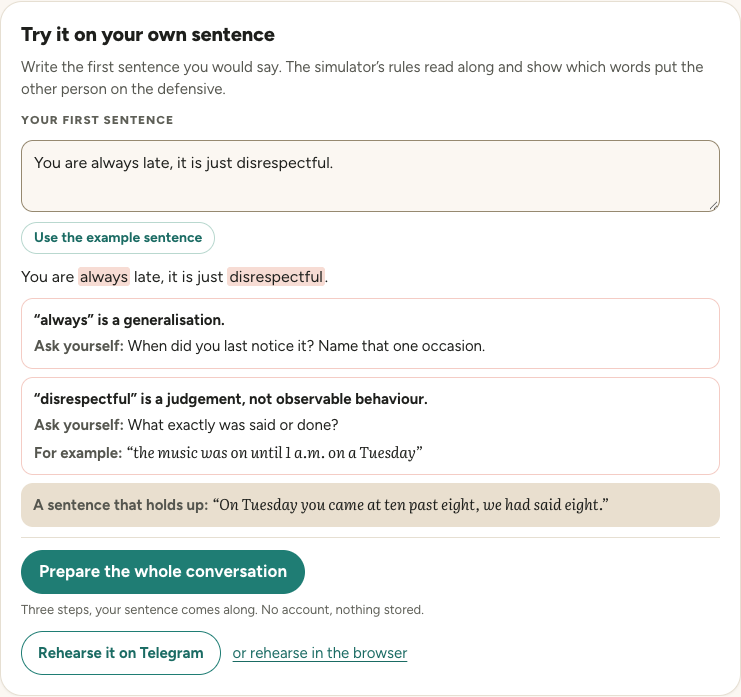
Try the same check with a fictional or lightly anonymised sentence first. For a missed hand-off, write down the observable event separately: “We agreed on the draft by Thursday; it arrived Friday.” This is my editorial example, not text generated by the tool. If the checker flags nothing, that only means its fixed rules found nothing in that sentence. It does not establish that the sentence is fair, safe, or likely to work with this person.
Build an opening the other person can answer
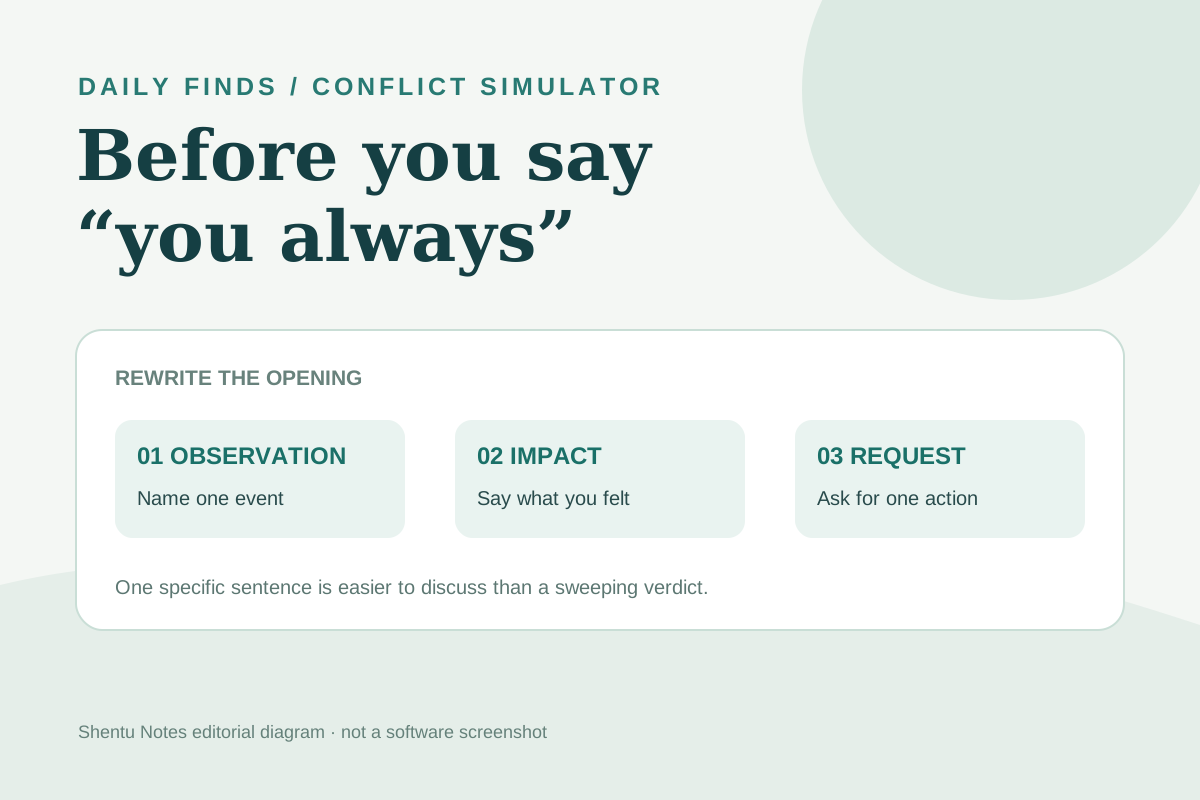
The method page arranges an opening in three layers: observation, impact, and request. Observation names a checkable event. Impact says what it meant for you, using your own feeling rather than guessing their motive. Request asks for an action both people could recognise later. The screenshot is the site's actual three-layer explanation; the cover above is our own summary diagram.
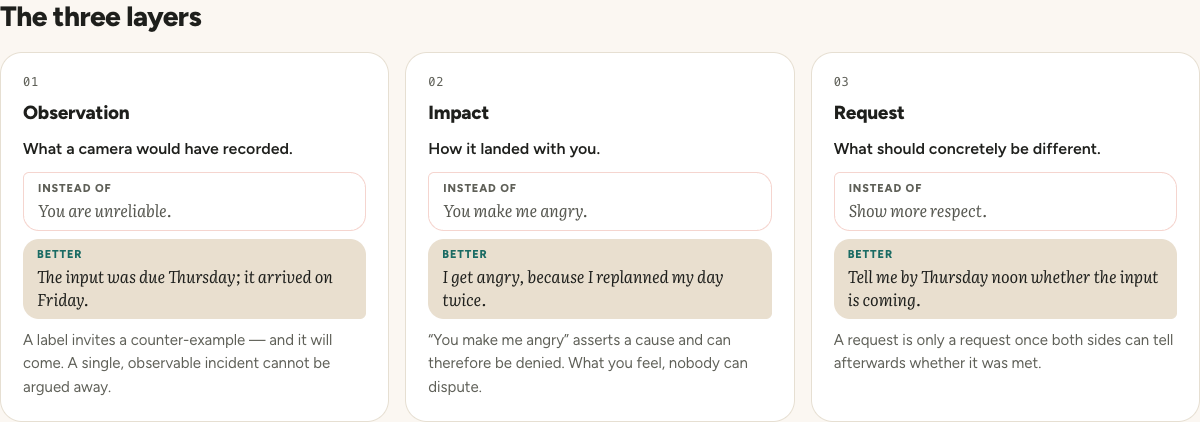
For that hand-off, a first draft could be: “We agreed on Thursday for the draft, and it arrived Friday. I felt anxious because I had to rearrange the review. Could you tell me by Wednesday afternoon if the next draft will be late?” Read it aloud. Does the event match what happened? Is anxious really your feeling? Is Wednesday afternoon a sensible deadline for this team? The tool can prompt a rewrite, but only you can answer those questions.
If you want more than the one-sentence check, click Prepare the whole conversation. In the first screen I saw five escalation questions; with none selected, Next opened choices for relationship, situation, and goal. I stopped there. I did not complete a draft, test its export link, or enter the separate browser role-play room.
Why this one is useful, and where it stops
The practical benefit is the pause before delivery. The checker turns “you always” into “which occasion?”, so you can replace a sweeping claim with something concrete. Unlike the English SocialCoach story already on this site, this article is about editing one opening line with fixed rules, not practising a back-and-forth AI conversation or trusting a score.
The distinction matters here too. The method-page checker and preparation assistant use rules; the site's optional browser practice room uses a language model and has a different data arrangement. The author's privacy policy says ordinary sentences are sent to its server for computation, then discarded without being saved in a conversation database or file. It says the web server keeps truncated-IP access logs for 14 days and runs an anonymous page counter. The optional practice room is for adults, uses a necessary session cookie and a model on the operator's own German servers, and deletes the conversation after the debrief or within 24 hours. I read those claims but did not audit the server or use the AI room. For an especially sensitive discussion, use a fictional example first and avoid names or identifying details.
The site was free to open and use in this test, in English, without an account. Its public repository exposes the rules and example content, not the full website engine. That material is CC BY-SA 4.0; the site's cards carry a separate CC BY 4.0 licence. The GitHub API snapshot on October 28, 2026 showed 0 stars, an unarchived repository, and a last push on October 13, 2026. There is no earlier comparable star snapshot here, so this is a usefulness pick, not a popularity or growth claim.
One last boundary: the site itself says its reflection tool is not therapy or legal advice. If a conversation involves threats or violence, seek appropriate human support rather than trying to perfect an opening line.
Original sources: English method and live sentence checker · prepare flow · privacy policy · public rule/content repository · content licence. The two interface images are our real screenshots of the official page, and the cover is a labeled Shentu Notes editorial diagram.