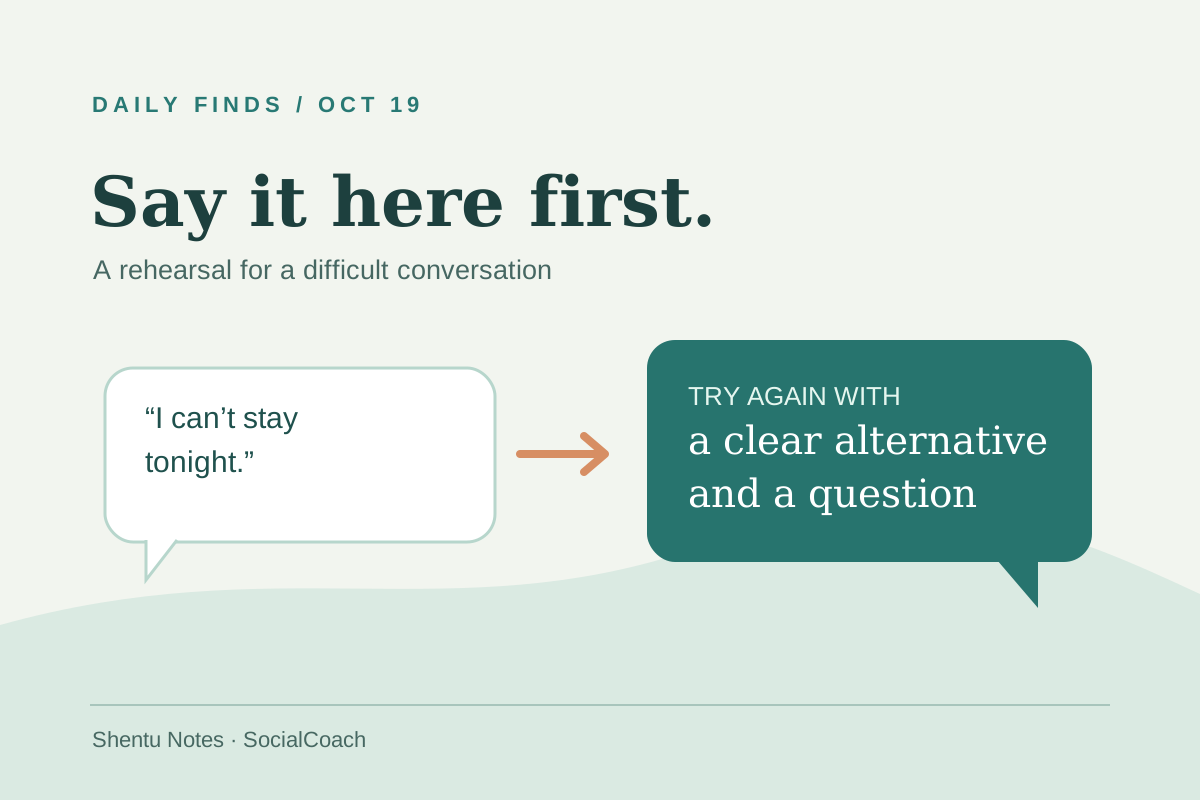
It is ten minutes before you leave. Your manager asks you to stay late again, and you have already promised to be at a family dinner. You know you want to say no; the hard part is finding words that are honest, brief, and still useful to the person asking.
SocialCoach gives you a place to rehearse that moment. It is a bilingual, browser-based role-play tool with prepared scenarios and a debrief that quotes your actual words. You can also describe a conversation of your own. I tried the English “Declining Extra Hours” scenario on October 19, 2026. One simulated exchange was enough to show what the tool does—and where its judgment needs your own.
Start with one real sentence, not a perfect script
Open the hosted app, choose English, then Choose a ready-made scene. The Arena showed 58 scenarios when I checked it, including workplace, friendship, family and romantic situations. I selected “Declining Extra Hours.” No account was requested in this route. The opening brief gave me a role, the manager's request, and three aims: say a clear no, offer a workable alternative, and discover what the client actually needs.
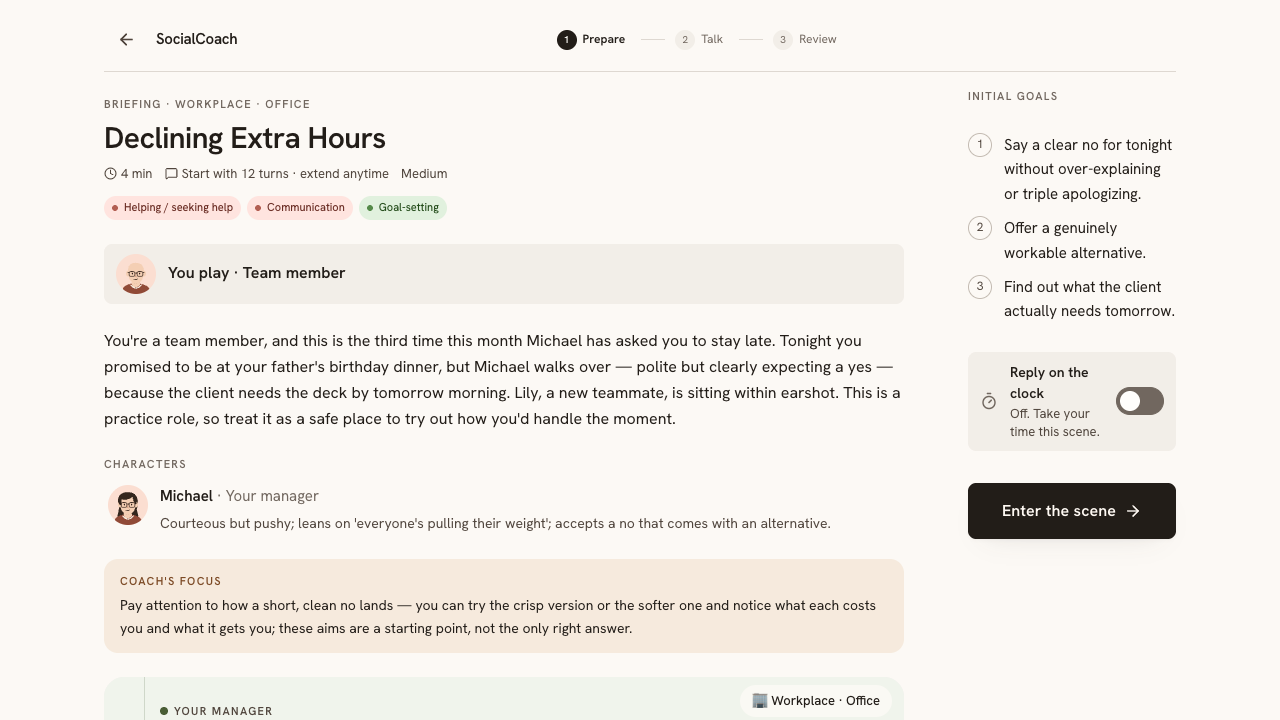
The brief matters because it changes the exercise from “make the other person agree” to “try a response and observe what it leaves unresolved.” For a first attempt, choose a scenario close to your problem without entering identifying details about a colleague, partner or client.
What happened in my short rehearsal
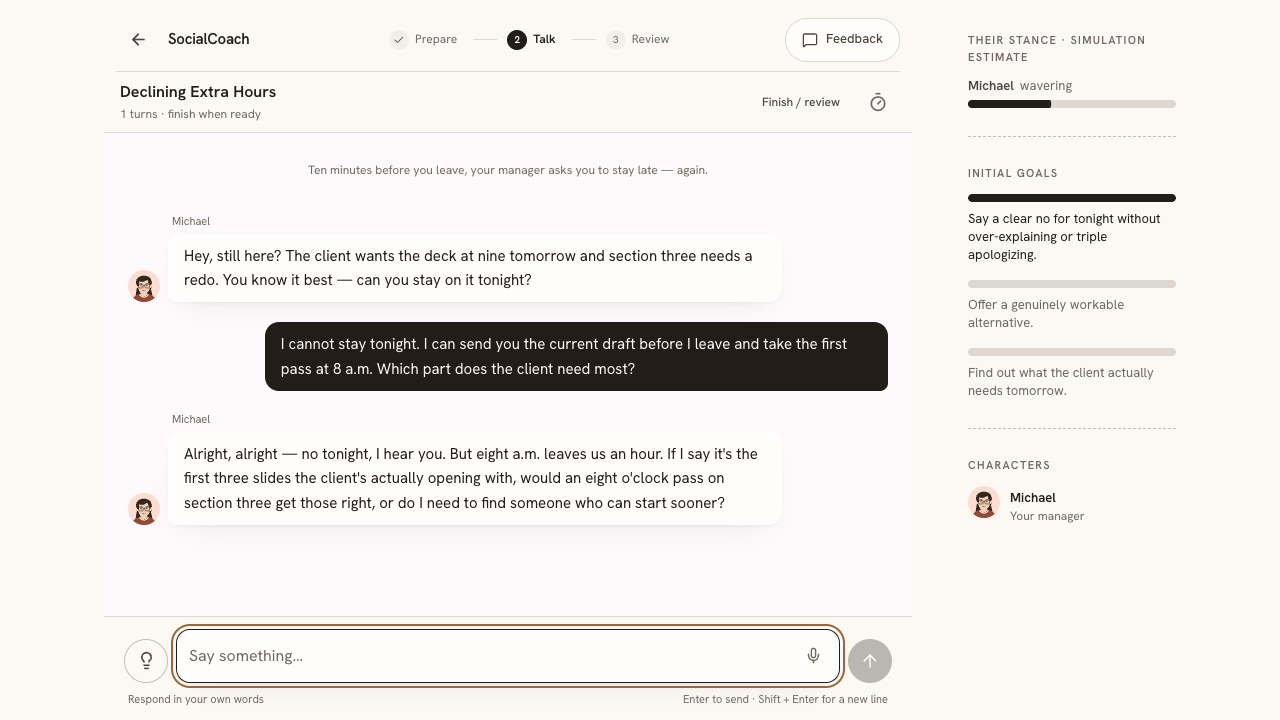
I typed one invented response: “I cannot stay tonight. I can send you the current draft before I leave and take the first pass at 8 a.m. Which part does the client need most?” The simulated manager accepted the boundary in words, then pressed on the schedule: an 8 a.m. pass would leave only an hour before the client meeting. The next decision was now concrete. Could someone else start earlier, or was the first-three-slides requirement small enough to handle in the morning?
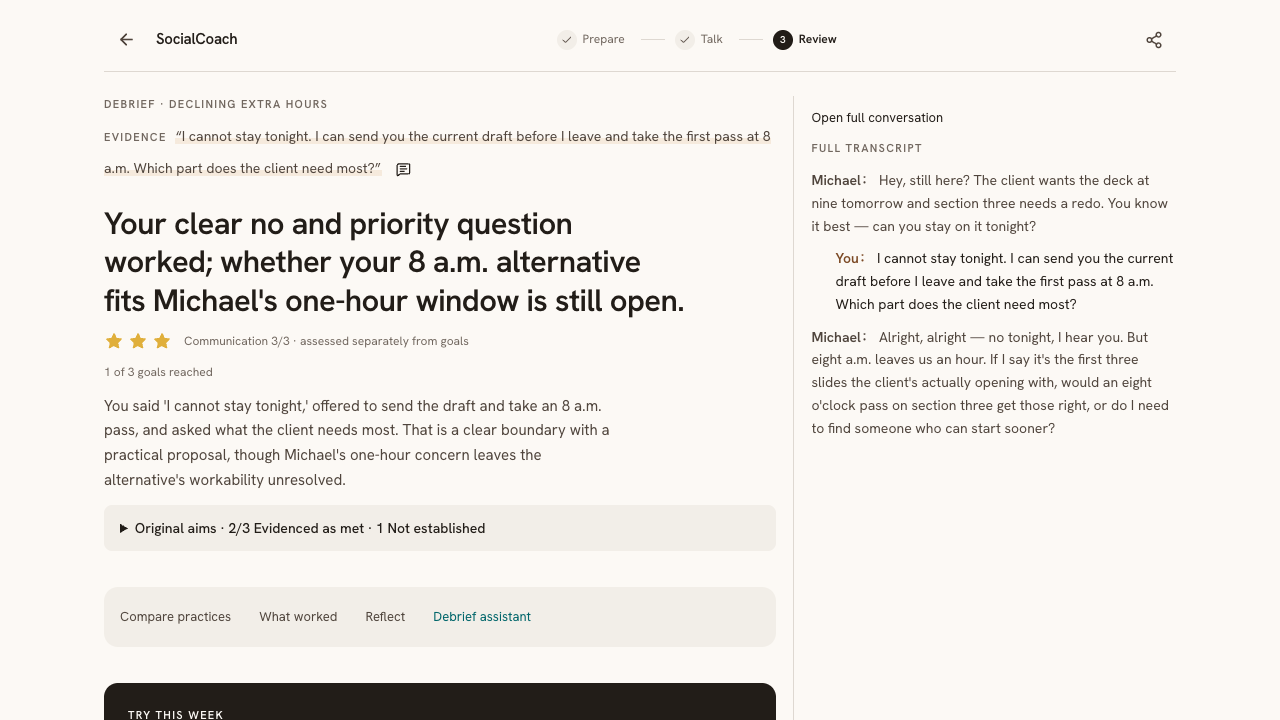
I ended the practice after that single exchange and opened the debrief. It quoted my sentence, said the clear refusal and priority question worked, and left the alternative's feasibility unresolved. That is the useful distinction: sounding considerate does not make an impossible offer workable. The interface also displayed a communication score and goal estimates. Treat those as feedback from a simulation, not a measurement of your real-world relationship or skill.
A five-minute way to use it
- Pick one upcoming conversation and state the outcome you can control: “I will say no clearly and ask about the priority.” Do not make another person's agreement your only success condition.
- Select a nearby prepared scene or write a fictionalised version of your situation. Begin with one sentence you might genuinely say.
- Read the character's pushback before writing more. Look for the practical constraint beneath it.
- End the scene and check whether the debrief quotes your words accurately. Rewrite just the sentence that created the biggest uncertainty, then try the scene again.
The official project README describes 58 scenarios, browser-stored practice history, export, self-hosting and a bring-your-own-model option. Its code is under Apache 2.0. The recorded GitHub API snapshot on October 19 showed 268 stars and a non-archived repository last pushed on October 12. This is a point-in-time observation, not a measured growth rate or evidence of effectiveness.
Cost, privacy and the limit of this test
The hosted route let me start and complete this one-turn English rehearsal without an account or payment screen. I did not test repeated sessions, shared-model limits, voice input, or a bring-your-own-key setup, so the ongoing allowance is unverified. Self-hosting requires Node.js, pnpm and model-service credentials according to the README, and model use can incur provider charges.
The project says profiles and practice history are stored in the browser. Relevant conversation context goes to the configured model provider—through the app server when the deployment supplies a model, or directly from the browser with your own key. Optional usage analytics may send non-transcript metadata with a random device ID; voice recognition may use the browser's speech service. That makes fictionalised practice a sensible starting point. SocialCoach is for rehearsal and reflection, not clinical assessment or a guarantee that another person will respond the same way.
Original sources: official repository and English README, project website, live app, and Apache 2.0 license. The cover is an original editorial illustration. The three interface images are dated captures from the hosted app using a fictional scenario.