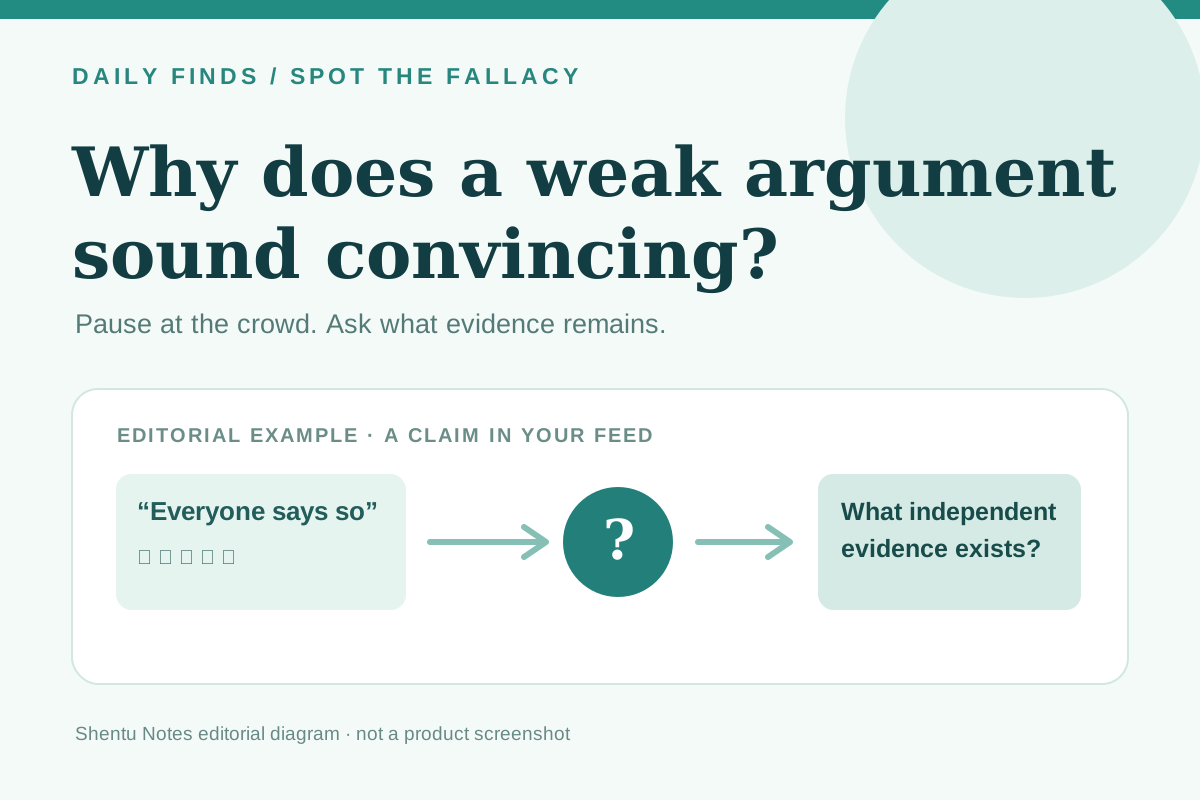
A post has thousands of approving replies. Your first instinct may be that so many people cannot be wrong. But what if those replies came from paid accounts? Before you forward the post, you need a way to separate the appearance of agreement from a reason to believe the claim.
Spot The Fallacy gives you short practice scenarios about flawed reasoning. You choose the pattern that fits, then read an explanation and a stronger version of the argument. I tried its Social Media context on October 23, 2026. It gave me three questions without asking me to sign in. The useful part was not getting the label right; it was seeing precisely which piece of evidence the argument lacked.
Try one small round
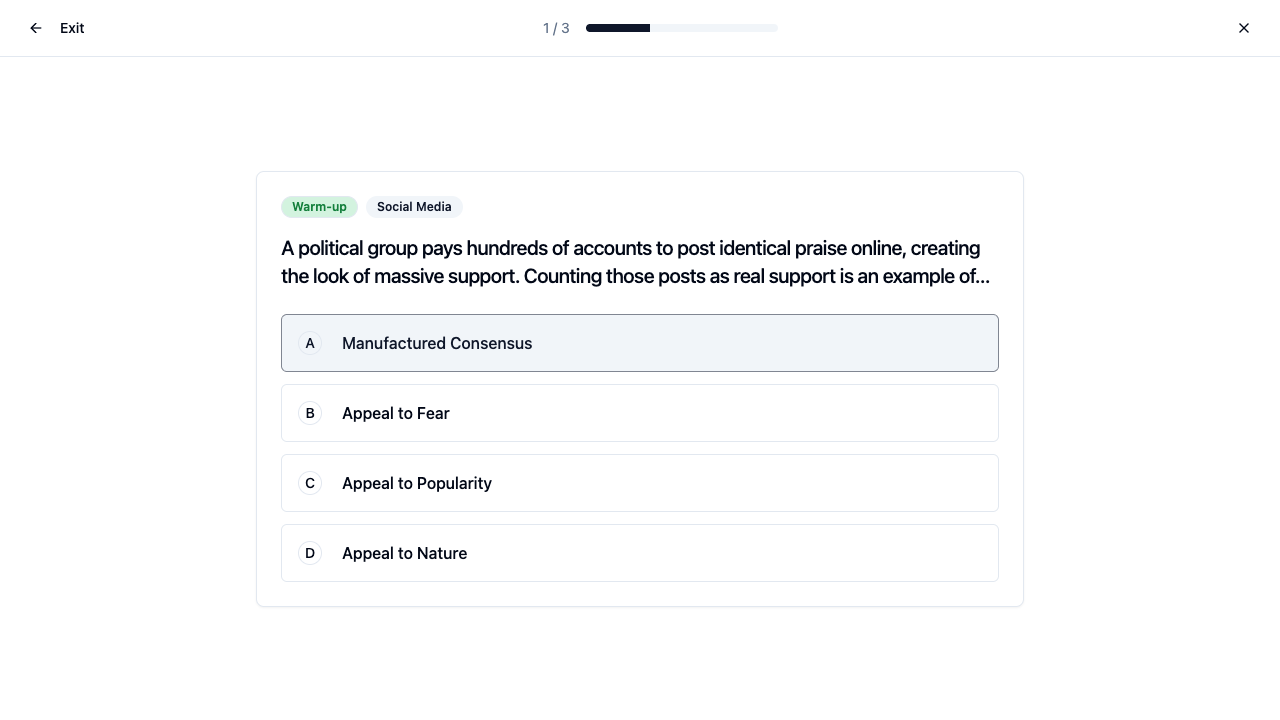
Open the live site and choose Browse All Modes → Context Focus → Social Media. That started a three-question round in my browser. The first scenario described a political group paying many accounts to post identical praise, making support appear larger than it was. The answer choices included Manufactured Consensus and Appeal to Popularity.
Pause before selecting an answer. Ask: What is being treated as proof? Here, a large-looking crowd is the supposed proof, but the crowd itself was created. I selected Manufactured Consensus. You do not need to know the terminology beforehand: the exercise works because it makes you identify the move the argument is making.
Read the explanation, then transfer the idea
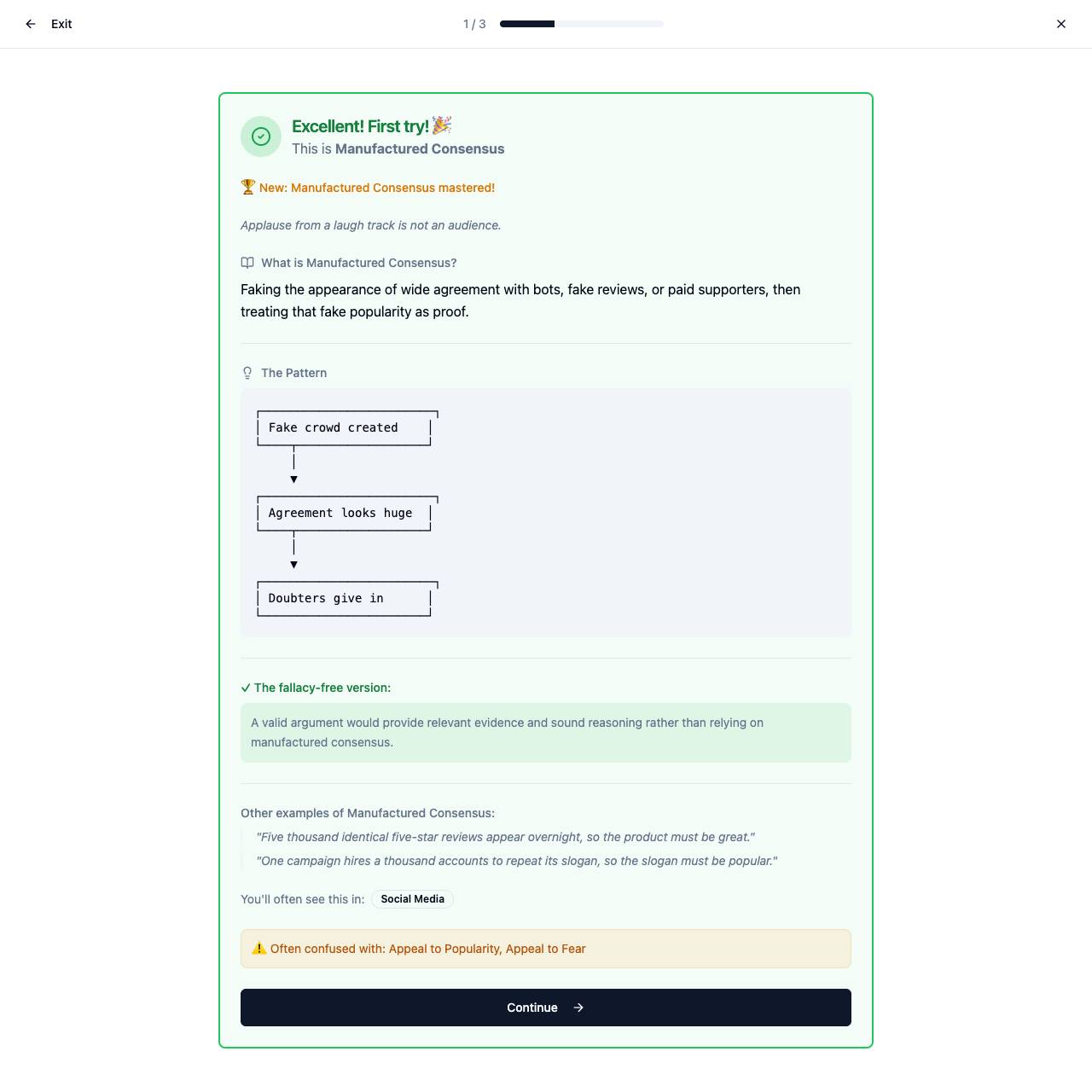
The feedback screen defined the pattern, drew a short chain from a fake crowd to apparent agreement, and offered a better standard: relevant evidence and sound reasoning. It also named similar patterns that people might confuse with this one. This is more useful than a bare “correct” badge, because the next online claim will not come with multiple-choice answers.
Try this outside the game: when a post leans on “everyone agrees,” ask whether those voices are independent and what evidence remains if you ignore the count. If the claim concerns health, money, or another consequential decision, go to original evidence and qualified sources. Spotting a reasoning pattern is a starting question, not a fact check.
For a first session, complete just the three Social Media questions. After each answer, say in one sentence what the argument relied on and what information you would need to judge it. If you want more practice, the project also offers a ten-question Training Mode without a timer, a daily five-question challenge, and topic or context filters. Those are options, not homework.
What I checked before recommending it
The repository README describes 40-plus fallacies and 120-plus practice scenarios, progress saved in the browser’s localStorage, export/import backups, and offline use after the app first loads. It says the tool is free, has no ads, and requires no account. I verified that the live three-question flow opened without a sign-in or payment screen and that the first answer produced the explanation shown above. I did not audit its network traffic, offline behavior, all questions, or storage implementation; the privacy and offline descriptions are the maintainer’s claims.
As of October 23, 2026, GitHub’s repository API showed 0 stars, a most recent push on September 12, 2026, and an unarchived repository. The code is licensed under AGPL-3.0. This is a small, relatively new project selected for a specific practice flow, not a trending pick. This is the first dated star snapshot for it, so there is no measured growth rate.
Original sources: live app, repository and README, license. Both interface images are captures from the official live app on October 23, 2026. The cover is a Shentu Notes editorial diagram, not a software screenshot.