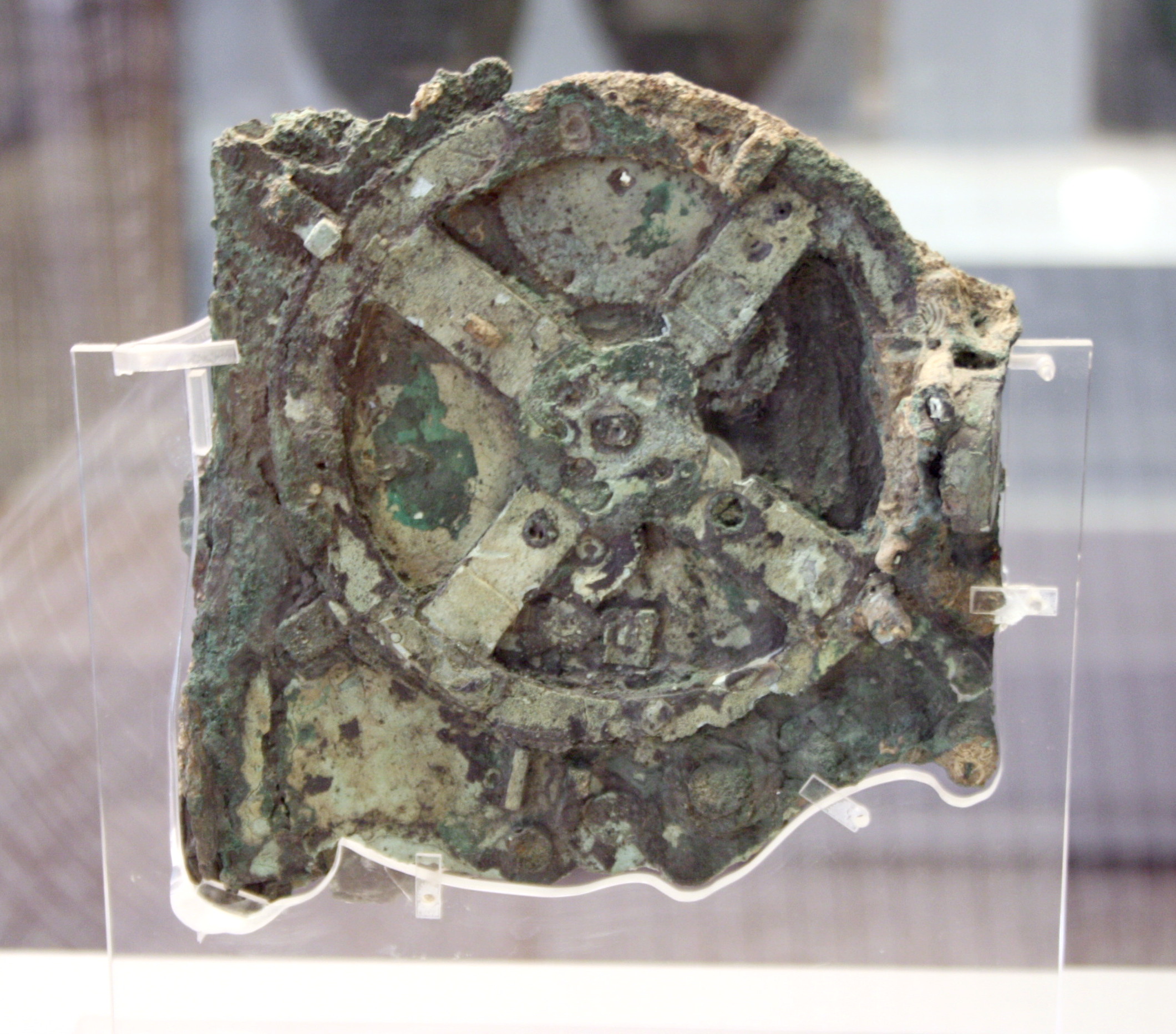
At first glance, it looks like an uneven piece of corroded metal. Then a circular outline appears, followed by the suggestion of teeth and smaller wheels. The Antikythera mechanism survives in damaged fragments, but those fragments preserve the remains of an ancient geared astronomical instrument. 1
The photograph shows an original museum object, not a polished modern reconstruction. That matters because reconstructions make the idea easy to understand, while the surviving bronze shows the more difficult starting point: how much of a machine can be recovered from a broken, altered object? 4

A machine brought up with a shipwreck
The mechanism came from a wreck off the Greek island of Antikythera. The German Patent and Trade Mark Office’s historical account describes sponge divers finding the wreck in 1900, followed by the recovery of objects that included statues and the corroded remains of the instrument. Its significance emerged through later examination. 2
It is an appealing reversal of the usual treasure story. A large statue announces itself immediately. A damaged lump of bronze may require someone to notice an odd detail before it becomes the most unexpected object in the collection. Here, the detail was mechanical: parts that belonged to a complex arrangement rather than to a single cast ornament.
Turning motion into a calendar
The American Society of Mechanical Engineers describes an analog astronomical and calendrical system. Researchers associate its functions with tracking cycles, including eclipse prediction and calendar relationships. Its surviving gears demonstrate a high level of mechanical skill in the Hellenistic world. 1
Calling it a computer needs that context. It did not resemble a laptop, run software or perform arbitrary digital tasks. Its geared relationships embodied particular calculations. Motion could be used to represent the progress of astronomical cycles, making an abstract pattern something a person could inspect on an instrument. 1
The National Archaeological Museum’s educational material explains the underlying problem: solar years and lunar months do not fit together as whole numbers. Ancient astronomers identified recurring cycles that helped relate those calendars and anticipate phenomena such as eclipses. A mechanism could give those mathematical relationships a physical form. 3
The surface was only the beginning
The DPMA account describes the importance of radiographic investigation in exposing gears and inscriptions concealed inside the damaged fragments. The outside alone could not supply a complete explanation. The object had to be studied as something with an internal structure. 2
Look again at the large round form in the photograph. Its recognizably mechanical outline is surrounded by surfaces that make the original instrument difficult to imagine. The contrast is precisely the attraction: enough survives to reveal purposeful engineering, while much of the finished object has disappeared.
The museum photograph was taken by Giovanni Dall’Orto in November 2009. It records the mechanism in Athens, long after its recovery. It does not show the complete instrument operating, and the original maker is not identified by the photograph or by the evidence cited here. 4
The strongest surprise is already substantial without adding a lost inventor or a secret civilization. Ancient craftspeople built a compact system of gears that represented patterns in the sky. What now looks like a damaged lump once made those patterns move together.