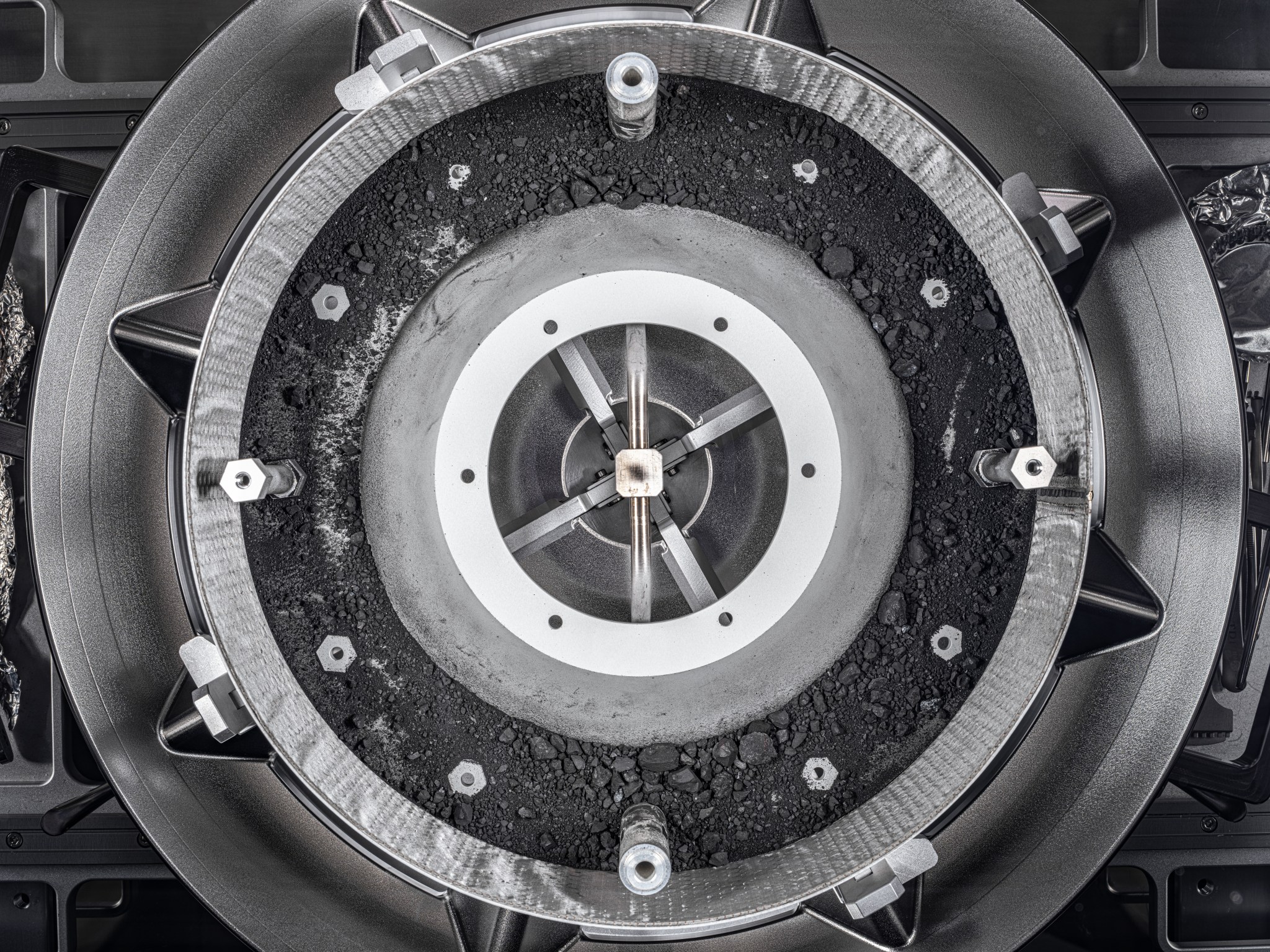
The black grains inside this circular collector came from an asteroid. Bringing them to Earth required a spacecraft mission. Getting at the rest of them required another, much smaller engineering effort: opening two stubborn fasteners.
This happened during NASA’s handling of the OSIRIS-REx sample returned from Bennu in September 2023. By January 2024, the curation team had developed special tools to remove the final obstacles to opening the collection head. The photograph shows the material revealed after that work. 12
The problem was access, not an empty container
Two of the collection head’s 35 fasteners resisted removal with the tools approved for use inside the protective glovebox. Work on that part of the opening paused in October 2023. 1
The team already had asteroid material to study. Before the head was fully opened, curators had recovered 70.3 grams from accessible parts of the hardware, exceeding the mission’s 60-gram requirement. The stuck fasteners held up access to the remaining material; they had not made the entire return inaccessible. 1
That is a rather different story from “NASA could not open its sample.” The useful detail is the constraint around the work. These were scientific samples, and the tools had to fit both the confined workspace and the effort to preserve the material from contamination.
Why a bigger wrench was not the whole answer
NASA’s January 11 update describes newly developed tools made with nonmagnetic surgical stainless steel. The team had to test the approach before using it on the real collector, including how the tools would work within the glovebox’s limited space. 1
The scale of the problem is what makes it memorable. A mission can solve the difficulties of traveling to an asteroid and returning its sample, yet still depend on a carefully designed tool for a task at the laboratory bench. The small operation belongs to the same scientific journey as the large one.
The opened head finally had its photograph
The two fasteners were removed on January 10, 2024. Further disassembly exposed the remaining sample, and NASA published the close view on January 19. The image combines high-resolution photography with focus stacking, bringing the sample into detailed view. 2
It is an actual photograph of the opened collector, rather than an artist’s impression of an asteroid. The dark material lies inside hardware built to capture and return it. The contrast between the irregular grains and the precisely manufactured ring makes the origin of each especially clear.
There was still curation work to do after the picture. Opening the head was a milestone on the way to removing, handling and measuring the material. 2
The final number came later
On February 15, 2024, NASA announced a total sample mass of 121.6 grams, more than twice the mission’s minimum goal. That follow-up supplies the outcome to the January opening story. 3
These are dated events, not a newly reported problem in 2026. Seen together, they give the photograph a satisfying sequence: the sample came home, part was already accessible, the team solved a restricted-access opening problem, and the full collection could be measured. Two fasteners became an unexpectedly important part of the trip from asteroid rock to research material.
The finished photograph keeps both halves of the story in view. Its manufactured circular frame belongs to the collection device; the uneven pieces inside belong to Bennu. The laboratory work joined the two without turning the sample into an ordinary open-air exhibit.