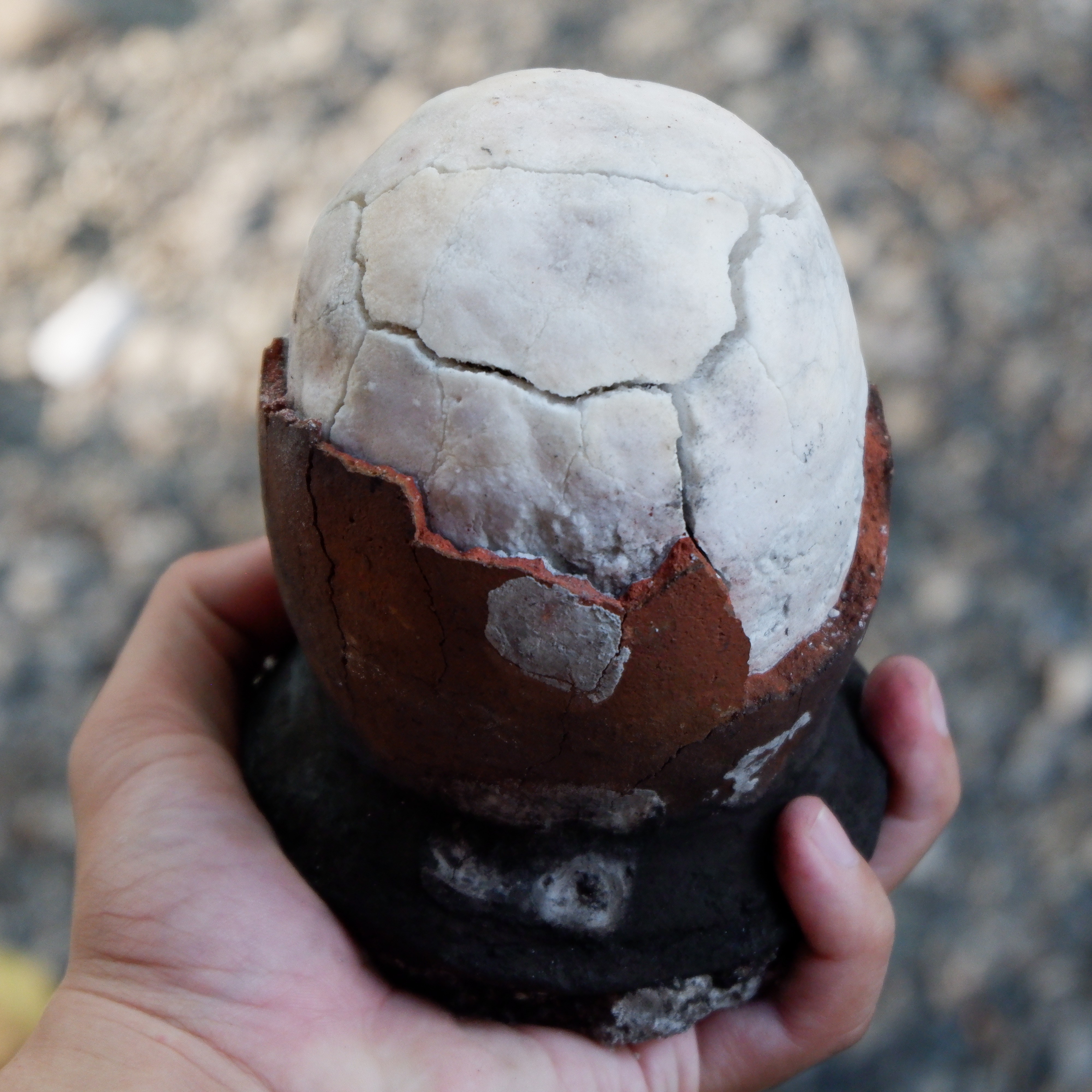
The white dome looks as though it might hatch. Cracks run across its surface, and pieces of a darkened clay vessel cling around its lower half. The hands holding it give the object a surprisingly substantial scale.
It is asin tibuok, a form of artisanal sea salt associated with Alburquerque on Bohol Island in the Philippines. The name means “whole salt.” The photograph by Lokalpedia, taken in 2021, shows the finished form: salt gathered into a solid mass rather than loose crystals in a shaker. 12

The broken pot is part of the explanation
The photographer’s description traces the process through seawater-soaked coconut husks, drying and burning. The resulting ash is used in filtering seawater to produce a concentrated brine. That liquid is then heated in clay pots, with more added as water evaporates. Eventually, solid salt forms inside the vessel. 1
The object’s shape therefore points back to a stage in its making. The curved surface belongs to a mass formed within a container; the remaining pottery makes that relationship visible.
It is a useful reversal of how seasoning usually appears. Instead of looking for tiny grains, your eye meets a single large object. The question becomes how a liquid from the sea acquired this solid, rounded form.
More than a different package for ordinary salt
Bohol’s provincial cultural profile documents asin tibuok-making as part of its intangible heritage. Its description separates stages of the work, including the preparation of husks and ash, filtering, and concentrating the brine. The sequence depends on material preparation before the final heating begins. 3
That is why the finished object can hide so much labor. The moment represented in the photograph comes after several changes in material and form. The rounded salt is the visible result of a process whose earlier ingredients are largely absent from the frame.
The pot remains the clearest clue. Its dark outside and broken rim make it possible to connect the pale solid above it with the making process, rather than mistaking it for a naturally occurring stone.
The recognition concerns knowledge as well as the object
In December 2025, the Philippine Information Agency reported the inscription of the practice on UNESCO’s List of Intangible Cultural Heritage in Need of Urgent Safeguarding. The report identifies the salt-making community of Alburquerque and describes efforts to protect knowledge carried on by a small number of families. 2
The list’s name matters. Recognition draws attention to the need to maintain skills and their transmission. It does not mean that the craft is automatically secure, or that every salt product from the Philippines belongs to this particular tradition.
For a reader encountering it for the first time, the unusual appearance is an excellent entry point. It supplies a concrete question without requiring an invented mystery: why is a seasoning shaped like this, and why is it still sitting in a broken vessel?
The answers lead back to the makers and the sequence of work. A familiar ingredient has become an object you can hold in both hands, with its container still helping tell the story of how it was made.
The cracks make the finished salt look fragile, but they also help reveal its structure. Pale seasoning and dark pottery remain together in one object, preserving a visible trace of the process.