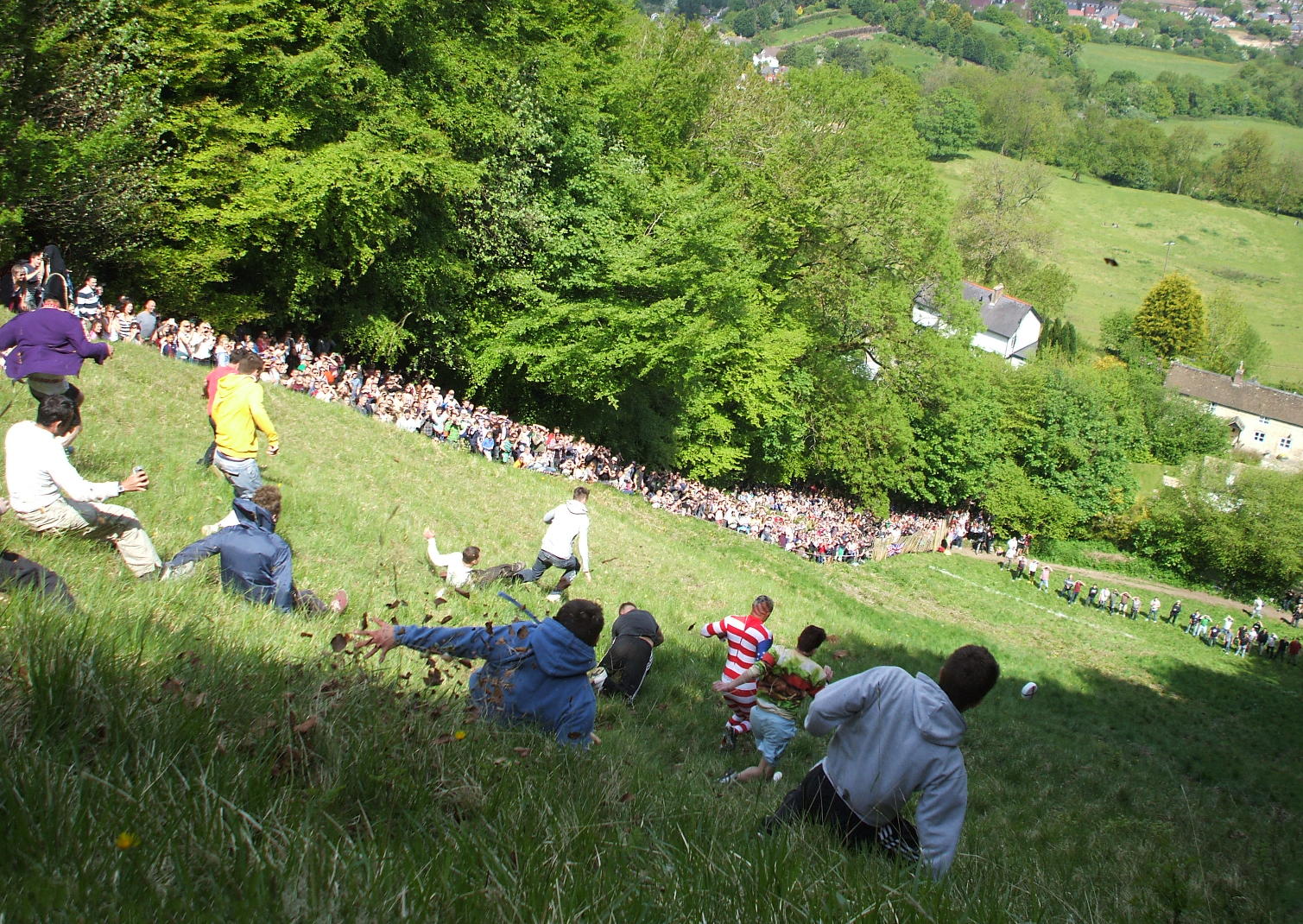
The runners seem to be moving in several directions at once. Some are on their feet, others are sliding or tumbling, and a dense line of spectators follows the edge of the grass. This is a race at Cooper's Hill in Gloucestershire, England, where the traditional prize is a wheel of Double Gloucester cheese. 12

The photograph was taken on May 27, 2013. It is a historical view of the event, not a picture of this year's race. Its strongest detail needs no dramatic embellishment: look from the people nearest the camera toward the crowd below, and the slope becomes the central character.
An everyday food becomes the finish-line reward
The basic custom is wonderfully direct. A round object is released downhill and competitors follow, with the first person to reach the bottom winning the cheese. An older event account describes the prize as Double Gloucester; ITV's reporting from the 2025 races confirms the cheese-centred competition and its rough descent. 23
The traditional object and the actual object released have not always been identical. ITV notes a period when a lightweight foam substitute was used before real cheese returned. The photograph here illustrates the race and terrain; it is not being used as proof of what any particular round object in the 2013 frame was made from. 3
That distinction does not weaken the story. The extraordinary sight is the human pursuit on the hill, while cheese gives the competition its particular identity. Replace the prize with a trophy and the route would still look startling, but the familiar dairy product makes the contrast harder to forget.
The hill makes the picture
Study the foreground before looking at the distant landscape. Bodies are tilted, arms stretch outward and participants occupy different stages of descent. The spectators form a boundary that helps the eye trace the course. Farther away, the gentler countryside makes the immediate patch of grass look even more severe.
The frame catches the race in progress, with the outcome still ahead of the people nearest the camera. Upright bodies and steep terrain make an awkward combination. Even those apparently standing are leaning into the descent, while a patch of open grass separates the participants from the spectators further down.
The custom belongs specifically to Cooper's Hill near Brockworth. It should not be turned into a claim that English people generally spend spring chasing dairy products down slopes. Local identity is part of the interest: a distinctive place has a practice recognised well beyond its immediate surroundings.
A tradition with a serious practical problem
The modern event also has a documented safety context. In a May 12, 2026 statement, Tewkesbury Borough Council's Safety Advisory Group raised concerns about emergency access, previous injuries and the absence of an official organiser and formal safety plans. The council recognised the event's place in local heritage while declaring it unsafe. 4
That statement belongs alongside the spectacle. This is a description of a cultural event, not advice on trying the descent or an invitation to attend. The same steepness that makes the image arresting creates real difficulties for participants and emergency services.
What remains most striking is the scale of the bargain: a recognisable food, a very demanding hillside and people willing to race for the prize. The picture supplies the imbalance before the title supplies the cheese. Together, they turn an ordinary wheel into a very unusual local story.