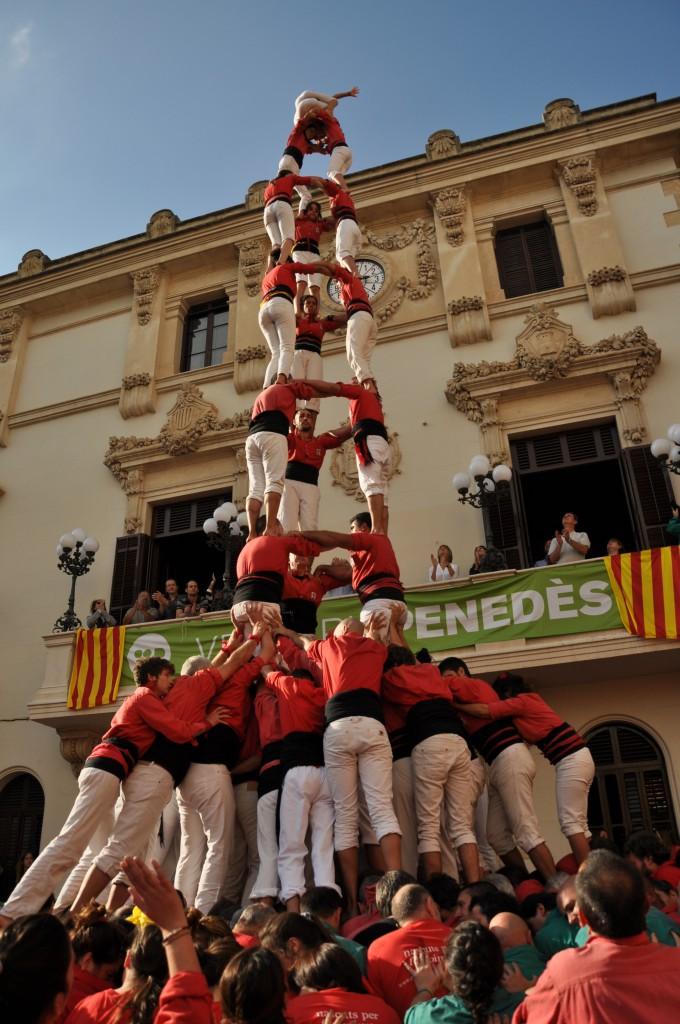
Your eye goes straight to the top: red shirts, pale trousers and a small figure high above the square. Then the photograph pulls you downward. Around the tower is a dense formation of people, their bodies and arms gathered into a base much wider than the narrow structure rising from it. 3

This is a castell, one of Catalonia’s human towers. The photograph records Castellers de Barcelona completing a nine-level tower with an auxiliary base in Vilafranca del Penedès on November 2, 2014. It is a particular team and a particular event, rather than a generic image of a crowd attempting a stunt. 3
The summit gets the attention
The Coordination of Catalan Human Tower Teams describes castells as structures reaching between six and ten people in height. Their form makes height the first thing a spectator notices, but the organization emphasizes teamwork, belonging and cooperation among people of different ages and backgrounds. 1
That description becomes visible in the photograph. The people closest to the ground do not provide a decorative frame around the achievement. The base belongs to the construction. Its breadth creates a strong visual contrast with the few people who occupy the upper levels.
A still image also gives you time to notice what a quick glance misses: repeated clothing, carefully concentrated positions and many participants whose contribution is easy to overlook when attention is fixed on the highest person. The spectacle is vertical, but the work spreads outward.
A festival tradition that grew taller
The teams’ federation traces the development of castells to the final human figures of the ball de valencians, a dance tradition. In the Tarragona region, those final formations gained importance and complexity. In Valls, the tower-building developed into a performance of its own. 1
By the early nineteenth century, Valls had organized groups that took the practice to town festivals. This history helps explain why a castell belongs in a public square with a team and a community around it. It emerged through repeated local gatherings and rivalry, rather than as an isolated record attempt. 1
Catalonia’s cultural heritage service describes a tradition with more than two centuries of history. It highlights effort, teamwork and self-improvement, and records its inscription on UNESCO’s Representative List of the Intangible Cultural Heritage of Humanity in 2010. 2
An achievement larger than its silhouette
Heritage recognition can sound abstract until you return to the picture. A tower has a shape that is easy to remember; the organization behind it is less immediately visible. Participants have to share a practice that continues beyond the few moments captured by a camera. 2
The photograph does not tell us what every person was thinking, how long this team rehearsed for this event or how the sequence unfolded second by second. It does show why describing the scene only as one person climbing very high leaves out most of the image.
Look at the bottom again. The tower narrows as it rises, so the summit naturally claims the eye. Yet the people who make its extraordinary height possible occupy the broadest and busiest part of the frame. The more closely you look, the less this seems like a photograph of a lone daredevil—and the more it becomes a portrait of a team.