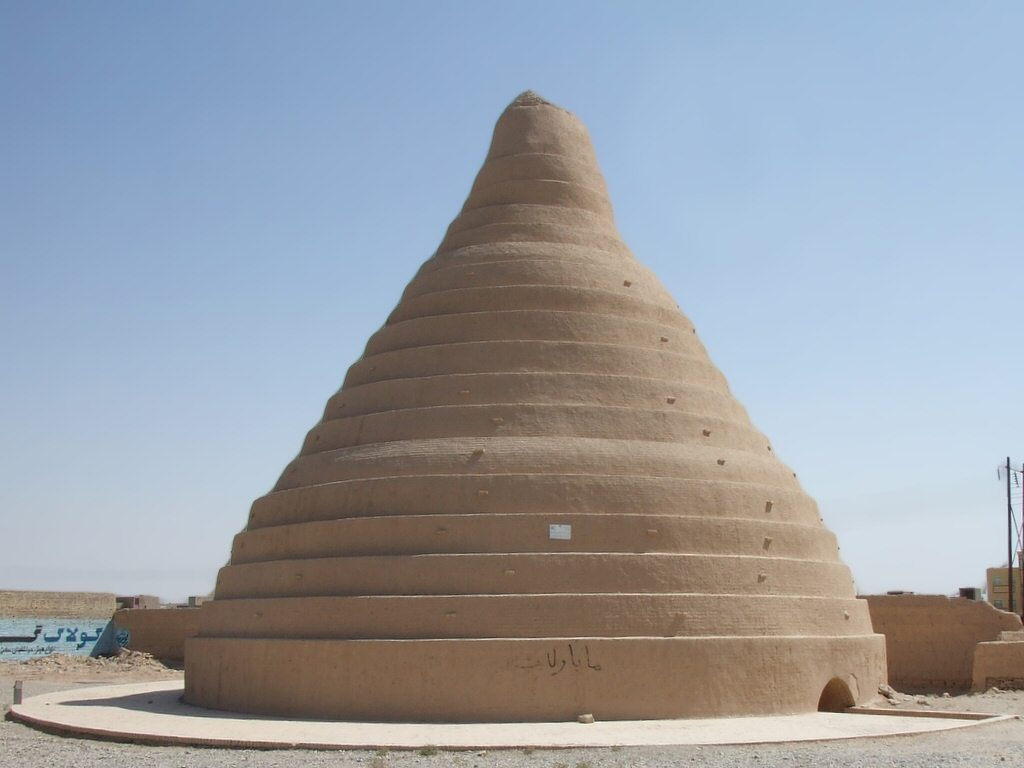
The tiny doorway makes the dome look even larger. Its stepped, earth-colored sides rise out of a bare landscape in Iran’s Yazd province. Somewhere beneath that dramatic roof is the part that explains the building: a place to keep ice.
A yakhchal was an ice house. Winter ice could be gathered and stored for use during warmer months. The surprise is seasonal: people were saving cold weather inside a building, then drawing on it when the weather changed. 1
The ice had to come from somewhere
In one traditional arrangement, shallow outdoor basins supplied the harvest. Water froze during suitable winter conditions, and workers collected the ice for storage. Other sites could receive ice brought from the mountains. The frozen supply went into a protected pit. 1
That distinction matters when looking at the photograph. A dome standing under a bright sky makes an irresistible image of desert refrigeration. But the roof alone does not explain the system. The water supply, winter conditions, collection work and storage space belong to the same story.
Think of the visible dome as a signpost to a much less visible operation. Looking only at the roof is a little like judging a pantry by its door: it shows where something was kept, while leaving the seasonal work that filled it out of sight.
A building that had to slow the thaw
A 2017 engineering study examined the ice-making and storage processes separately. Its example at Meybod, also in Yazd province, includes a pond shaded by a wall and a domed store. The paper describes mud-brick or adobe construction and models how ice could form and how much might survive the storage season. 2
The researchers also point out a useful problem with spectacular claims: estimates depend on the weather data and on the assumptions used to calculate freezing. A system’s existence does not tell us its exact output. Their analysis investigates those quantities rather than treating every old account as a measurement. 2
Meybod is the study’s example; the cover photograph is cataloged more broadly as Yazd province. The picture here is not a photograph of the paper’s experiment, nor does it show how much ice remained inside on a particular day.
The architecture outlasted the ice harvest
Historian Hemming Jørgensen’s book on Iranian ice houses examines the buildings as a distinct part of the country’s architectural heritage. The publisher’s overview describes both their construction and the practical choices behind locating and supplying them. It also places their preservation within the story: these structures can remain after the work they supported has ended. 3
Look back at the doorway. Against the enormous dome, it helps make the storage building readable at human scale. The outside gives the ice house its memorable silhouette; the pit and the seasonal routine give it a purpose.
The cleverness is easy to miss if the story becomes a claim about effortless cooling. This was a way of organizing water, labor, weather and shelter across time. The building helped a winter resource last longer, turning an ordinary change of seasons into something people could save.
The photograph rewards a second look at that contrast in scale. A modest opening serves a building whose roof dominates the scene. The image shows the container; the historical accounts explain the resource it was built to protect.