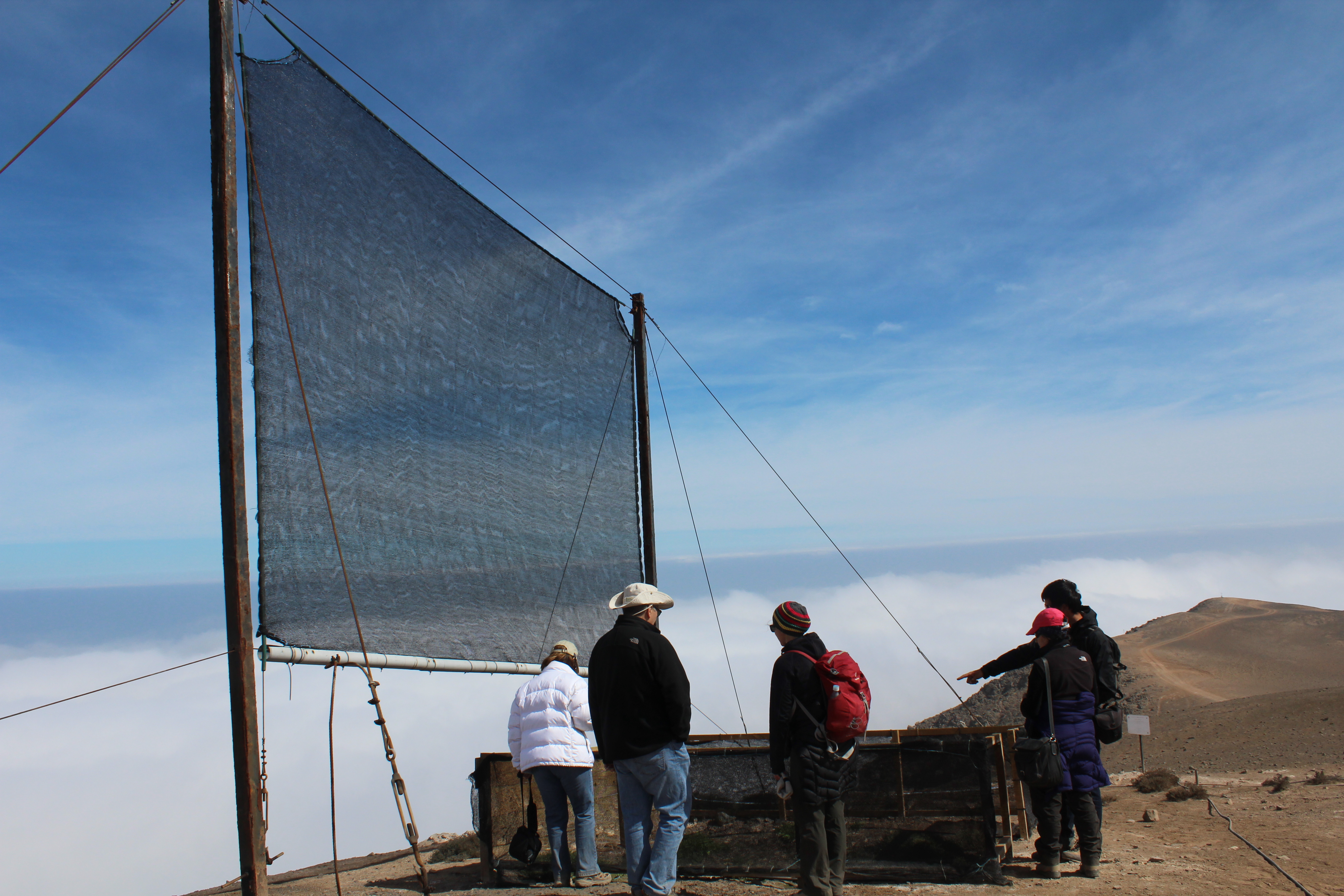
The net rises above a bare hillside like a fence that somebody forgot to finish. There is no crop behind it and no obvious river below. Its target is passing fog: tiny liquid droplets carried through the air, small enough to drift past until a strand of mesh gets in their way. 1
The photograph was taken at Alto Patache in northern Chile in July 2013. People standing beside the panel show its scale, while the exposed landscape makes the purpose feel wonderfully unlikely. The university visit places the working collector in a human setting: people gather at its base while the mesh rises high above their heads. 2
A cloud meets a very selective fence
Fog harvesting begins with water that is already liquid. Wind moves the droplets toward a vertical mesh. Some strike its strands, join other droplets and become large enough to run downward. Collection channels lead the water away. The basic collection step can use wind and gravity rather than a powered refrigeration unit. 1
That distinction matters. A fog net is intercepting a moving supply, so the right landscape and weather are part of the equipment. A dry place with little passing fog will not become a water source simply because someone stretches a net between two poles. The apparent simplicity depends on finding the resource first.
Alto Patache is a useful example because the University Católica de Chile operates a research station there. Its public accounts describe the coastal fog as a resource for both the station and scientific work. The station's setting also helps explain the photograph: a dry-looking hillside and a fog collector can belong in the same scene. Low rainfall and airborne droplets are different things. 2
Why an ordinary screen is not the whole answer
A net needs openings that let air pass while giving droplets enough chances to hit a strand. MIT's 2013 account of research with Chilean collaborators identifies filament thickness, opening size and surface coating as important design choices. Too much mesh is not automatically better: the moving air and the collecting surface have to work together. 1
There is another question after collection: what came in with the water? ETH Zurich's 2023 research report points out that pollutants in fog can reach the collected droplets. Its team tested a specially coated mesh designed to collect water and break down certain organic contaminants, using laboratory experiments and a small pilot installation in Zurich. 3
The ETH experiments concern a separate research system; the older Alto Patache collector appears in the photograph here. Collection, treatment and storage are distinct steps. Catching water is an ingenious beginning, while testing its quality determines how the harvested supply can be used.
The surprising part is the direction
Most familiar water collection starts with rain falling onto a roof or flowing over the ground. Here the collecting surface stands upright, meeting droplets carried sideways through the landscape. Seen that way, the tall panel stops looking like an abandoned fence and starts looking like a doorway through which a cloud is being asked to pass.
The cleverness is easy to miss because the hardware is so plain. Follow the imagined route of one droplet: air, strand, larger drop, gutter. A piece of mesh has made an almost invisible resource large enough to collect.