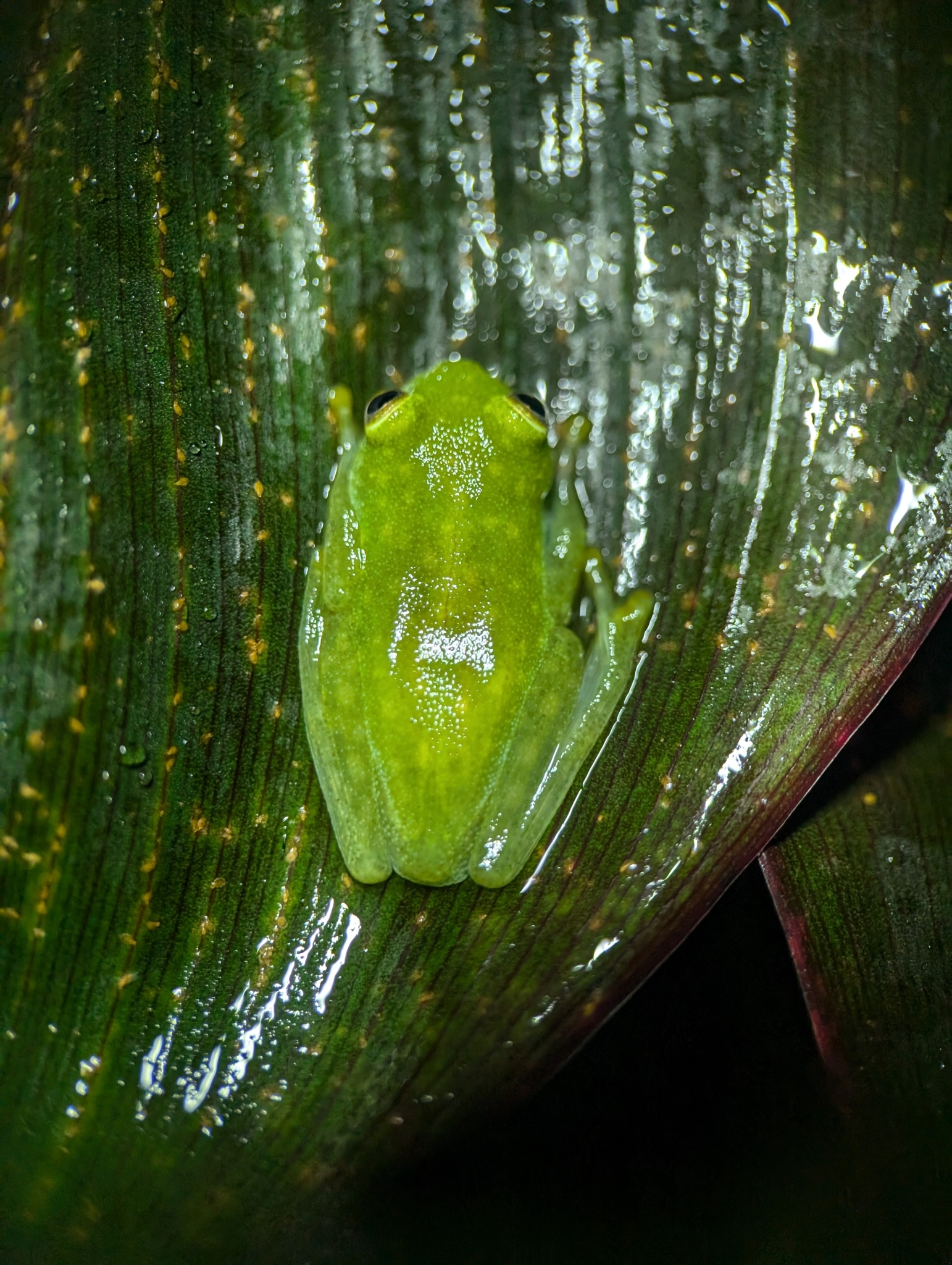
A small green frog clings to a leaf, its limbs spread against a glossy surface. At first it is an appealing portrait. The more surprising story lies beneath the skin: northern glassfrogs can become more transparent while resting by moving much of their circulating red blood cells into the liver. 1
The photograph shows a wild individual in Nicaragua in August 2024. It illustrates the species, Hyalinobatrachium fleischmanni, rather than an animal from the laboratory study. No single portrait can establish how many blood cells this particular frog had circulating at the moment it was photographed.
Red blood is a problem for transparency
Transparent tissues alone do not make an animal see-through. Blood contains cells that absorb and scatter light, making the circulatory system conspicuous. A 2022 study in Science investigated how glassfrogs overcome that obstacle, treating the position of those cells as part of the camouflage mechanism. 1
The researchers found that resting frogs removed roughly eighty-nine percent of their red blood cells from circulation and packed them into the liver. Transparency increased compared with the active state. That result describes the study conditions and species; it is not a rule that every frog, or every glassfrog at every moment, follows the same measured percentage. 1
Think of the visual difference between spreading coloured material through a clear container and gathering it in one small area. The comparison helps explain why location matters, though a living frog is a much more complex system than a container. The research tracked a biological change, not a disappearance of the blood itself.
The investigators listened to absorbed light
Duke’s account of the work describes photoacoustic imaging. Light absorbed by blood cells produces signals that can be detected acoustically, allowing researchers to follow where the cells are concentrated. The technique made it possible to investigate an internal change in a living animal rather than relying on its outward appearance alone. 2
When the frogs became active again, the cells returned to circulation. The account connects that movement with the animal’s changing need to be active. Resting camouflage and an active body place different demands on the same small creature, making the shift more interesting than a fixed see-through appearance. 2
The leaf in the photograph provides a useful reminder of the setting in which camouflage matters. Its green surface surrounds the frog’s outline, while reflections and veins create their own visual pattern. The image gives context for the animal’s appearance, but it does not measure the internal mechanism described by the experiment.
A familiar photograph can hide unfamiliar physiology
A later Duke feature explains how the collaboration developed across biology and engineering, beginning with curiosity about the frog’s unusual appearance and continuing with tools able to investigate it. The discovery depended on connecting what could be seen with a method for locating what could not. 3
Questions remain about how these frogs manage the concentrated cells. The findings are a starting point for further biological investigation, rather than an established treatment for human blood disorders.
Look once more at the tiny animal on the leaf. Its green skin is visible, but the most unusual part of the story is a reversible rearrangement inside its body. Becoming harder to see can involve moving something bright and conspicuous to a less visible place.