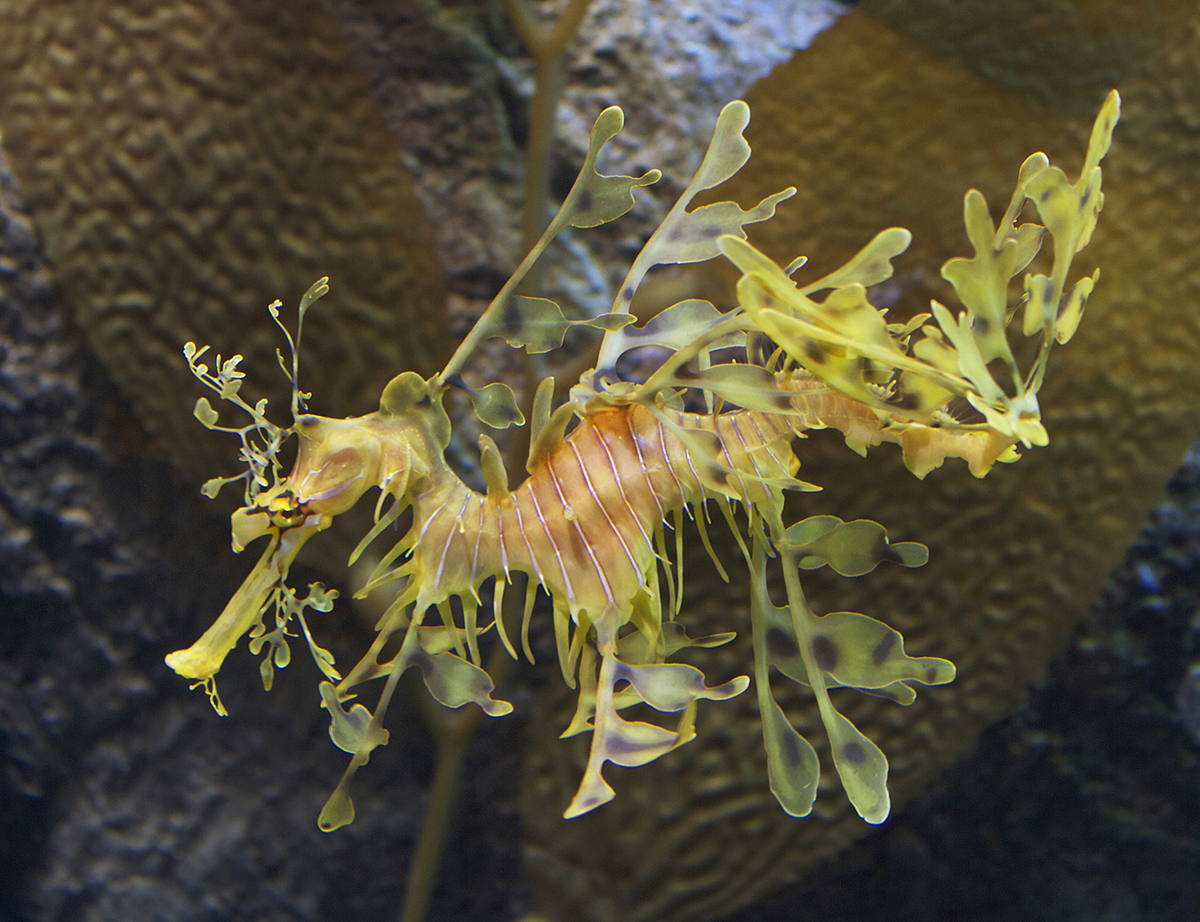
Find the eye, then follow the long snout. What first looks like an untidy spray of underwater leaves resolves into a fish: the leafy seadragon, Phycodurus eques. Its curling body and branching frills make the boundary between animal and background unusually difficult to read. 1
This individual was photographed at Monterey Bay Aquarium in California in October 2012. It is a captive example of a species native to Australian waters, not a photograph taken on a wild Australian reef. The distinction leaves the visual surprise intact while keeping the animal's location honest. 2

The disguise is part of the body
The Australian Museum describes leafy appendages and colouring that provide camouflage on kelp-covered rocky reefs. These are parts of the fish itself. It has not gathered a costume of loose seaweed and draped it over its back. 1
Look at the photograph in stages. The eye and tubular snout supply familiar animal features. The ribbed body continues toward a curved tail. Then thin, irregular shapes branch outward and interrupt the outline that would normally make a fish easy to spot. Against an appropriate reef background, that broken outline is the point.
Monterey Bay Aquarium places the species in the cooler waters off southern and western Australia, among seaweeds and seagrass. Its account describes slow swaying with the current. An animal shaped like drifting vegetation benefits when its movement also fits the surrounding scene. 3
The picture is especially useful because its background lets the body stand out. Follow the darker line through the centre, then inspect the pale frills along its sides. The contrast reveals the separate shapes that would overlap with vegetation in the wild, turning an elaborate outline into a practical disguise.
The showiest parts are not the engine
The leaflike frills draw attention, but small, almost transparent fins do the swimming. Aquarium of the Pacific describes dorsal and pectoral fins that oscillate rapidly, while the tail helps with direction. The visible ornament and the propelling equipment have different jobs. 4
That separation changes what to watch in a moving seadragon. A broad leafy projection may be the easiest part to see, yet a much less conspicuous fin can be supplying motion. The animal's apparent drifting should not be confused with a complete absence of swimming.
Its mouth has another specialised task. Monterey Bay Aquarium describes a tube-like snout used to take in small shrimplike prey called mysids. The fish waits for prey to come near and draws it in. The little opening at the end of that snout belongs to a feeding animal, even when the rest of the body suggests a plant. 3
A second surprise sits beneath the tail
Leafy seadragons are relatives of seahorses and pipefishes, and the male carries the eggs. Unlike a seahorse's pouch, a male seadragon's brooding area lies beneath the tail. Monterey Bay Aquarium describes eggs transferred to this brood patch and cared for until hatching. 3
The photograph illustrates the body and disguise rather than a documented brooding individual. The aquarium's account adds that reproductive surprise to the visible one: a fish with a plantlike outline also carries a very different family arrangement beneath its tail.
Return to the head once more. The eye provides a useful anchor in all those leaflike edges. Once you see the fish, it is difficult to unsee—but its shape explains why a wild animal among moving vegetation might escape a much quicker glance.