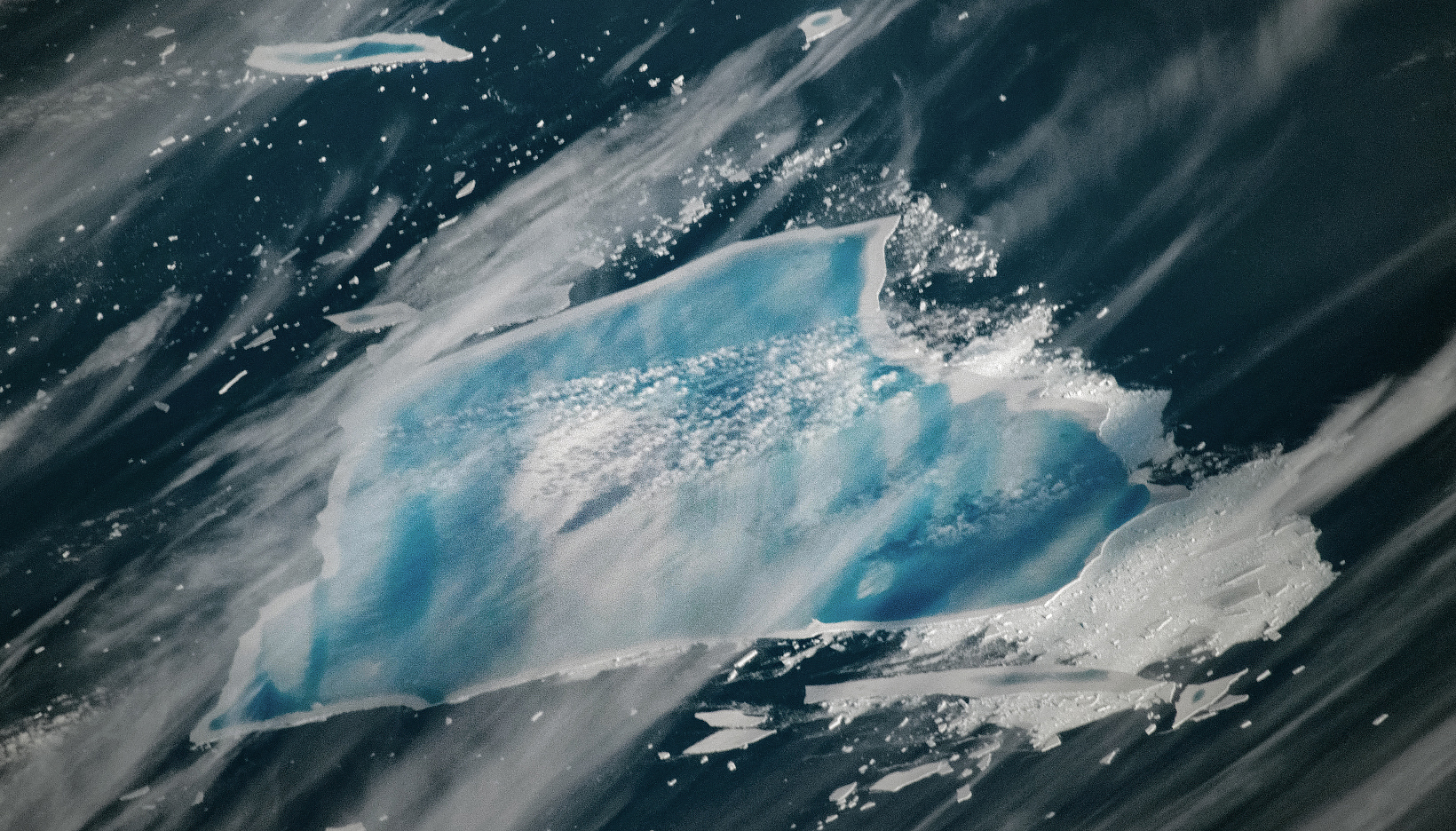
The blue is on top of the ice. In this photograph taken from the International Space Station, broad pools cover much of iceberg A-23A, with a pale edge tracing the boundary between the slab and the darker ocean around it.
An Expedition 74 crew member photographed the scene on December 27, 2025. NASA published the view in January 2026, describing extensive meltwater on a long-lived iceberg that had already experienced substantial breakup. This is a dated chapter in that story, not a report of its position today. 1
The color revealed something happening at the surface
NASA’s account connects the vivid blue areas with water collecting on the iceberg. It also describes how the weight of pooled water can help force open cracks, and how the white rim relates to the changing shape of the floating slab’s edges. 1
That makes the color more than an unusual visual effect. Water accumulating on top of ice belongs to the processes changing the iceberg itself.
The photograph gives the scene an unexpected appearance: a pale border surrounds an interior streaked and flooded with blue. Wisps of cloud cross the view, but the contrast between the iceberg and the ocean remains clear.
NASA identifies this as an astronaut photograph, taken with a digital camera and later cropped and enhanced for contrast, with lens artifacts removed. The supplied image is a processed photograph of a real scene, distinct from a simulated view. 1
A long journey preceded the picture
A-23A separated from Antarctica’s Filchner Ice Shelf in 1986. For more than thirty years it remained grounded in the Weddell Sea before beginning a much more mobile phase. The British Antarctic Survey’s January 2024 tracking account described its movement out toward the Southern Ocean. 2
That history makes the photograph a view of something already old by iceberg standards. The blue pools appeared late in a journey that could be followed across many separate observations.
A single image cannot supply that history on its own. It records one moment; tracking and earlier measurements connect it with the larger object moving through the ocean over time.
The outline had already changed
JAXA’s November 2025 account followed A-23A using several satellite missions. It documented large pieces separating during 2025 and presented observations showing the breakup’s progression. Its time-stamped sequence explains why describing the berg with one permanent size would be misleading. 3
By the time of the December photograph, the familiar name referred to a diminished remnant of the much larger iceberg that originally left Antarctica. Numbers and superlatives attached to earlier stages do not automatically describe later ones. 13
For that reason, the blue photograph is most useful when its date stays beside it. The story here concerns the scene observed then, rather than an unsupported claim that the iceberg remains intact now.
Look back at the pale rim and blue interior. The surprising part is how much change is visible in something that can look solid and monumental from a distance. A floating slab carries evidence of melting, cracking and its earlier journey across its surface. The astronaut’s view caught those details from a perspective that made the contrast impossible to miss.