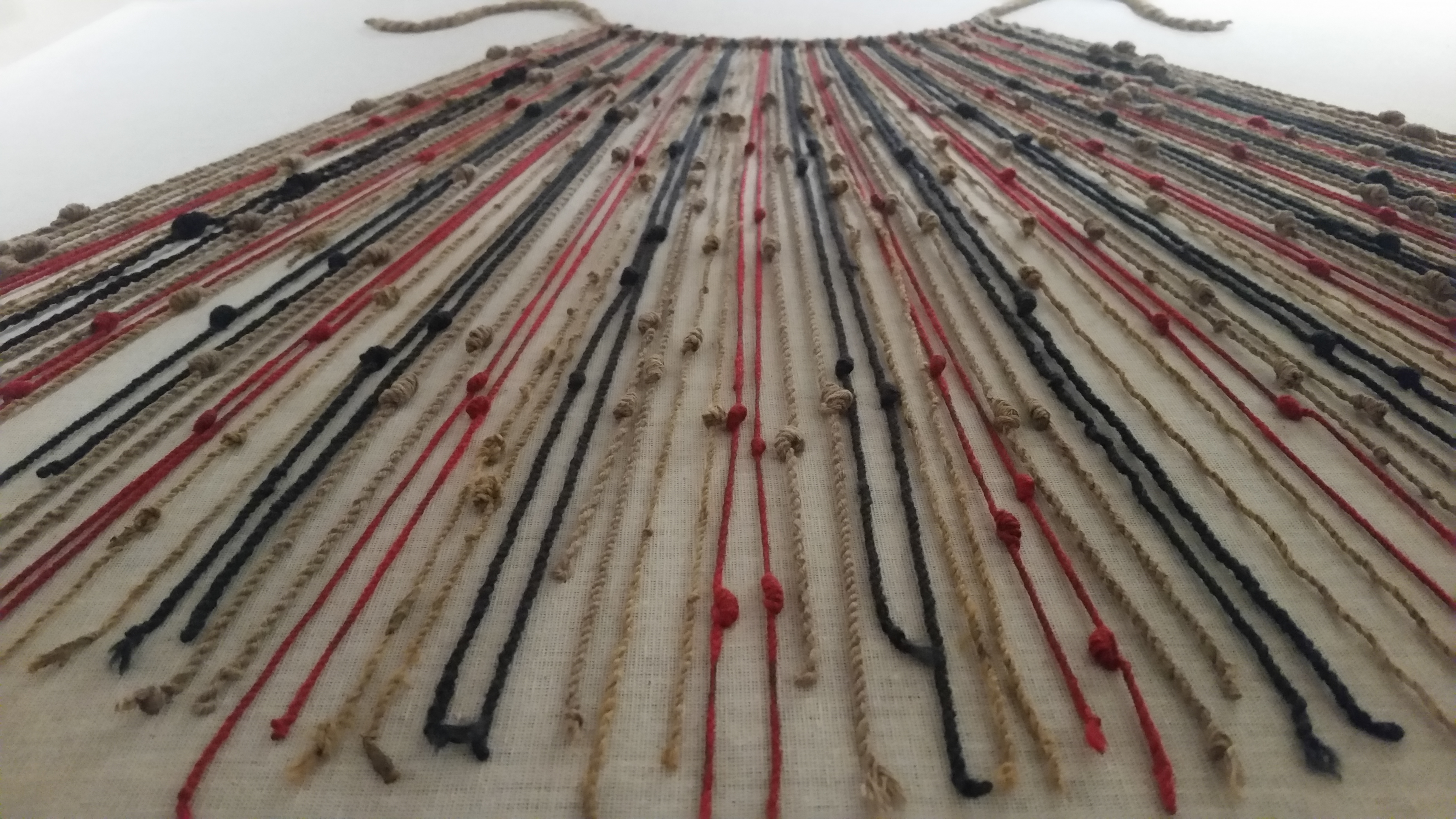
Spread across a museum display, the cords almost resemble an unfinished textile project. Long strings hang beside shorter branches, with clusters of knots interrupting their lines. Yet this arrangement belongs to a sophisticated Andean way of keeping information: the khipu, also commonly spelled quipu. Its structure was meant to be read. 1
The photograph was taken at Museo Machu Picchu, Casa Concha, in Cusco in 2018. It shows a displayed object, not a modern diagram explaining a complete message. That distinction matters. Seeing a knotted record is different from being able to identify everything a particular maker intended it to say.
Information had a physical shape
The Smithsonian’s National Museum of the American Indian explains that Inka khipus encoded quantitative information useful to officials, including records of labour and taxation. A main cord supported hanging strings whose knots, colours, lengths and construction could vary. Information depended on the arrangement, rather than on a single isolated knot. 1
Think about how that changes the act of looking. A cord’s relationship to its neighbours becomes important. So does the difference between an attachment and a knot placed farther along a string. The object is three-dimensional, and its physical organization is part of its meaning. Calling it a tangle misses the very order that made it useful.
The museum’s separate collection record classifies one example as a counting record made from cotton cord and dyes, using tied and knotted techniques. That object comes from Chulpaca in Peru and is attributed to the Inka. It provides a documented comparison, rather than an identification of the Casa Concha object in our photograph. 2
The specialists mattered too
A Metropolitan Museum of Art publication describes specialists known as khipukamayuq and the importance of cord construction, colour and knot placement. It also discusses historical accounts of information being preserved through cords. The record and the trained person who interpreted it belonged to the same system. 3
That is a useful antidote to the idea that a clever object explains itself. A printed ledger also relies on shared conventions: which columns mean what, which units are used and how a total is read. A khipu asks the viewer to recognize a different set of conventions, even where the original reader’s knowledge is no longer fully recoverable.
The Smithsonian notes that khipus may also have carried functions beyond accounting, potentially approaching a form of writing. That possibility remains a research question. It does not mean every surviving cord has been translated into a modern sentence or that all proposed interpretations have equal support. 1
Look for order before looking for a secret
In this photograph, the repeated hanging lines and small changes in colour invite a slower inspection. You can appreciate the deliberate arrangement without claiming to decipher it. The strongest surprise is already established: records can be constructed from fibre, and a knot can belong to an administrative technology.
The object expands what a record can look like. Put beside a familiar page of figures, these cords suggest another relationship between memory, material and skilled readers. The information did not have to sit on a flat sheet. It could hang from a cord, waiting for someone who knew where to look.