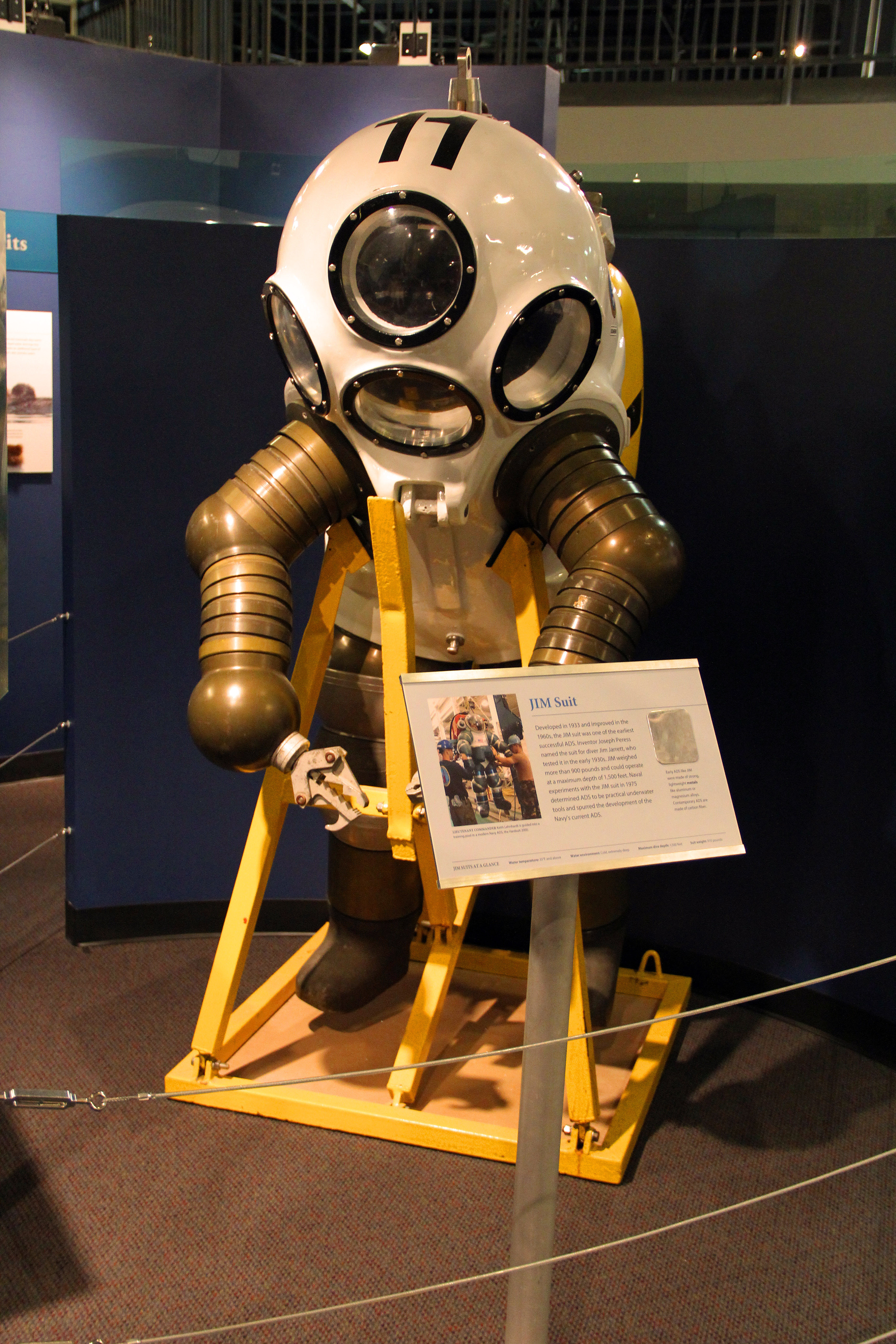
The round viewing port and oversized joints make this museum object look more like a robot than clothing. Yet a person belonged inside it. The JIM suit was an atmospheric diving suit: a hard enclosure that kept its occupant at surface pressure while operating underwater.
That makes “suit” an unexpectedly modest word. The U.S. Naval Undersea Museum describes the machine as a one-person submersible with articulated joints. Instead of letting the surrounding water’s pressure determine the diver’s environment, its shell carried a protected environment down with the diver. 1
The joints were the difficult part
A rigid container can protect what is inside. Making that container move creates another problem. The person needs to bend limbs and do work, while the enclosure must keep doing its job.
The Western Australian Museum’s account describes the JIM suit’s articulated construction, including oil-supported joints and manipulators used in place of bare hands. Life-support equipment supplied the person inside, while communication connected the diver with the surface. These were parts of an operating machine, not simply a waterproof outfit. 2
The photograph makes that difference visible. The arms and legs are divided into substantial sections, and the head is enclosed behind a viewing port. The human outline is recognizable, but very little about the object suggests the flexibility of ordinary clothes.
JIM had a namesake
The name comes from diver Jim Jarrett. He tested an earlier hard diving suit developed by Joseph Peress in the 1930s. Decades later, that earlier work helped inform the modern JIM project associated with Mike Humphrey and Mike Barrow of Underwater Marine Equipment Limited. 1
The museum’s history traces a striking connection between the generations of equipment: Peress’s earlier suit was found in a Glasgow junk shop and brought back into the development story. What looks like a piece of futuristic machinery therefore has a history involving older experiments and the recovery of an overlooked object. 1
The dates matter. This is technology with a development history, not a new robot unveiled today. Different atmospheric suits also used different materials, joint arrangements and equipment. A photograph of one example should not become a bundle of specifications gathered from every model.
A person could inspect what a rescue team needed to reach
The U.S. Navy evaluated JIM in 1975. In its account of submarine rescue, the Naval Undersea Museum explains why atmospheric diving suits were useful: divers could investigate a disabled submarine and prepare access for rescue equipment. Maintaining surface pressure inside the suit removed the need for the decompression associated with a diver exposed to increased ambient pressure. 3
That was the purpose behind the unusual silhouette. The operator needed protection from the environment and enough movement to perform work within it. Every visible joint sits at the meeting point of those two demands.
This photograph was taken at the Naval Undersea Museum in February 2012. It records an exhibit at that time; the museum’s object page currently marks the suit as off display.
Look once more at the viewing port. Behind the machine’s almost human shape was an actual human space: a tiny room that went underwater with its occupant.
The photograph also gives an unusual view of clothing as architecture. There is a boundary around the person, a window to look through and joints that allow the whole enclosure to move. That is a very different relationship between a body and its surroundings.