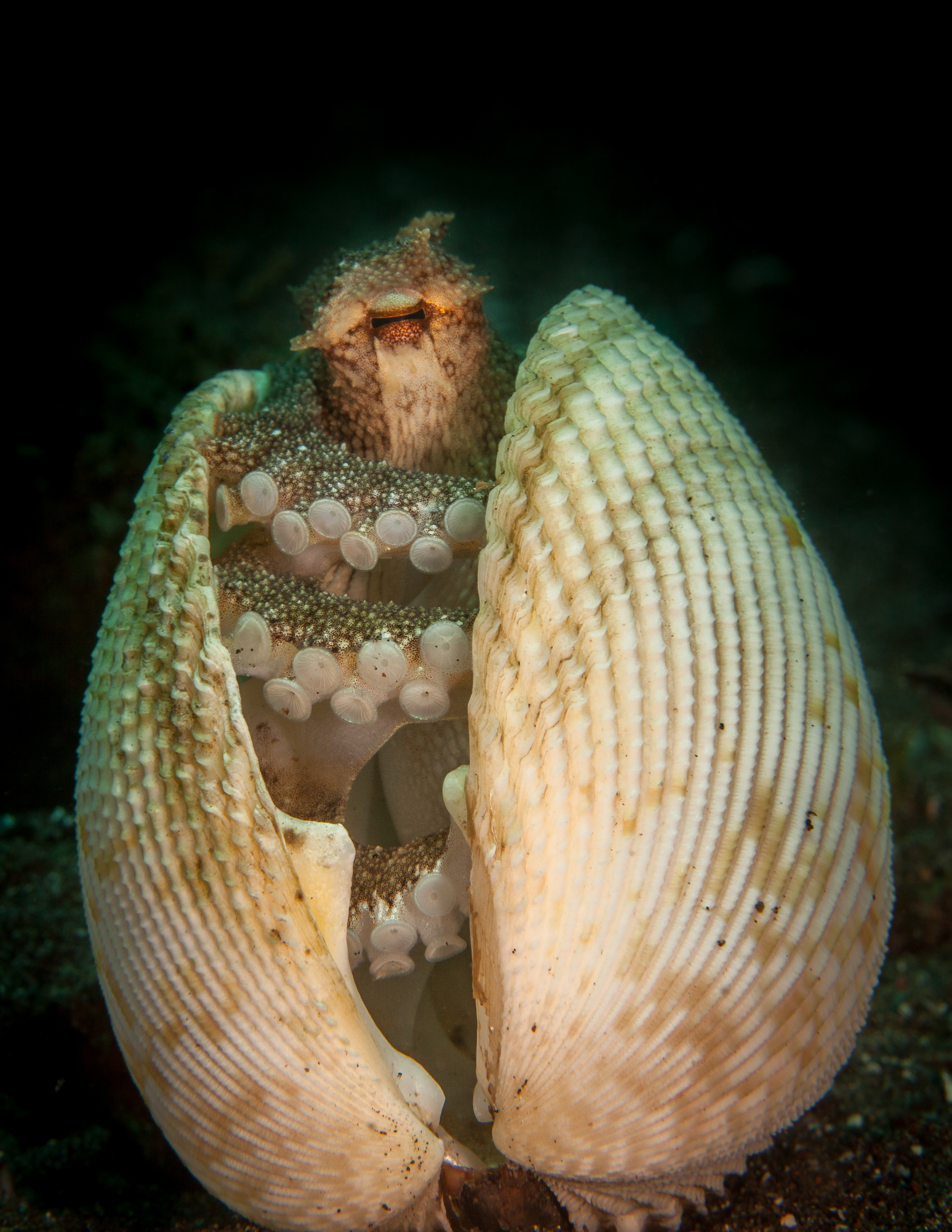
The octopus looks as though it has closed a little door around itself. Two curved shell surfaces frame the animal, leaving its eyes and rows of suckers visible through the opening. The photograph records a coconut octopus in Lembeh, Indonesia.
This species, Amphioctopus marginatus, is also known for a different kind of shell use: carrying coconut-shell pieces and deploying them later as shelter. The shell in the cover photograph is a seashell, not a coconut. It shows the animal using a shelter, rather than the transport sequence reported by researchers. 13

Finding a hiding place is only part of the story
A 2009 paper by Julian Finn, Tom Tregenza and Mark Norman reported defensive tool use in coconut-carrying octopuses. Its title captures the behavior that made the observation memorable: an animal carrying an object that could become protection later. 1
The distinction is worth pausing over. An animal may encounter a cavity and move into it. Transporting something useful changes the relationship: part of the potential hiding place goes with the animal.
The immediate sight can look awkward or comical to a human observer. The scientific question is more precise. What is the object doing during transport, and what happens when the octopus actually uses it?
A shelter assembled when needed
A 2013 research review of aquatic tool use describes observations from northern Sulawesi and Bali. The octopuses carried shells in a form that was not then functioning as shelter, before using them to create an enclosure when threatened. The review treats the conditional deployment as an important feature of the behavior. 2
That temporal separation is what makes the case especially interesting. Carrying the object and receiving its protective benefit are different stages. The object has to remain available between them.
This does not tell us that an octopus imagines a house in the same way a person does. The observation concerns what the animals did; interpreting the full extent of their mental experience requires additional evidence.
Why researchers care about the definition
The same review distinguishes tool use from simply wearing or permanently carrying something. Its discussion focuses on objects that an animal manipulates in a particular context to achieve a result. Under that approach, the shelter-building sequence matters more than an object’s resemblance to a human tool. 2
That makes the coconut case useful even though the equipment is simple. The interesting feature is the relationship between the animal, the object and the situation in which it is deployed.
The broader question is not whether a coconut shell looks like a sophisticated invention. It is whether close observation reveals a more flexible use of the surroundings than a quick glance would suggest.
The photograph shows a quieter part of the idea
Here, the curved surfaces almost conceal the octopus. The opening leaves enough of its body visible to connect the protective object with the animal using it. This is a separate photographic example, taken years after the 2009 study. 3
It cannot demonstrate a whole sequence of behavior in one frame. What it does offer is a striking view of the same species making use of a hard exterior object around its soft body.
That is enough for a second look. The animal can disappear into what looks, at first, like a pair of ordinary shell surfaces. Research on carried coconut pieces adds another layer: sometimes the hiding place is something the octopus brings along.