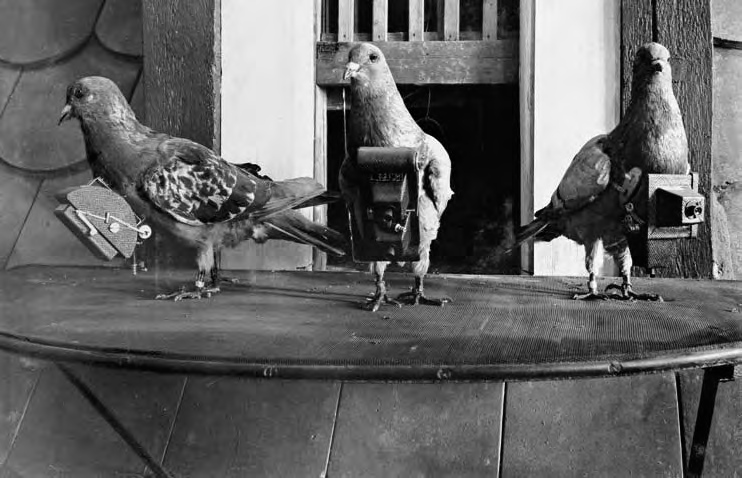
The boxes beneath these pigeons are cameras. Each bird carried a lens, a shutter mechanism and a harness into the air—without a human photographer looking through a viewfinder.
In the early twentieth century, German pharmacist Julius Neubronner experimented with this unlikely way to photograph the world from above. A delayed-action mechanism released the shutter while the pigeon supplied the flight. [1][2]
Some surviving images contain a detail that belongs to this particular photographer: wing tips at the edges of the frame. [3]
The idea began with a pharmacy
Pigeons already had a place in the Neubronner family's work. According to the Swiss Camera Museum, Julius's father, Wilhelm, received urgent prescriptions by carrier pigeon in Kronberg, Germany. Julius carried on the practice. [1]
That background makes the camera project a little easier to picture. For this pharmacist, a pigeon was a bird with a useful journey to make. Adding a camera offered a way to see something of that journey.
The museum describes Julius developing a small device attached to the bird's chest with elastic straps. A delayed-action trigger allowed it to take photographs automatically. Once the equipment was in flight, there was no person looking through a viewfinder. [1]
It is an appealingly strange combination: a living delivery system carrying a machine built to record the view.
A tiny camera with a surprisingly ambitious lens
There was serious engineering behind the novelty. The German Museum of Technology's collection entry describes a Neubronner pigeon camera dated 1907, complete with a breast harness and a pneumatic triggering device. Its lens pivoted mechanically to produce a panoramic picture. [2]
A panorama asks the viewer to take in a wide scene. On a pigeon, that means a broad view from a camera whose position depends on a flying animal. The object is small enough to look whimsical, yet the photographic ambition is easy to recognize.
Seen beside today's aerial cameras, the harness is the detail that stops you. Everything has to go along for the ride: camera, mechanism and attachment. The bird is doing the carrying while the device waits for its moment.
The wings are the best part
Surviving images show what the experiment could produce. One set, catalogued on Wikimedia Commons as photographs from Neubronner's pigeon-mounted camera, includes a view with wing tips intruding at the edges. [3]
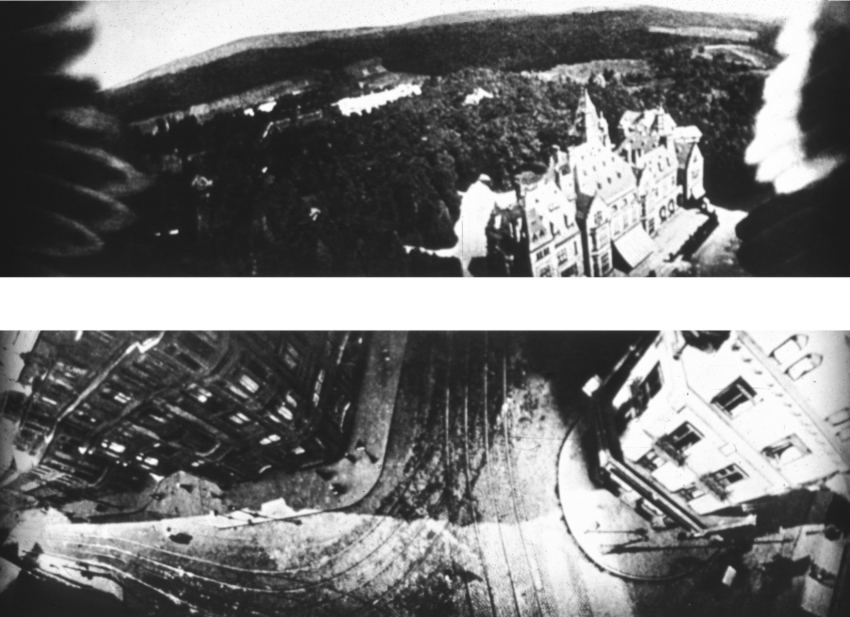

Aerial photographs attributed to Julius Neubronner, including a view with wing tips visible. Public domain, via Wikimedia Commons.
The buildings give you the landscape. The feathers give you the story.
That small interruption turns an aerial photograph into something much more personal: evidence of the animal carrying the camera. You can look at the scene below and, at the same time, see a little of how the picture was made.
It is also the perfect ending to this particular invention. A pharmacist sends a camera aloft on a pigeon, and the pigeon manages to appear in the picture.
Sources
- Swiss Camera Museum: Photographer pigeons — pharmacy background, chest attachment and delayed-action trigger.
- German Museum of Technology, via Google Arts & Culture: Pigeon-camera — the camera dated 1907, harness, trigger and panoramic mechanism.
- Wikimedia Commons: Pigeon wingtips — surviving image description, attribution and reuse status.