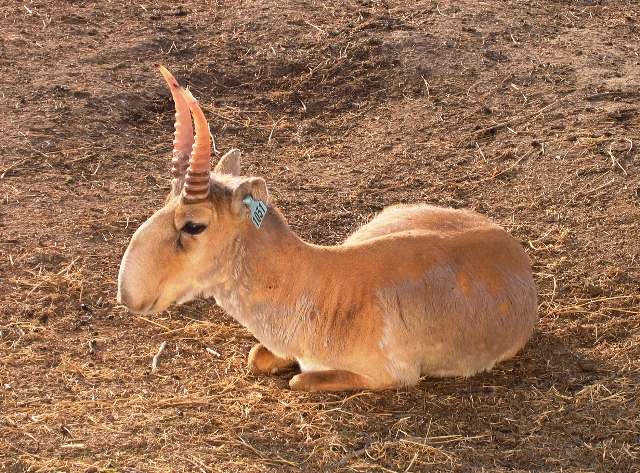
Start at the horns and this looks like an antelope. Move down to the face and the familiar outline changes. The saiga has a broad, hanging muzzle that projects over its mouth, with nostrils directed downward. It gives the animal an expression that can look almost invented—until you meet the environment it lives in. 1
Saigas inhabit the Eurasian steppe, where open ground can be dusty in summer and bitterly cold in winter. The Saiga Conservation Alliance explains that the distinctive nose helps filter dust and warm incoming cold air. The feature that first seems out of place is connected to the place the animal belongs. 2
A nose with more going on inside
San Diego Zoo describes a complex internal arrangement of bone and soft tissue, with hairs, glands and mucus-lined passages. The external shape is only the visible part of that anatomy. Its account presents air warming and dust filtering as functions the unusual muzzle may help perform. 1
The international Convention on Migratory Species also identifies those functions in its species profile. It is a useful way to think about the nose without turning it into a tiny mechanical appliance: air passes through living tissue before reaching the lungs, and that passage matters in a harsh landscape. 3
The photographed animal is resting, so there is no cloud of dust or winter breath to dramatize the explanation. That quiet view has an advantage. You can follow the outline of the face from forehead to nostrils without the distraction of a running herd. The swollen-looking muzzle is visible as an ordinary feature of an ordinary moment.
Built for an open, demanding landscape
The conservation alliance describes saigas as highly mobile animals, moving across large areas of steppe. A landscape can look empty to a camera while still placing strong demands on the animals crossing it: exposure, seasonal changes and long distances all shape the problem of living there. 2
The nose belongs in that larger picture. It is one conspicuous feature of an animal whose life depends on more than a distinctive face. The alliance’s work combines research, protection on the ground and cooperation with local communities across the saiga’s range. 2
San Diego Zoo’s account also describes threats from poaching and disease. Physical adaptations help an animal meet its environment; they do not make a population immune to new pressures. The unusual muzzle is an entry point to the story, rather than a complete explanation of the species’ fortunes. 1
What this particular photograph shows
Vladimir Yu. Arkhipov photographed this saiga in a breeding centre in 2006. The source does not identify the precise centre or country, so the image is presented as a captive individual, not as a wild animal photographed on a named migration route. The ear tag is visible in the picture. 4

Notice how much of the expression comes from the nose. The ears and horns are comparatively familiar shapes, but the face seems to end farther forward and lower down than expected. It is the sort of detail that makes you look twice before you know anything about the species.
Once the dust and cold enter the explanation, that second look changes. The saiga still looks extraordinary. Its most surprising feature now has a practical connection to the air it has to breathe.