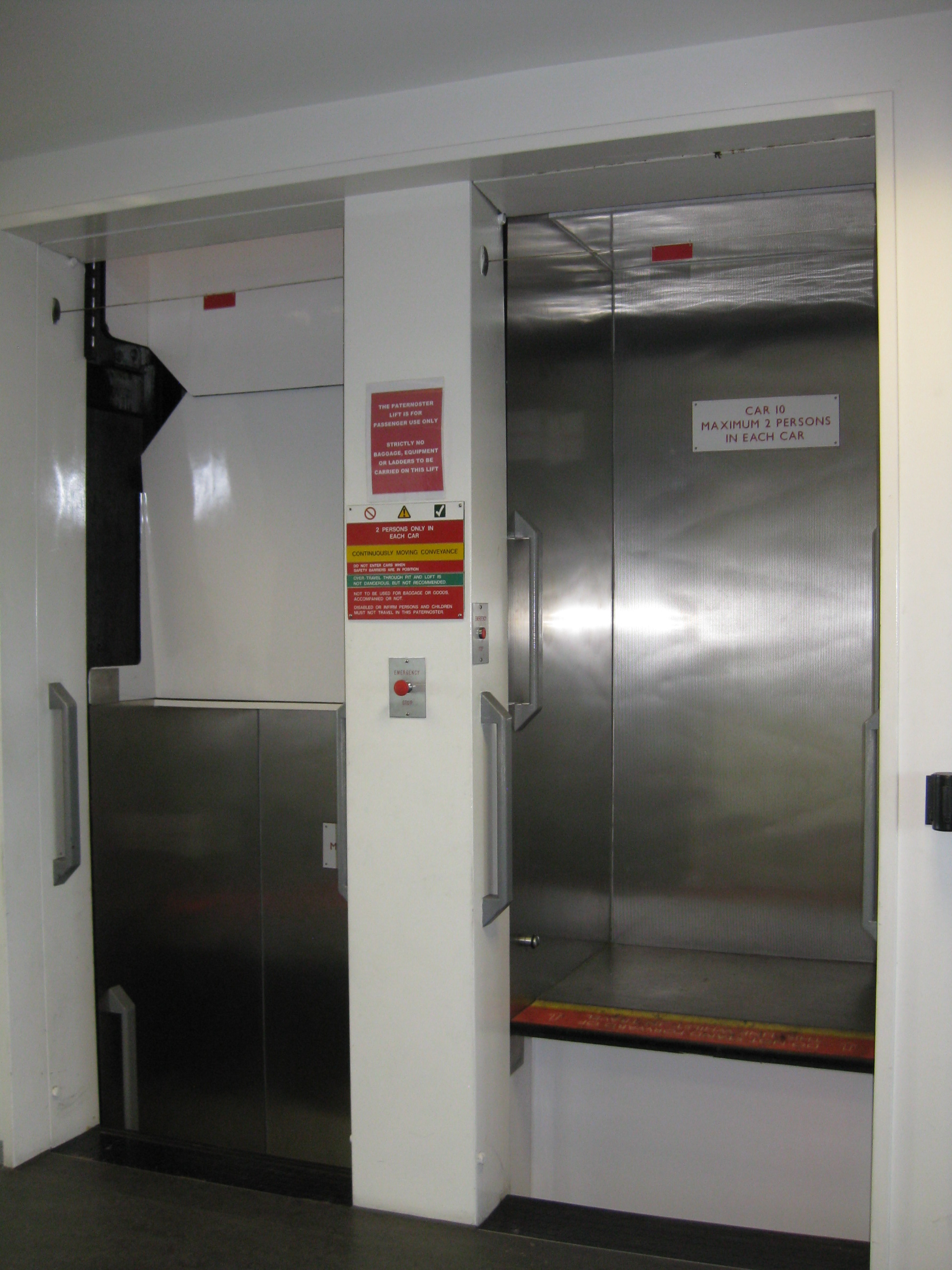
An elevator normally announces itself with a closed door. At Sheffield’s Arts Tower, the unusual part is the open space where you expect that door to be. A small compartment passes the landing, then another follows. The building’s paternoster uses a continuous loop, with cars travelling upward on one side and downward on the other. 1
It looks less like summoning a private room and more like watching rooms circulate. That difference explains the photograph: the opening is part of the machine’s normal arrangement, rather than an elevator caught halfway through a repair. The picture was taken at the Arts Tower’s top floor in July 2013; it records the installation, not its availability today. 3

A chain of little rooms
The university describes 38 compartments, each designed for two people. Instead of dispatching one car to whichever floor has called it, the mechanism keeps its sequence of cars moving through the building. The name refers to a string of rosary beads: paternoster is the Latin opening of the Lord’s Prayer. 1
The comparison becomes easier to understand once you look at the two adjacent openings. They belong to opposite sides of one circulating system. A conventional elevator hides much of its movement inside a shaft and behind doors. Here, the passing compartments make the circulation unusually visible. That exposure is the feature that first makes an otherwise ordinary journey between floors look unfamiliar.
The Arts Tower opened on June 23, 1966. In its June 2026 anniversary account, the university described the paternoster as one of the building’s enduring attractions, alongside the teaching and working life that continues inside the tower. It is a piece of campus infrastructure with a much larger audience than most campus infrastructure ever acquires. 2
The tea party that came to the passengers
One story in that anniversary account makes the mechanism feel especially human. Physical chemist George Porter recalled travelling with his wife to a tea party on the thirteenth floor when the paternoster stopped. They were left with the landing at neck height. According to the university’s retelling, the Vice-Chancellor joined them at a higher level and served tea while they waited. 2
That is a recollection preserved by the university, rather than an incident documented by our photograph. It also gives the word “continuous” its proper limits: the machine can stop. The arrangement describes how its cars normally circulate, not a promise of uninterrupted operation.
An old idea with maintenance behind it
Preserving the installation has involved substantial work. The university records new wiring, controls and lighting during the 2009 refurbishment, along with mechanical work and additional safety features. Its current guidance also makes clear that inspections and maintenance can take the lift out of service. 1
Anyone visiting should follow the university’s posted instructions; it specifically asks passengers to leave before the cars travel beyond the permitted landings. The attraction is the unusual engineering in normal use, not an invitation to test its limits.
Look back at the open compartment and the surprise becomes simpler. Sheffield preserved a different answer to a familiar problem: how to keep people moving through a tall building. The result still makes a hallway look as though a procession of little rooms is passing through it.