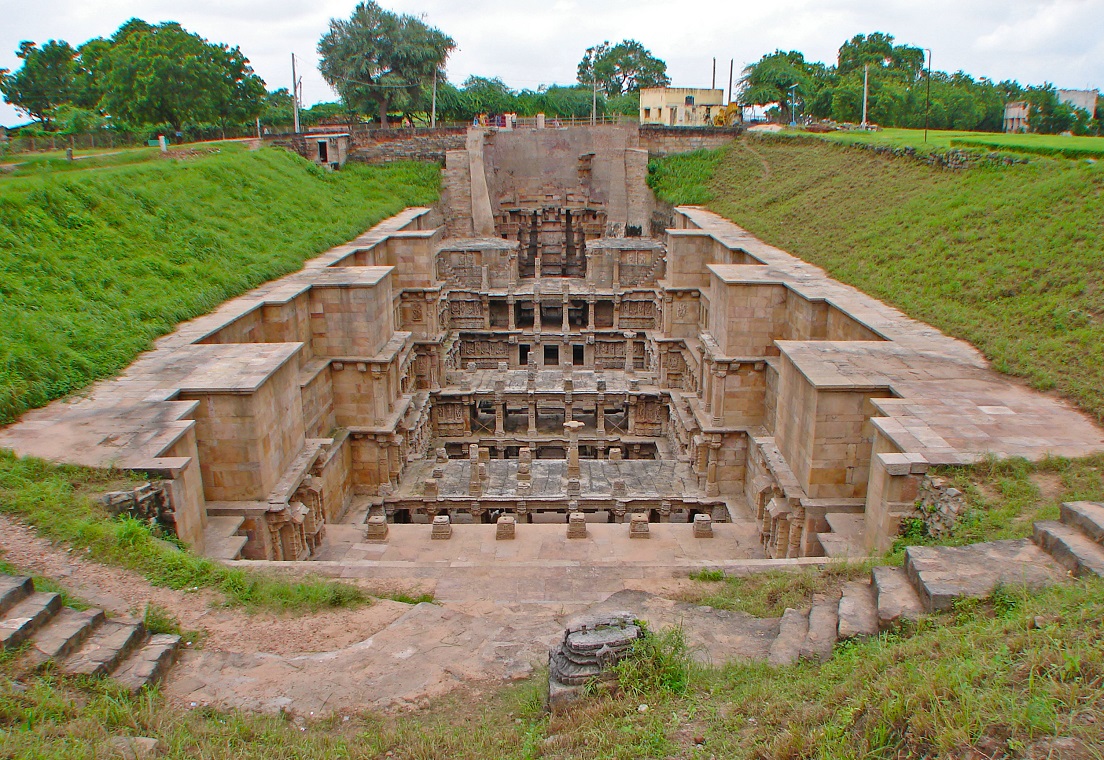
From the lawn, the structure opens downward. Repeated terraces, columns and stairs descend into a long stone space, making the landscape look as though somebody has removed its centre. Rani-ki-Vav, in Patan, Gujarat, is a stepwell: a water structure with an architectural presence far beyond the ordinary meaning of a well. 1
The photograph makes its unusual direction immediately clear. Most monumental buildings ask you to look up. This one draws your eye below the surrounding ground. The broad entrance narrows into a sequence of smaller spaces, so that the route toward water becomes the dominant shape of the monument.
A practical journey, given an extraordinary form
UNESCO describes Rani-ki-Vav as an eleventh-century memorial to a king, designed as an inverted temple celebrating water. Its seven levels bring together a stepped corridor, pavilions, a tank and the well itself. It belongs to a wider tradition of water architecture on the Indian subcontinent. 1
The useful idea is simple enough to grasp without an engineering diagram: instead of treating water as something reached only through a small opening, a stepwell gives people an architectural route downward. At Rani-ki-Vav, that route became an exceptionally elaborate built space. The distinction between infrastructure and monument becomes difficult to maintain when both purposes occupy the same staircase.
That does not mean the surviving monument is still supplying water today. UNESCO explains that changes affecting the Saraswati River and groundwater altered its original function. The structure preserves the form of a historic water system, while its present importance lies in the architecture and heritage that survive. 1
The walls reward a closer look
The wide view gives you the shape. The sculpture gives you another scale of attention. UNESCO records hundreds of principal figures and many smaller carvings, drawing on religious, mythological and secular subjects. Stone surfaces that might have been left as plain retaining walls became places for detailed figures and ornament. 1
Look from the edge toward the lower levels and the repeated divisions create a visual rhythm. Then imagine moving closer to one carved panel: the experience changes from a large geometric space to individual bodies, gestures and patterns. The whole structure and its smallest details invite different kinds of looking.
A monument that had to be uncovered
Gujarat Tourism recounts that nineteenth-century visitors found much of the stepwell buried in silt, with only parts such as the shaft and some pillars visible. Its account describes later rediscovery and restoration by the Archaeological Survey of India. The monument was not always available to view in the open form shown here. 2
The general photograph was taken in September 2006. It records a real place and a particular view, rather than a reconstruction showing the stepwell operating in the eleventh century. The people who built it, the water levels they encountered and the ceremonies once associated with it are not visible in a modern photograph. 3

What is visible is the surprising answer they left behind. A need to reach water became a procession of spaces below the earth. Even after its original water function changed, the staircase kept its power to draw the eye downward.
The surrounding green banks make the contrast sharper: the most elaborate space is the one cut below them.