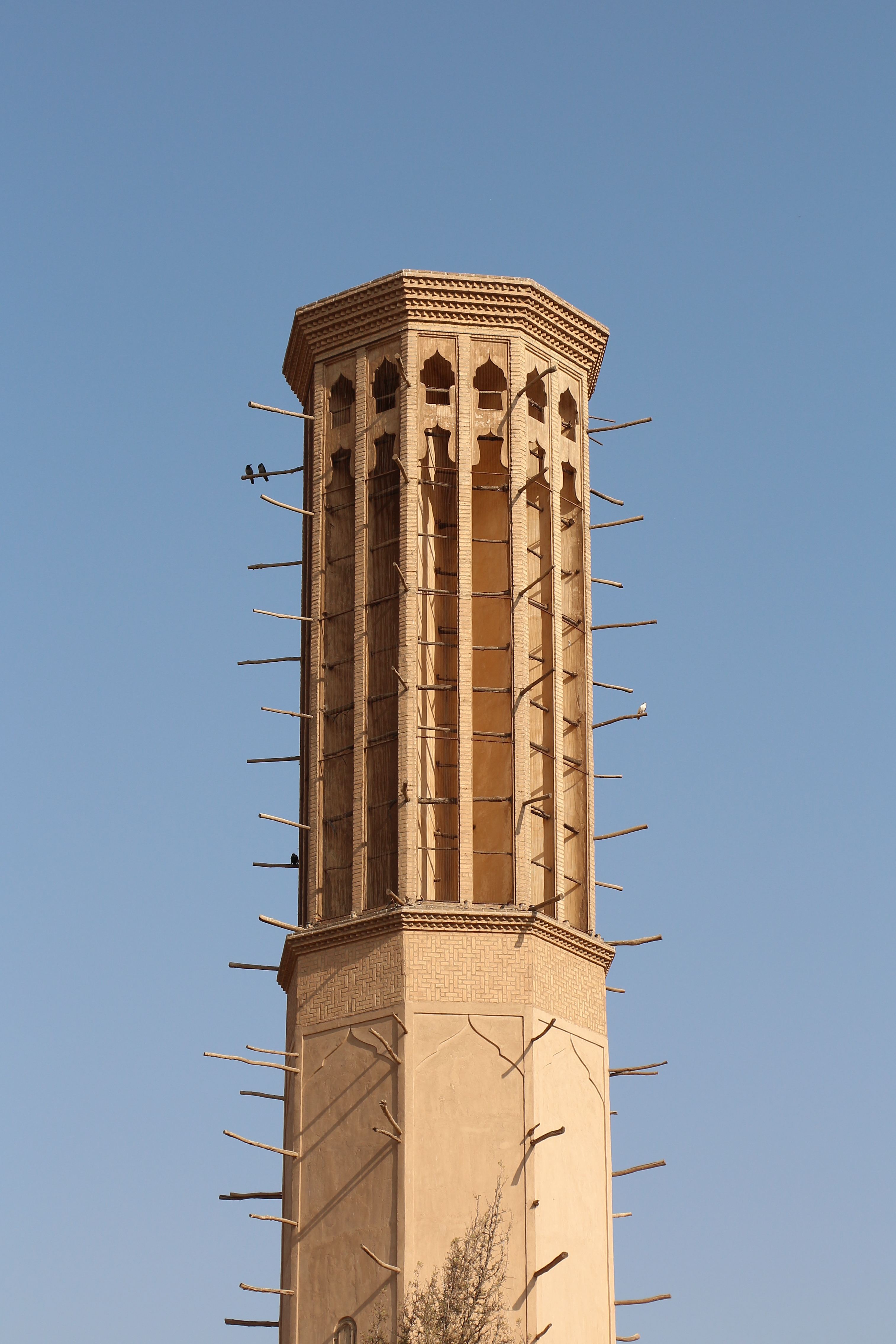
The tower looks almost too slender for the building beneath it. Near the top, long openings divide its sides into vertical channels. They are the important part: this is a windcatcher, built to put moving air to work inside a building.
The photograph shows the pavilion’s tower at Dolat Abad Garden in Yazd, Iran. A windcatcher, also called a badgir, gives outdoor air a route into the spaces below. Its appearance follows a practical question: how can a building make use of the wind? 13

Start with the openings
Mechanical engineer Murat Çakan describes the basic arrangement as catching air from a prevailing wind direction and channeling it into a house. His account, published by Istanbul Technical University, discusses examples across several regions rather than treating the tower as a single design used everywhere. 1
That helps make sense of the silhouette. A decorative tower can be read from the outside alone. A windcatcher asks you to imagine a connection between those elevated openings and rooms you cannot see from the garden.
The photograph makes that connection intriguing without showing the whole system. Its narrow channels are visible against a clear sky, while the building continues below the frame. The tower’s height makes it conspicuous; its relationship with the enclosed space gives it a job.
Moving air and cooling air are related tasks
Çakan’s account also describes arrangements that combine ventilation with evaporation. Air can be directed over water in a pool or another suitable feature before entering occupied space. Evaporation provides an additional cooling mechanism. Such arrangements depend on the building and its setting. 1
That distinction keeps the idea understandable. Catching a breeze provides airflow. Adding contact with water introduces a further process. A photograph of an exterior tower cannot tell us the exact temperature achieved inside, or establish that every windcatcher uses the same water arrangement.
Neither does the explanation require a claim that the tower works equally well in every climate. The interesting design choice is how a building connects itself to local conditions.
The surrounding architecture belongs to the story
The Museum of Islamic Art in Berlin’s account of Iranian architectural landscapes contrasts the humid Caspian region with the dry central plateau. It describes building forms shaped by those conditions: raised houses and rain-shedding roofs in wetter areas, and substantial earthen construction in the central desert. 2
This broader view makes the tower more than an isolated curiosity. Ventilation, shade, wall construction and water systems can be considered together. The museum’s photographs by geographer Eugen Wirth document that variety; the cover here is a separate photograph by Bernard Gagnon, taken in 2016. 23
The dates and locations are different, but the useful question is shared: what can the way a place is built tell us about living there?
Look again at the upper openings. There is no need to imagine a hidden motor to understand their purpose. The building itself provides a path for moving air. What seems at first to be a striking addition to the skyline is also a piece of environmental equipment, expressed in the shape of the architecture.
Those channels are easier to appreciate once the purpose is clear. Their repeated vertical lines give the tower its distinctive rhythm, while also reminding us that the air has somewhere to go.