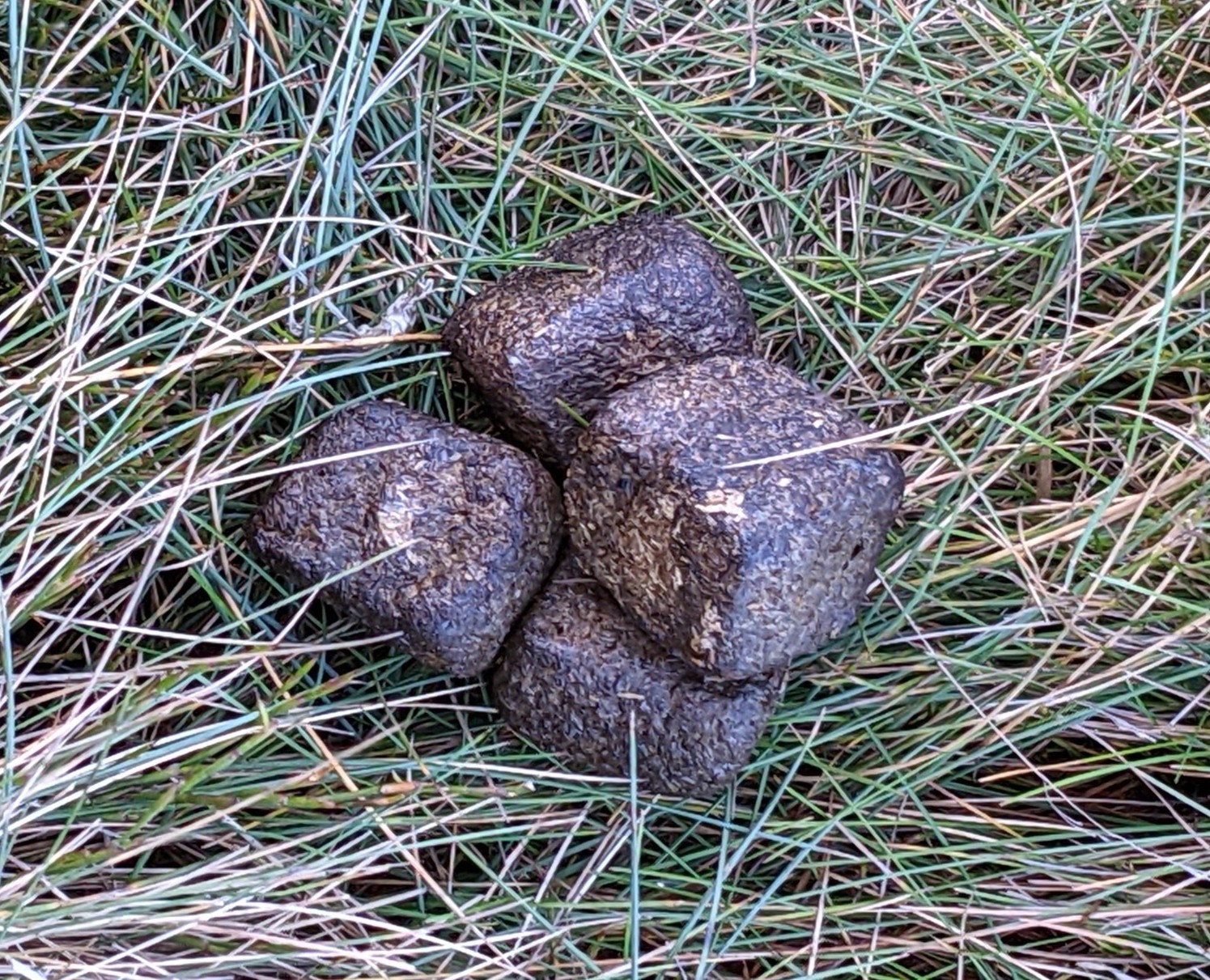
At first glance, the brown pieces among the grass could be little clods of earth. Look at the flattened faces and rounded corners, though, and there is a more specific explanation: these are wombat droppings.
The photograph was taken at Cradle Mountain in Tasmania in May 2021. The pieces are recognizably blocky rather than mathematically perfect cubes. That is plenty strange enough. An animal’s digestive system produced the shape without a little square mold waiting outside it. 3

The obvious guess puts the action in the wrong place
Wombats’ unusually shaped droppings prompted a question that sits somewhere between biology and engineering. A soft tube normally seems an unlikely machine for making corners. Where, along the route, does the material become boxy?
A 2021 research paper in Soft Matter investigated the bare-nosed wombat using anatomical observations, measurements of intestinal tissue and mathematical modeling. The researchers found cube formation within the final section of the intestine. Their investigation also showed that the exit itself was round. 1
That moves the interesting part of the process upstream. The finished shape was already developing inside the animal, rather than being stamped into it at the last possible moment.
The tube does not behave the same way all the way around
The team found differences in thickness and stiffness around the intestinal wall. Its model represented a contracting ring with alternating stiffer and softer regions. Under the modeled conditions, those differences could generate corners in the cross-section. 1
It is a useful change in how to imagine the problem. A tube does not have to begin as a rigid square to help form a square-like shape. Different parts of a flexible wall can respond differently as it contracts. Here, the important distinction was a property of the tissue, not a hidden cutting edge.
The paper presents a mechanism supported by experiments and a simplified model. It represents a cross-section, with limits to what it reproduces.
An unlikely research subject already had a following
Georgia Tech’s earlier account, published in 2019, describes the collaboration behind the investigation and the attention it received through an Ig Nobel Prize. The subject was funny at first encounter, but it gave engineers and biologists a real shape-making problem to study together. 2
That combination helps explain why the photograph works. You can recognize the odd geometry before knowing anything about intestinal tissue. The technical question arrives naturally afterward: what could a soft digestive organ do that would leave those faces and corners behind?
Shape and purpose are different questions
Researchers have proposed that the blocky shape could help droppings remain on raised surfaces used for scent communication. The evolutionary explanation remains a proposal, separate from the formation mechanism. 1
The photograph gives us the result at ground level. There are no sharp industrial edges and no identical manufactured pieces, just droppings with an unusually geometric character.
The remarkable part is that their corners lead back to something soft. What first looks like a small visual joke becomes a question about how living tissue moves, changes material and leaves a shape behind.
The three pieces in the image vary in size and outline. Their corners are softened, and the grass provides a familiar background. That ordinary setting makes the repeated blocky shape stand out more clearly than an exaggerated, perfectly square illustration would.