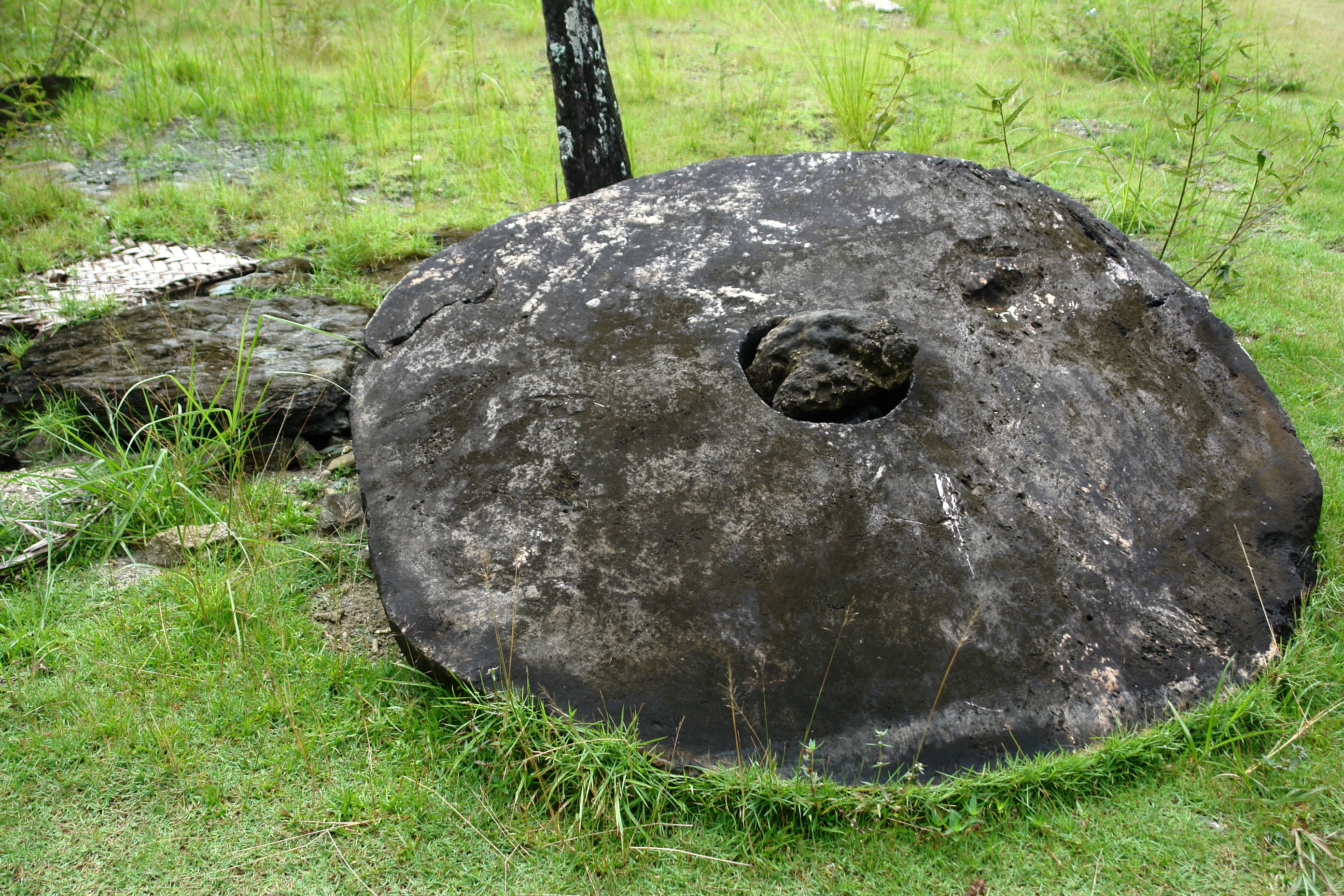
The stone in Scot Nelson’s photograph has a hole through its middle and grass around its edges. It looks like an object that would require a plan, several people and considerable effort to relocate. As money, though, a large stone like this could change hands without changing its place. 13

These disks are rai, associated with Yap in the western Pacific. The Bank of Canada Museum explains that a transfer could be recognized through community agreement and remembered ownership. For a large rai, the transaction did not require its new owner to take it home. The public knowledge changed while the stone stayed still. 1
The journey mattered before the payment
The size is only the first unusual feature. Making rai involved obtaining stone from islands including Palau, then bringing the finished objects back across the sea. The Bank of Canada Museum describes sailors and carvers travelling more than 400 kilometres, negotiating access to quarries and undertaking laborious carving and transport. 1
A hole could help people carry a disk on a pole. That practical detail changes the way the photographed stone reads: the opening is part of the object’s working history, not simply a decorative centre. A rai had already required an exceptional journey before anyone considered its later transfers.
This is one reason a disk’s significance could not be read from its dimensions alone. People remembered its history. The effort and circumstances of acquiring it belonged to the understanding of the object, along with who owned it. A photograph can show the stone’s surface; it cannot display all of that shared knowledge. 1
Too large for a pocket, useful for an important occasion
Smithsonian collection notes describe rai ranging from small examples to enormous stones. They could feature in substantial or socially significant exchanges, including wedding gifts. Yap also used other forms of currency, and smaller stones could be moved. The largest disks should not make us imagine every everyday purchase involved a boulder. 2
The Smithsonian’s National Museum of American History holds a particular example weighing 112 pounds and measuring about 60 centimetres across. Its catalogue records that it was broken during a move before reaching the museum. That is a different object from the stone shown here, but it offers a striking physical reminder of why keeping a large disk in place could be sensible. 2
A familiar payment transfers a balance or an object. Rai make the distinction between those things unusually visible. Ownership and possession of the same patch of ground do not have to travel together for an exchange to be understood.
The stone and the story around it
Nelson photographed this example on Yap in June 2007. Its weathered face and grassy surroundings give it a settled presence. There is no transaction underway in the picture, and we do not know the ownership history of this particular stone. 3
That absence is part of what makes the subject interesting. An outsider sees a heavy disk resting on the land. The people who know its history may see a much more specific object, with relationships and past exchanges attached to it.
The stone can remain exactly where it is. What moves is the community’s understanding of whose stone it is—and that can be enough to make the payment real.