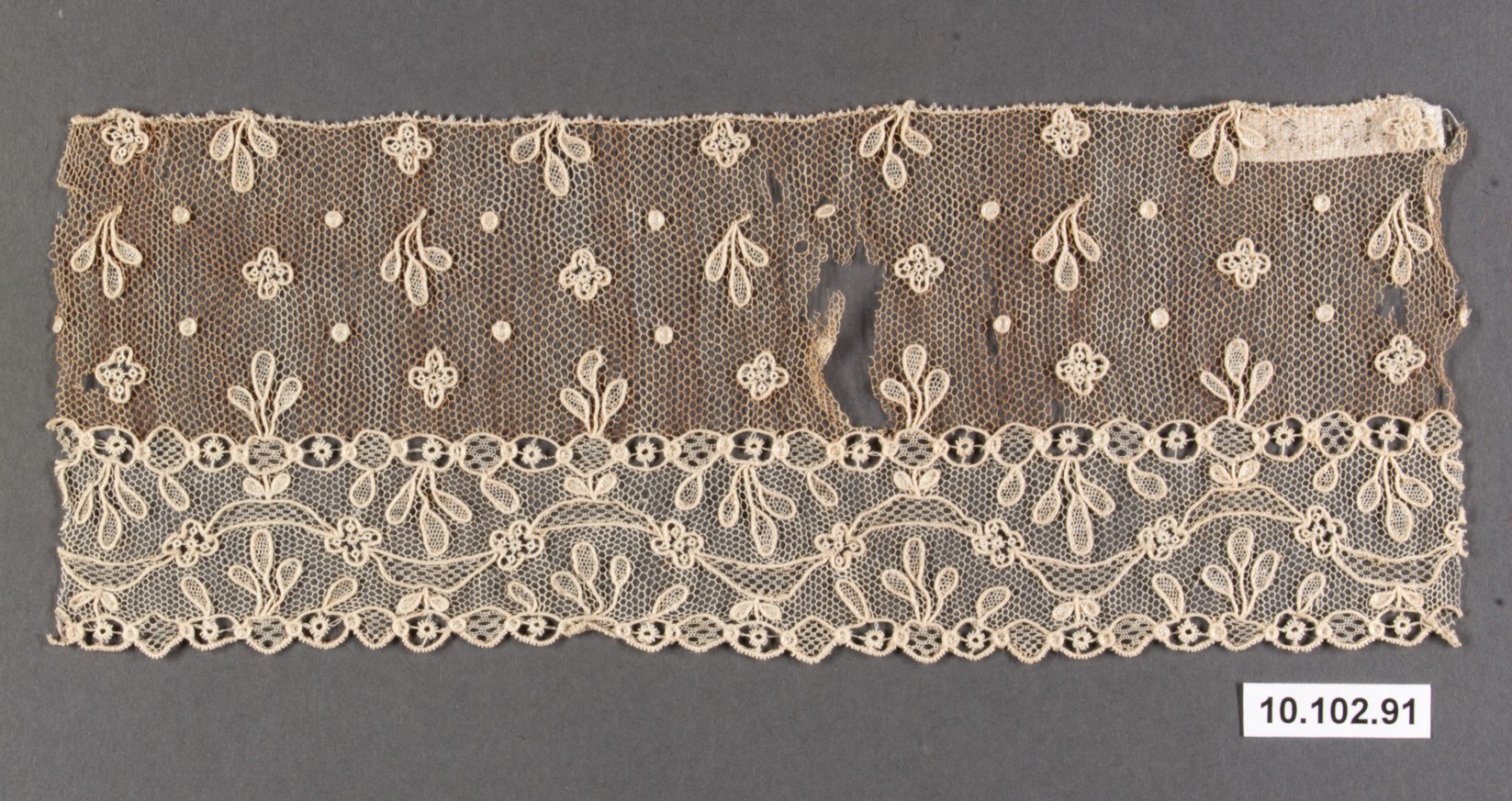
The lace looks almost lighter than the space around it: fine mesh, little flowers and a denser border of repeating curves. Then the making process introduces an object that seems to belong to another world. In the Alençon needle-lace tradition, a lobster claw is used in a finishing stage to press and polish stitches. 1
The claw does not create the whole textile, and it is not a shortcut that replaces the lacemaker’s handwork. Its role comes near the end of a much longer process. That small detail is surprising precisely because the finished result looks so carefully controlled. 1
The pattern is built with a needle
UNESCO describes point d’Alençon as a rare form of needle lace from Normandy. A design is prepared on parchment, then its outlines, mesh and decorative parts are worked through successive stages. The finished lace is released from its support before trimming and finishing. The lobster claw belongs to that final treatment. 1
The photograph shows a late-eighteenth-century fragment in the Metropolitan Museum of Art, accession 10.102.91. It is an example of the finished material, not a photograph of a present-day lacemaker at work or proof that this particular fragment was finished with a specific surviving tool. 4
Looking closely makes the distinction between the airy background and the more substantial pattern easy to see. Small motifs stand apart in the mesh, while the lower section gathers them into a busier border. Much of the visual effect depends on relationships between thread and open space.
A tiny area can mean a great deal of work
Mobilier national describes a sequence of ten stages and gives an average of about seven hours for a square centimetre of the lace. That is a description of the demanding technique, not a measured production time for the museum fragment shown here. The institution also explains that some stages require particularly sustained concentration and close visual attention. 2
Those details change how the image reads. A narrow strip stops looking like a small amount of material and begins to suggest a large investment of skilled time. The apparent lightness of the object hides the weight of the work that produced it.
Training is central to the tradition. UNESCO and the French institutions describe an extended apprenticeship passed on through practical instruction. Published estimates of the years required differ, but they agree on the essential point: mastering the whole sequence is a substantial undertaking. 12
A living workshop, not only an old luxury
Alençon’s tourism service describes the national conservation workshop, established in 1976, and its continuing connection with contemporary creation. The practice has a history in luxury clothing and decoration, but preserving it involves people working in the present rather than simply keeping old pieces behind glass. 3
The photographed fragment helps make that continuity tangible. It preserves an earlier result of needle-lace work, while the institutional accounts explain the skills still being taught. The photograph cannot show every movement that went into the fabric, but it gives you something real to examine.
And at the end of that exacting sequence sits the improbable finishing tool. A lobster claw sounds like the joke in the story. In the workshop, it has a precise place among many patient stages.