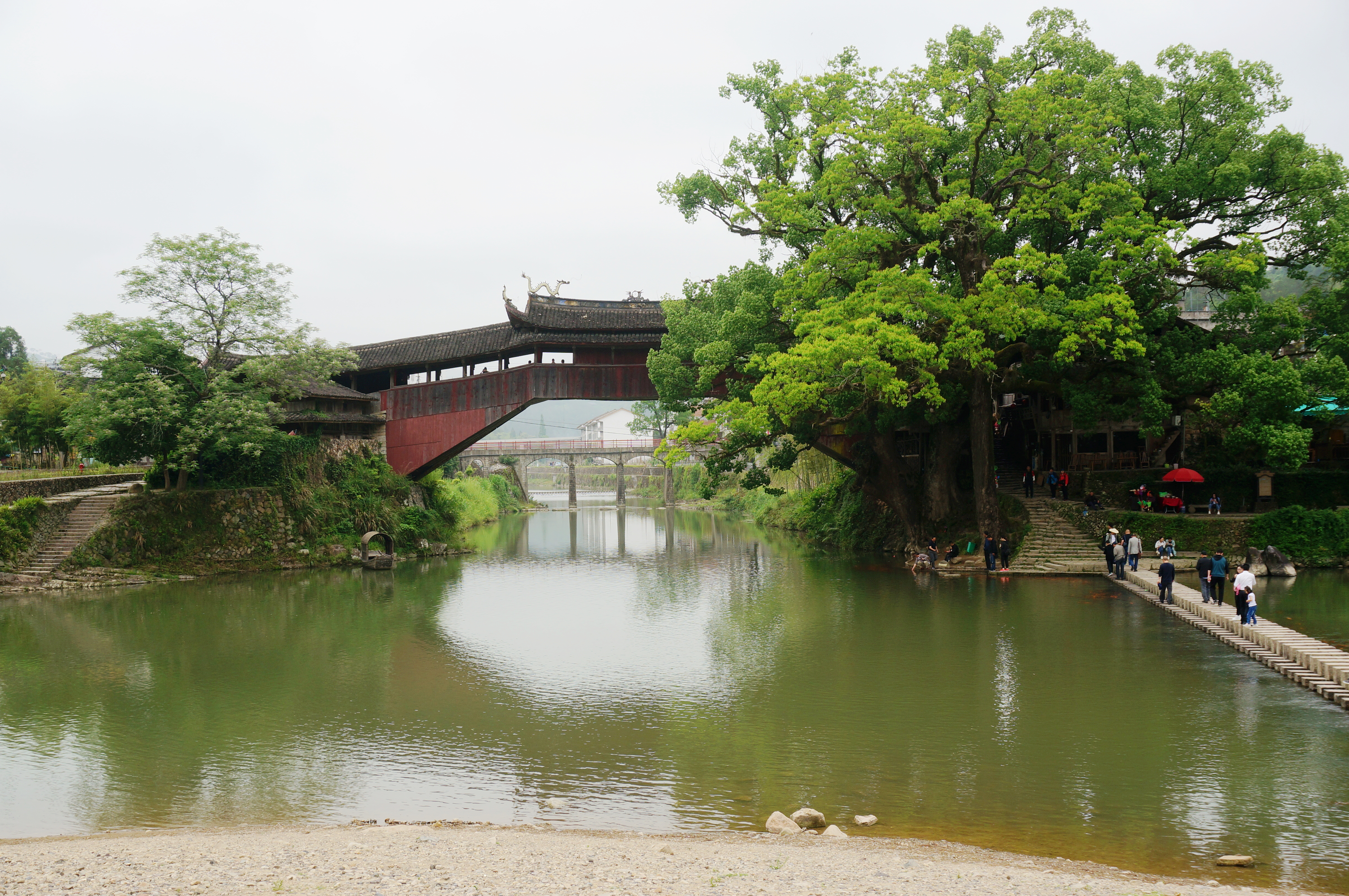
A long covered crossing reaches over the water, with its roofline framed by trees. The Beijian Bridge in Taishun, Zhejiang, is the finished object in this photograph. The wider tradition it illustrates contains a striking idea: wooden beams can be combined through a technique described as beam-weaving. 1
The word weaving may bring cloth to mind. Here the material is timber, and the purpose is a bridge. UNESCO’s account of Chinese wooden arch-bridge building describes beam-weaving and mortise-and-tenon joints alongside the tools and experience needed to make the structure work in a particular setting. 1
The skilled decisions sit inside the structure
A roofed bridge offers several things to look at once: the passage people use, the covering above them and the system supporting their weight below. The photograph shows the completed crossing in May 2019. It does not show the carpenter making a joint or the construction sequence hidden by the finished form.
That limit is useful. A finished bridge can invite curiosity about its making without supplying a complete lesson in how to reproduce it. Choosing and fitting timber, understanding the span and responding to the local environment belong to the builders’ knowledge, rather than to a simple visual recipe.
UNESCO’s 2009 decision describes work directed by a master carpenter and carried out with other woodworkers. It records teaching through spoken instruction and personal demonstration, including apprenticeships and transmission within families. The tradition depends on people being able to show another person how a particular task is done. 2
A crossing can become a room for a village
The same decision explains that the bridges serve social and cultural purposes alongside transport. They provide places to meet, exchange information, spend time together and maintain community relationships. A roof makes the crossing more than an exposed path from one bank to the other. 2
Look at the photograph with that in mind. The long covered volume has the presence of a building, even though it spans water. The route through it and the room-like space around that route are part of the same object. That overlap helps explain why communities care about preserving more than a convenient shortcut.
The tradition is associated especially with northeastern Fujian and southwestern Zhejiang. A periodic report submitted for the heritage listing describes its skills and customs as part of local culture, tied to the need for transport and the shared life of villages. Those regional settings matter more than treating the bridge as a generic example of all Chinese construction. 3
Keeping the skill is continuing work
The 2009 listing identified threats to transmission. UNESCO’s later account records the tradition’s transfer to the Representative List in 2024 following safeguarding work, including the involvement of communities and younger learners. That history points to an active process of preservation rather than an automatic survival of old techniques. 1
The finished bridge is the visible attraction. The less visible achievement is the capacity to keep teaching the craft behind it. Wooden beams can make an arresting photograph, but the skills that connect them have to pass between people if another bridge is to follow.
The roofline is easy to remember. The deeper achievement is the chain of demonstrations and corrections that allows a difficult craft to remain usable knowledge.