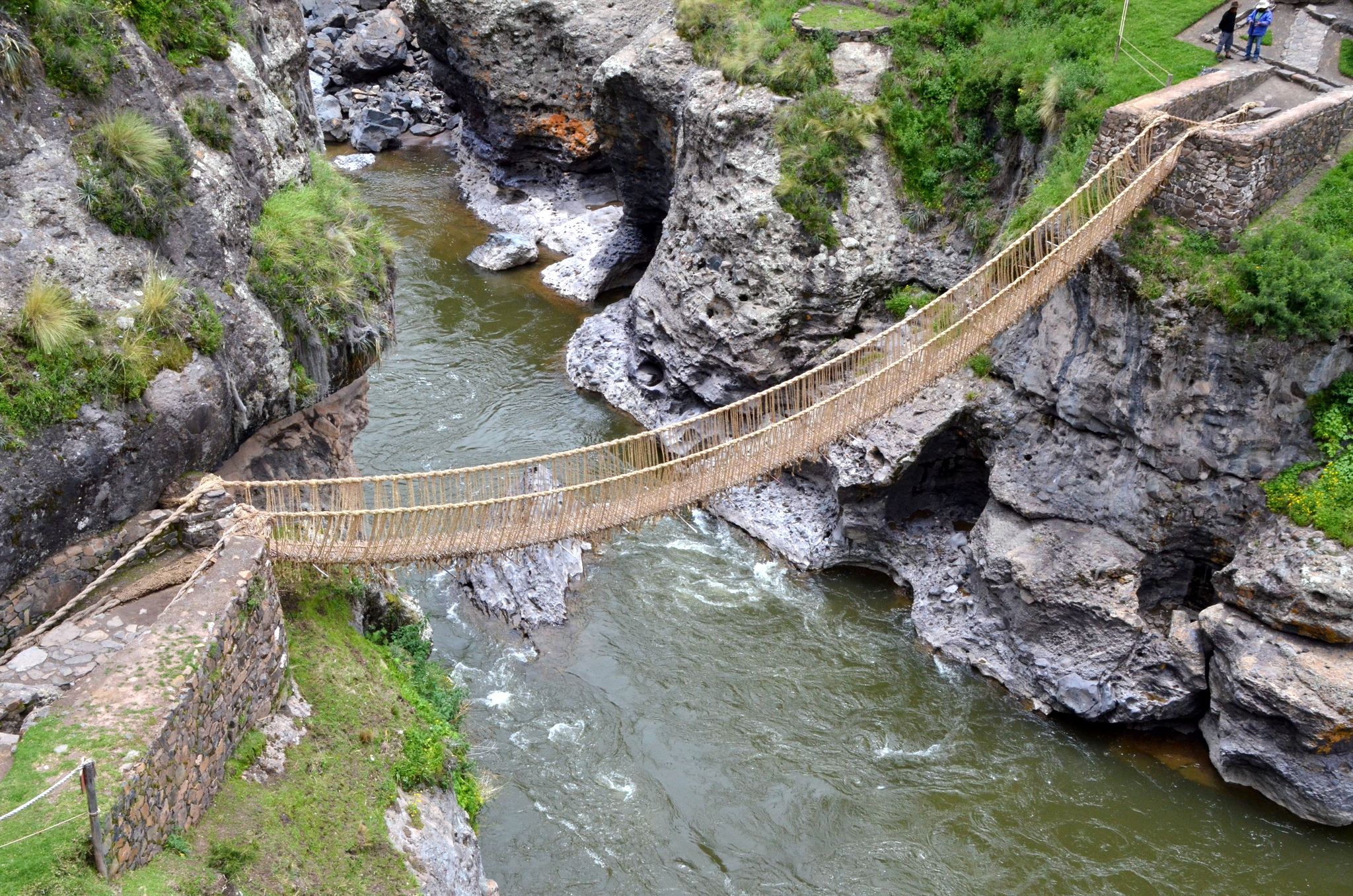
The bridge hangs above a rocky gorge, its walkway curving toward the river below. Look at the cables and handrails: this crossing depends on ropes made from plant fibres. Q’eswachaka, in Peru’s southern Andes, is a suspension bridge renewed through the work of four Quechua communities. 1
The photograph, taken in 2018, shows the finished structure across the Apurímac River. It does not show that year’s building process, and the ropes in it are not the original materials of an ancient bridge. The remarkable continuity lies in the method and the people who keep practising it.
A bridge begins before anyone crosses
UNESCO describes the annual renewal as a shared undertaking by Huinchiri, Chaupibanda, Choccayhua and Ccollana Quehue. Families prepare fibres and small ropes, which are combined into the much larger cables needed for the crossing. Experienced bridge builders direct work that depends on cooperation as well as individual skill. 1
The small-to-large progression is the useful detail to hold in mind. A strand of dried plant material does not resemble a bridge cable. Twisting and braiding bring many fibres together, making a material with different capabilities from an isolated strand. Each stage has to support the next one.
The Smithsonian’s engineering lesson explains the principle in terms of tension. Suspension cables carry pulling forces, while the number of fibres, the amount of material and the way ropes are braided affect their strength. Knowledge of materials is therefore central to the design, not an ornamental addition to it. 2
That helps explain why the builders’ expertise matters more than a quick description of the ingredients. Saying that the bridge is made from grass tells you what is visible. It does not tell you how to select, prepare, combine and place the fibres so a crossing can function. Those are learned decisions.
Renewal is part of the design
The Smithsonian Folklife Festival’s account describes the work as an annual community practice, linked to Inka traditions. It also records how participants brought rope-making and bridge-building knowledge to Washington, D.C., for the 2015 festival. The tradition could be demonstrated elsewhere while remaining rooted in its home communities. 3
UNESCO’s account places rituals and communal relationships alongside construction. The crossing carries cultural meaning as well as people. Its renewal is a way of maintaining obligations, skills and connections between generations. Treating the bridge only as a surprising material experiment would leave out much of what keeps it alive. 1
The photograph has a useful limit
A still image can show the suspended path, the rocky setting and the scale of the gorge. It cannot measure a cable’s condition or establish whether a crossing is safe on a later date. This is an account of a documented craft tradition, rather than current visitor advice.
What the picture does make clear is the distance between raw material and finished purpose. Plant fibres have become a path through open air. The builders’ achievement is not simply that they once made such a bridge. It is that communities have kept the knowledge active enough to make it again.
The ropes are visible evidence of work, but their makers supply the continuity. Looking at the bridge as a product of repeated learning makes the apparent material paradox easier to appreciate.