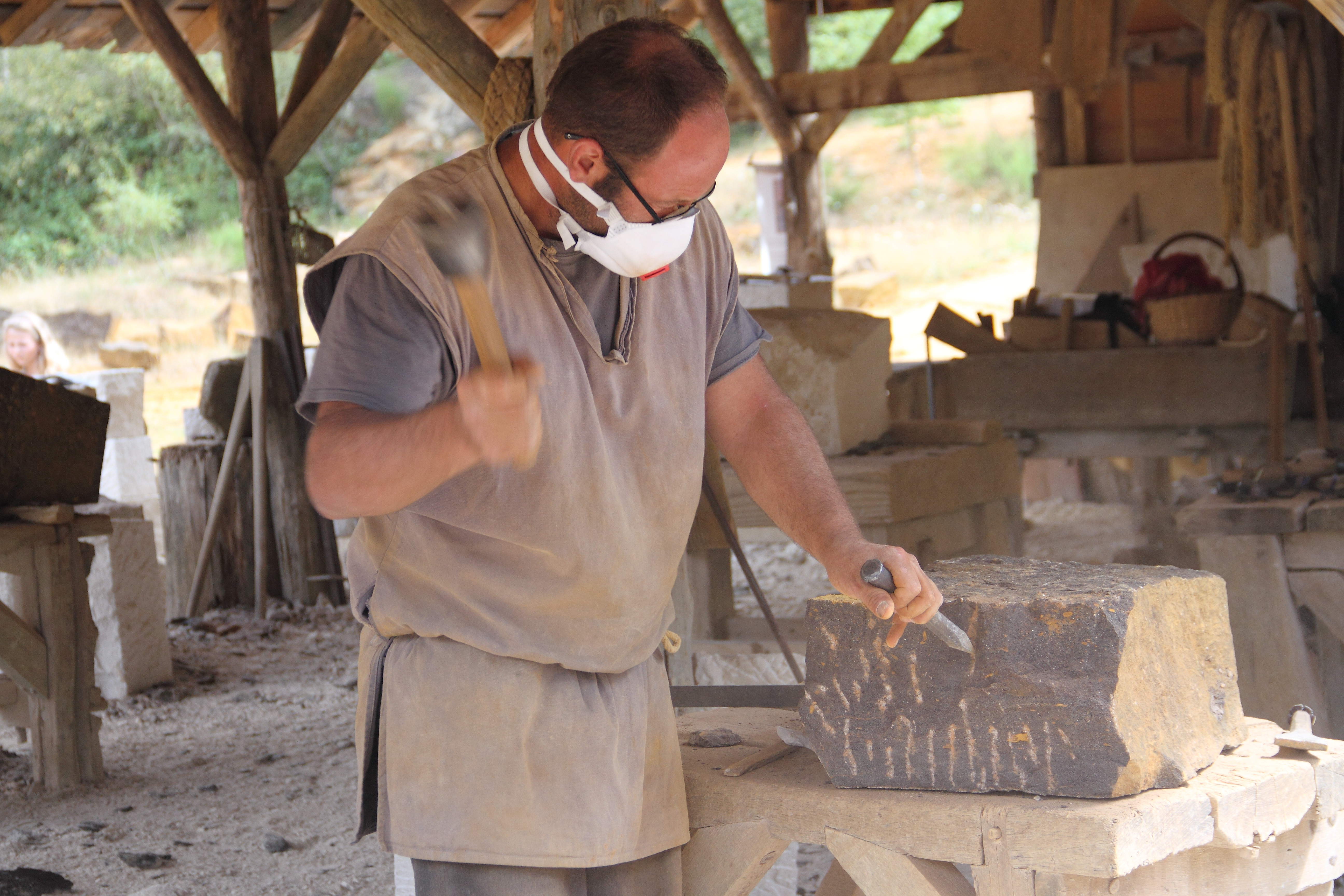
The stone is still on the workbench. A mason leans over it with tools in hand, surrounded by the rough materials of a building site. This is Guédelon in France, where craftspeople are constructing a medieval-style castle to investigate how such buildings could be made. The photograph records the work in August 2016. 1

It is an appealing reversal of the usual castle visit. Instead of starting with a completed monument and imagining the workers who made it, you can begin with the work. A block has to become a usable piece of architecture before there can be a wall worth admiring.
A building site that asks historical questions
Guédelon describes its project as experimental archaeology: building in order to understand. Its official introduction places the site in a former quarry in Burgundy and lists the trades involved, including quarry workers, masons, carpenters, blacksmiths, tile-makers and rope-makers. Stone, wood and earth are treated as materials to be worked, not just scenery around a finished attraction. 2
The mason in the photograph is one visible part of that network. The image identifies the activity and place; the worker is unnamed. Concentrating on the work brings the tools, block and bench into focus. Each supplies a clue to the practical steps hidden inside a completed stone building.
Look at the block's pale cut marks and the uneven material around the bench. The picture catches a stage that a finished building usually conceals. Once a stone has been laid, a visitor sees the surface that remains. At the bench, the shaping itself becomes visible.
One craft depends on several others
A stone wall can suggest a single trade, yet the project's own list quickly widens the picture. A mason needs a supply of stone, appropriate tools and an organised place to work. A castle also needs timber, roof coverings and the connections between those materials. Considering those dependencies makes the achievement more interesting than a simple claim that somebody can build without machines. 2
Guédelon is a modern research and visitor project using historical building methods. The photograph itself includes protective equipment. The historical question concerns materials, techniques and construction decisions; there is no need to imagine that everyone has literally stepped outside modern life.
The project's experiments extend beyond the castle walls. Its official account describes a water-powered flour mill reconstructed with archaeologists from INRAP, drawing on the remains of a twelfth-century mill discovered at Thervay in the Jura. The working reconstruction allows questions about milling to be explored through an actual mechanism. 3
INRAP's own description presents this as experimental archaeology, with archaeological discoveries supplying models for the full-size mill. That connection matters: a convincing-looking old building and an experiment grounded in evidence are different achievements. The point of making something is also to learn from what making it requires. 4
The unfinished part is the attraction
In the stoneworker's photograph, the most revealing object is not a battlement or tower. It is the block beneath the tools. You can see the gap between raw material and finished component, and recognise that skill has to bridge it repeatedly.
That is what gives Guédelon's premise its pull. A castle is easy to picture as an object from the past. The workbench turns it back into a sequence of human decisions: where to strike, what to remove, what must fit next. The impressive result begins with the small, exacting job happening in front of the camera.