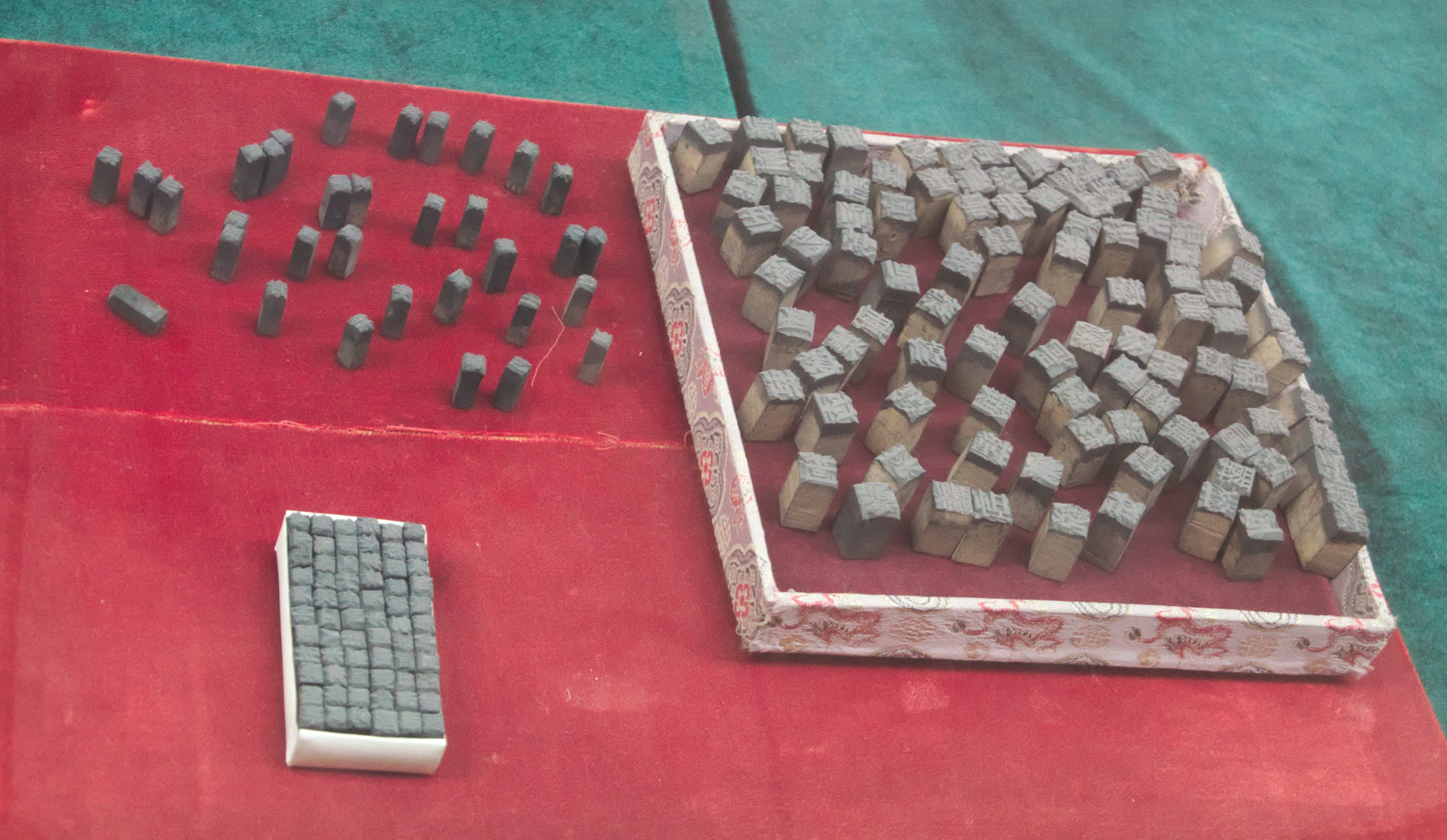
The tray looks like a crowded collection of tiny wooden blocks. Each piece carries something more specific than a decorative pattern: a Chinese character that can become part of a printed page.
The photograph shows wooden movable type at the China Printing Museum in Beijing. It is a museum example, separate from the working tradition maintained in Rui’an, Zhejiang, where craftspeople use wooden type to compile and print clan genealogies. The objects help explain the task; they are not a photograph of a Rui’an printer at work. 13

A page begins as a collection of separate pieces
Movable type makes the arrangement of a page temporary. The printer selects individual pieces, positions them, secures the layout, applies ink and transfers the text to paper. After printing, the pieces can return to storage for another arrangement. 1
For Chinese text, that immediately raises a practical question: how does someone find the right character among so many separate objects?
The answer involves organization and learned skill. China’s intangible heritage account describes the use of character components and ordering conventions to arrange the type, along with verses that assist retrieval. Knowing how to navigate the collection belongs to the craft as much as knowing how to print from it. 1
The skill is visible in decisions, not just tools
The same heritage account describes type cut in reverse and the care involved in creating a level, secure printing surface. Small differences matter when many pieces must work together as one page. 1
A tray of type can make the method look like a simple matter of picking up blocks. The finished impression depends on more: the preparation of the pieces, the accuracy of the arrangement and the handling of ink and paper.
The museum photograph is particularly good at showing the contrast between quantity and order. Loose pieces fill the larger tray, while a compact arrangement nearby suggests what those separate units can become. It gives a physical scale to work that a digital page usually hides.
Why this tradition continued in Rui’an
China’s nomination and safeguarding documentation submitted to UNESCO links the practice with the production of clan genealogies. It describes craftspeople taking their type and equipment to ancestral halls, where they arrange and print family histories by hand. 2
That context gives the technical skill a recurring purpose. The printers are helping produce a community document whose names and relationships need to be organized, checked and recorded.
The historical documentation also describes tasks distributed among members of the working community. Those descriptions record the practice at the time of submission; they should not be read as a rule about what every man or woman does today. 2
A familiar page hides an unfamiliar amount of handling
Once the text is printed, the reader sees lines of characters. Before that point, the same text exists as a collection of pieces that someone must select and assemble correctly.
That transformation is the striking part. The skill is not simply in owning a large set of type. It is in being able to move through it, find what a particular page needs and make the collection function as a readable record. The wooden blocks in the photograph are small; the knowledge needed to put them in order is the larger object of interest.