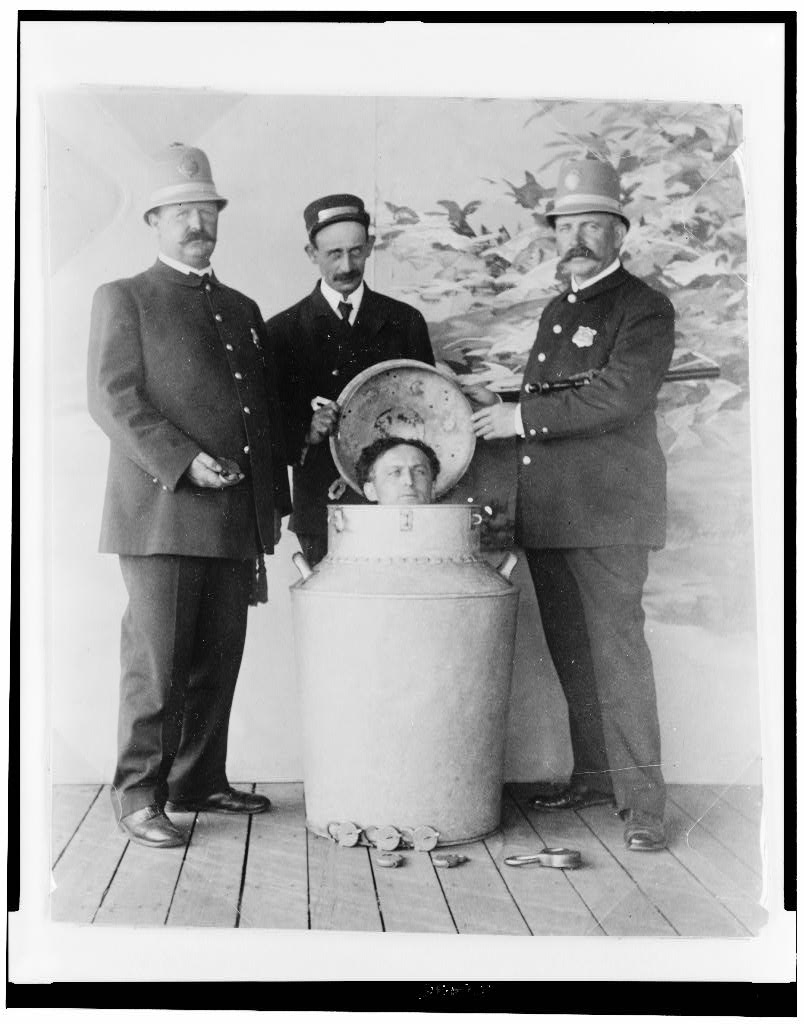
Houdini’s head is sticking out of a giant milk can. Three men stand around him, the lid is open and locks lie on the floor. It is a setup that makes the question immediate: how would someone get out after the container was closed?
The Library of Congress catalog dates the photograph to about 1908. That year, Houdini introduced an escape involving a water-filled milk can in St. Louis, then toured the act in the United States, England and Germany.
This photograph captures the setup. It gives us the performer, the container and the hardware—but leaves the mechanics of the escape out of sight.
A familiar container, an unfamiliar use
The photograph makes the container’s scale easy to judge: it holds a man, yet leaves him little room. The lid and locks give the setup its tension. The archive identifies the act; this single image leaves the sequence and mechanism unseen.
He built a career around getting out
The Library’s account of its Houdini collection traces a significant career change to 1899. Impresario Martin Beck encouraged the performer to concentrate on escapes. Handcuffs and confinement became central to his public identity.
The same archive preserves publicity and documents that show how carefully that identity was constructed. Houdini’s fame involved performance, photographs and the circulation of an unforgettable persona. An escape could become an image, and an image could make someone want to see the next escape.
A milk can made the premise easy to understand. Houdini could offer a challenge that audiences recognised before they knew how it might be answered.
The escape artist also studied deception
There was another side to his interest in seemingly impossible situations. A 2019 Library of Congress essay describes his contact with police and his study of criminal methods. In 1906 he published The Right Way to Do Wrong, a book presenting ways people were deceived.
The essay places the book alongside his showmanship and public reputation. Understanding a trick could help expose a fraud, while demonstrating unusual knowledge could also strengthen his own celebrity. Those interests give the performer more depth than a list of daring feats alone.
Look back at the can. Its appeal survives because the puzzle is so concrete: an ordinary-looking object, a human body and an apparent barrier between the two. More than a century later, the photograph still makes a reader pause over the same question.
This is a historical account of a professional stage act. Water confinement is dangerous; the article provides no instructions for attempting it.