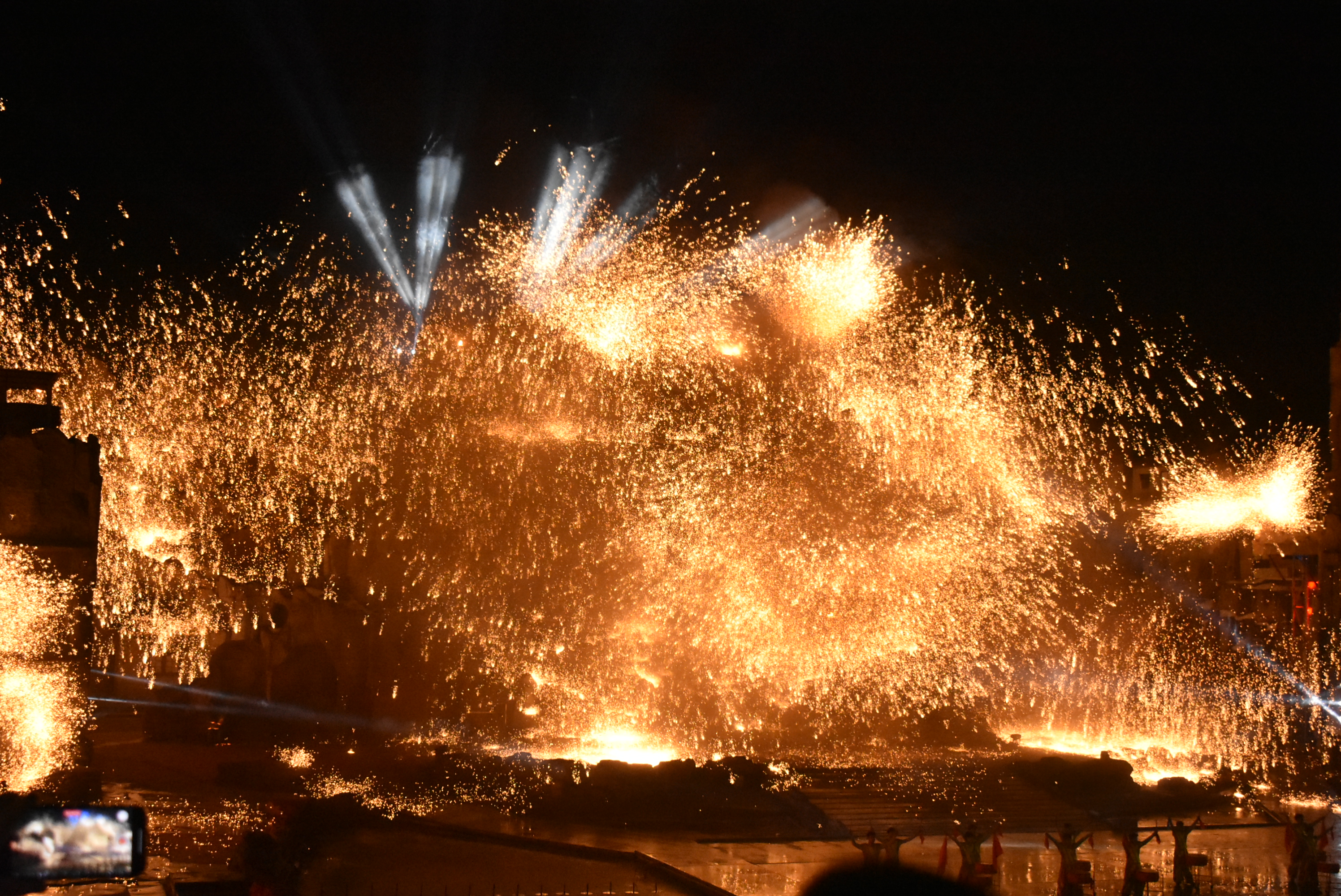
The golden trails spread across the darkness like branches. Beneath them stand the performers, small against a canopy of sparks. The scene was photographed at Situ Town in China’s Shanxi province in February 2024.
The material behind the spectacle is molten iron. Datiehua, commonly translated as “iron flowers,” sends droplets of hot metal into the air, producing a burst of glowing sparks. The flowers in the name are a visual description of that brief, spreading pattern. 1
A craft measured in a fleeting picture
The photograph makes the result look almost suspended. The bright paths fill much of the frame, while the darker lower part gives them a human scale. It is easy to notice the light first and the people second.
That order is part of the surprise. The performers are not standing beneath a permanent illuminated roof. The canopy exists for a moment in the paths of the hot material. A still image preserves a shape that the performance itself cannot hold in place.
It also leaves things outside the frame. We can see the sparks and the figures, but a photograph alone does not identify the individual performers or establish how long they trained. The image record supplies a place and date, not a biography of everyone beneath the light. 3

The regional name matters
China’s national intangible cultural heritage register documents a datiehua tradition from Queshan in Henan province. That entry was included in the national list in 2008. Its description connects the performance with metalworking and describes a presentation involving a large framework and other festival elements. 1
Queshan is one documented regional tradition. It is not the location of this photograph. The cover records a performance in Shanxi, and the distinction helps avoid turning several places and forms into one interchangeable scene.
The heritage entry preserves a local history and performance context. Its existence also makes the subject more interesting than a caption that simply says “Chinese fireworks.” A particular community’s recognized practice has details that a broad national label would lose.
Iron flowers do not always look the same
An official Travel China feature describes related performances in different settings. In Nuanquan, Hebei, the form known as dashuhua involves throwing molten metal against a wall. The same feature discusses presentations within modern cultural attractions, including Kaifeng. 2
Those settings change what a viewer sees: a wall can form the backdrop in one place, while a larger staged presentation frames the sparks in another. The common visual appeal does not make every version identical. Neither source establishes that all the regional forms use one exact routine. 12
For a reader encountering the craft for the first time, the useful comparison is right there in the title and photograph. A familiar-looking shower of celebratory light comes from an unfamiliar material and a demanding performance skill.
Molten metal makes this a dangerous professional activity. The image offers a close look at its visual result, not instructions for recreating it.
Return to the tiny figures at the bottom of the picture. They turn an abstract golden pattern back into a human performance. The sparks are what grab attention; the people working beneath them are what give the photograph its extraordinary scale.