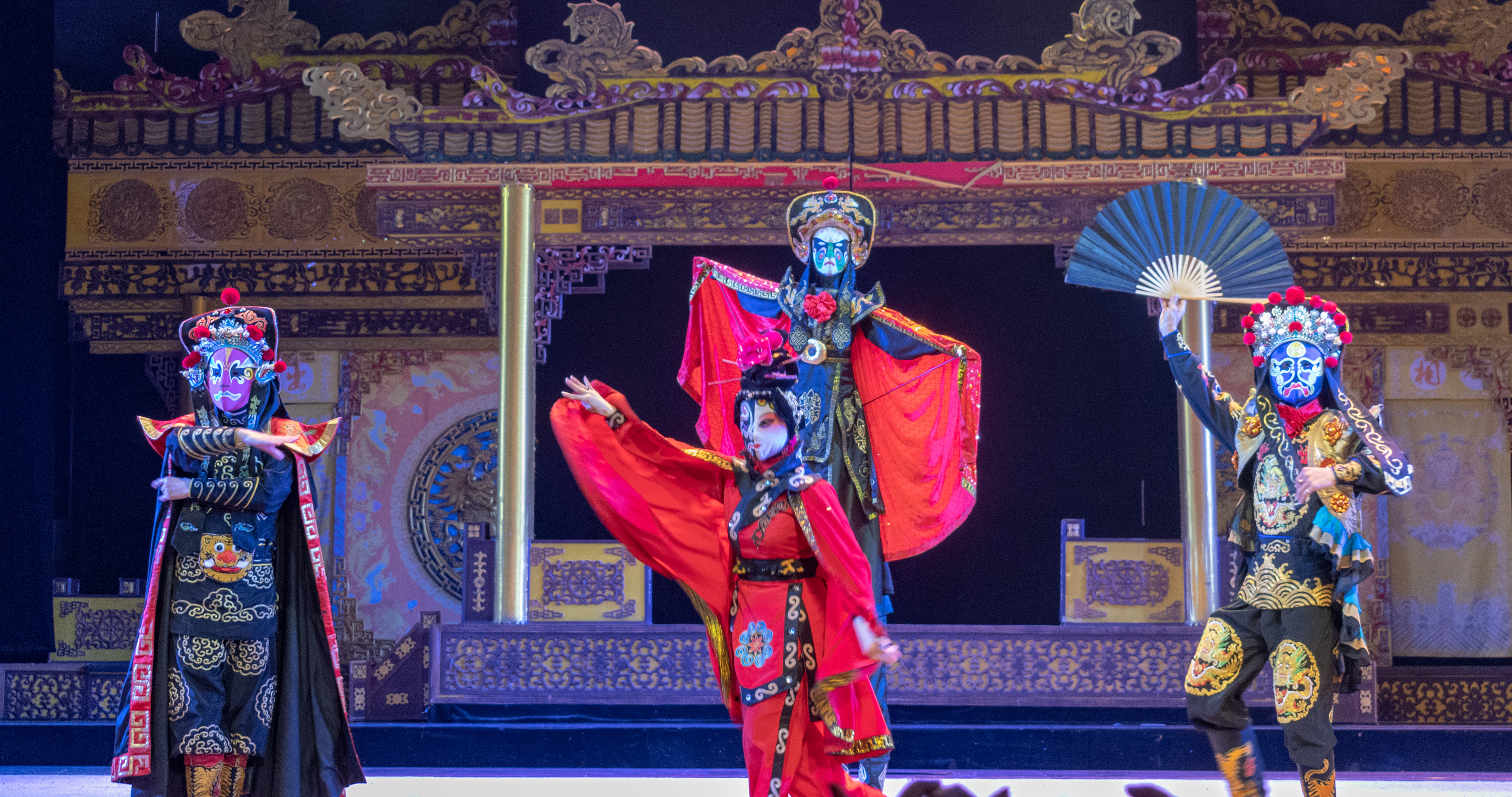
Watch the face. That seems like the obvious strategy when a performer is about to change it. Then a fan moves, the head turns or a hand passes, and the audience is looking at another design. Sichuan opera’s bian lian makes the briefest interruption feel like the most important moment on stage. 1
The name means face-changing. Its appeal is immediate even for a spectator who does not understand the sung language: a familiar human outline suddenly carries a different expression, color and pattern. The performer has to make the transition fit the movement of the act, so the surprise arrives as part of a performance rather than as a pause for changing costume. 1
The face is part of the drama
A China Culture account describes the changes as a way to reveal shifts in a character’s emotions. That context gives the spectacle another dimension. A new face is not merely another item to count; it can change how an audience reads the figure standing in front of it. 1
The photograph here was taken in Chengdu on May 26, 2018. It shows a vividly costumed face-changing stage act, with painted faces and fans distributed across the composition. We have not identified the performers. The image captures a moment of the presentation, not a sequence proving the speed of a particular change. 4

Even without motion, the picture gives the eye plenty to follow. Bright fabric, contrasting faces and extended arms compete for attention. Imagine having to keep a single face under observation while all those other parts of the stage remain active. The visual setting is part of what makes the craft so compelling to watch.
More than a mask trick
China Culture’s account of Sichuan opera places face-changing within a much broader form involving acting, singing and instrumental music. It describes five musical systems that were brought together by the Sanqinghui troupe, established in Chengdu in 1912. The dramatic texts used the Sichuan dialect. 2
That wider context matters when a short clip of a spectacular change travels on its own. A few seconds can show the surprise very effectively, but they reveal little of the vocal style, music and dramatic conventions around it. The best-known image of a form can also be a very small part of it. 2
Knowing that masks and prepared theatrical materials are involved does not remove the performance challenge. The striking part remains the coordination: keeping the change within the flow of a gesture while maintaining the character and the audience’s attention. 12
A craft that keeps finding new forms
The spectacle is still developing. In January 2026, Sichuan Online interviewed Wang Chao, deputy director of the Chengdu Sichuan Opera Research Institute, about elaborate acts involving multiple faces and costume effects. He placed those variations within an existing history of innovation in Sichuan opera. That report concerns a later performance discussion, not the people in our 2018 photograph. 3
For a first-time viewer, the most satisfying question may be less “How many faces are there?” than “How did I miss that moment?” A change can happen in plain view while the performer decides exactly where your attention goes. The next face makes you want to watch again.